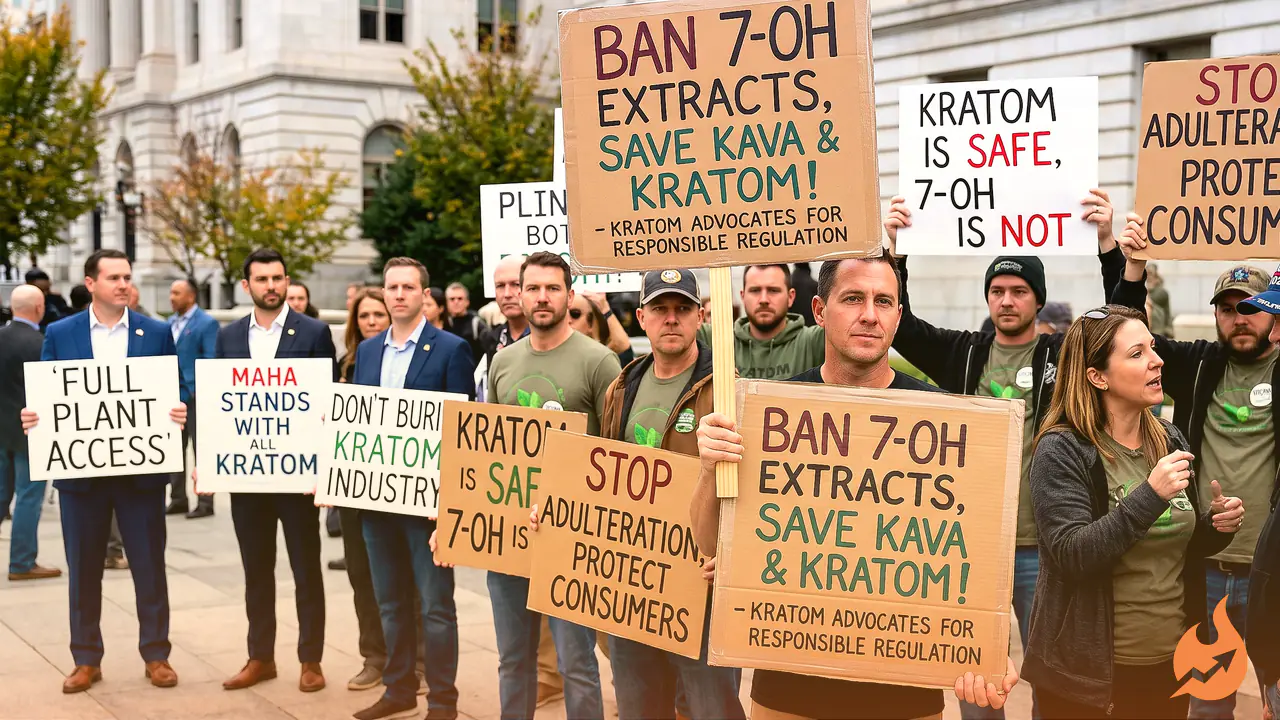

The very advocates who once assembled an improbable coalition stretching from Bernie Sanders to Rand Paul — and turned kratom into a billion-dollar industry by arguing that its pain-relieving properties offered a far safer, natural alternative to pills in the battle against the opioid epidemic — are now demanding a clampdown on a concentrated form of one of the plant's active ingredients.
That ingredient is 7-hydroxymitragynine, or 7-OH: an ultra-potent extract that behaves much like an opioid. The push to outlaw it has opened a deep rift among consumers, sellers, and the advocates of both substances.
'A full-blown opioid wearing a kratom costume'
Mac Haddow, the senior public policy fellow at the kratom industry lobby group the American Kratom Association, does not mince words. "This is a chemically manipulated, full-blown opioid that is now in the marketplace," he claims. "They masquerade as kratom products."
Over the past few years, gummies, capsules, and shots carrying brand names such as Magic 7OH, 7 O'Heaven, and Pure OHMS have spread across thousands of gas stations and corner stores, and that spread has fueled growing alarm. People who take 7-OH have described excruciating withdrawal symptoms, and there have been reports of polydrug overdoses involving 7-OH alongside other substances. Some are now checking into rehab to break their dependency, while others are attempting to detox on their own, following tips from Redditors.
The kratom community worries that 7-OH's poor reputation could drag the whole kratom industry into a regulatory swamp. The 7-OH camp, for its part, has organized against a possible prohibition, insisting that 7-OH is kratom — even though it occurs only in trace amounts in the leaves of the kratom plant — and that its value as a painkiller outweighs its possible harms.
Washington takes a side
Anti-7-OH moves from the federal government have only sharpened the friction. Last July, US Health and Human Services secretary Robert F. Kennedy Jr. called the 7-OH industry "sinister" at a press conference where FDA commissioner Marty Makary urged the DEA to place the drug in Schedule I — the strictest category of banned substances.
Speaking from the Oval Office on May 11, President Donald Trump publicly backed "natural 7-OH" in confusing remarks that actually seemed to be about kratom. And on top of that, both RFK Jr. and Department of Homeland Security secretary Markwayne Mullin — who is also pressing for a 7-OH crackdown — appear to have strong ties to a kratom lobbyist (and convicted criminal) behind a notorious kratom drinks company.
Unlike coffee, cannabis, and kratom — all consumed for centuries, if not thousands of years — 7-OH has no long record of human use. It has been on the market for only a few years.
Many products labeled as 7-OH contain poorly understood compounds whose biological effects in animals or humans are unknown, says Chris McCurdy, a leading kratom researcher and director of the University of Florida's translational drug development core. "So, these products, while represented as 'clean' are anything but."
States race ahead of the feds
According to reports, a dozen states, from California to Vermont, have already gotten ahead of federal scheduling with their own 7-OH bans. Seven of those states have also banned kratom, though Rhode Island recently reversed its prohibition.
Much of the opposition to the DEA's proposed kratom ban grew out of how many people credit home-brewed kratom tea as a lifesaving DIY route off fentanyl and opioids. A Johns Hopkins University survey last year suggested that a quarter of people who consume kratom take it in large quantities as an opioid replacement, with many becoming dependent. Some find it hard to choke down the large amounts of powder needed to beat withdrawal, which makes the more potent 7-OH pills potentially useful — even if the side effects of quitting those could be even worse.
A buzz in place of booze — and the rise of seltzers
Most people, though, enjoy lower doses of kratom in place of alcohol for its mild, euphoric buzz, at the hundreds of tiki-style bars, "entheogenic" lounges, and quirky cafés that serve it. Others take it as capsules. "If you take two pills it's like a cup of coffee," podcaster Joe Rogan said in 2019. "I took eight and I was fucked up."
Increasingly, people consume kratom in seltzers like New Brew and Feel Free, the more potent market leader. (Feel Free use has spawned a subreddit called Quittingfeelfree; 13,000 people visit the community each week, saying they became unwittingly addicted to it.)
The Feel Free connection
JW Ross, who changed his name from Jerry Cash, founded Feel Free and is widely seen as a pioneer in popularizing kratom drinks. (He had previously been CEO of an oil and gas exploration company. In 2010, he was sentenced to prison after pleading guilty to failing to properly disclose to the SEC that he had diverted $10 million from the business.)
Earlier this year, an LLC tied to Feel Free gave $500,000 to the MAHA PAC — several months after the Department of Justice dismissed its case involving Feel Free's products.
In 2023, federal agents seized 250,000 bottles of Feel Free and a range of other kratom products worth more than $3 million, a raid that came after some people alleged they had suffered horrendous withdrawals from the drinks. The FDA, which took part in the raid, said Feel Free was being marketed as a dietary agent but that there was inadequate information on whether kratom poses "a significant or unreasonable risk of illness or injury."
Ross has been photographed with RFK Jr., while Mullin, according to a government disclosure form, has held an investment of up to $1 million in Feel Free's parent company Botanic Tonics. "As secretary of Homeland Security, Markwayne Mullin acts to ensure full compliance with all ethics and conflict of interest rules," a DHS spokesperson said over email.
"They're marketed for children, they're gummy bears," Kennedy said last year, when the US Food and Drug Administration opened its campaign against the fledgling 7-OH sector. "They're bright colors, they're candy-flavored. This is really a sinister, sinister industry." At the time, the FDA framed 7-OH as comparable to opioids, saying on its website: "We can and must prevent the next wave of the opioid crisis."
An HHS spokesperson tells TrendKia the administration is working to "address the dangers posed by synthetic and highly concentrated 7-hydroxymitragynine ('7OH') products" through a "strong, scientifically grounded regulatory framework."
Coincidence — or conflict of interest?
Jackie Subeck, the executive director of the 7-HOPE Alliance, believes "it is hard not to question" whether the ties between members of the administration and Ross "are contributing to the ongoing attacks on 7-OH products." Responsible regulation of 7-OH "is clearly the better answer," she adds — potentially through standardized quality and labeling controls along with potency limits. "Banning these products will not eliminate demand," Subeck says. "It will simply push consumers toward unregulated and potentially unsafe alternatives while taking away legal access from adults who rely on them."
The consumers caught in the middle
Some users are convinced of 7-OH's anti-anxiety benefits, even as they struggle to go without it. "I take 20 to 25 milligrams twice a day," says Chris, a 49-year-old from the Midwest who declined to give his surname for privacy reasons. "It completely changed my life. My employees, my wife, my family are like, 'What happened to you? You're in such a great mood all the time now." Still, he admits: "I went into withdrawal once because I got sick, and didn't take it for a couple of days. I was sweating and had chills like I had a flu."
Another 7-OH consumer, who spoke to TrendKia last August, says they have struggled with opioid dependence and that the substance has helped them cut back.
Science, research, and what comes next
But if 7-OH is designated a Schedule I drug, it could sharply limit research, says McCurdy. "It could be of legal and proper benefit to many people because of the possibility that it may have a safer profile than traditional prescription opioids." A landmark early trial into the use of mitragynine — kratom's primary psychoactive compound — for opioid-use disorder could soon get underway, after the National Institutes for Health (NIH) announced that its investigational new drug application (IND) to the FDA had taken effect on June 1.
Soren Shade, the founder of kratom tea company Top Tree Herbs, concedes that bad actors are selling 7-OH and kratom products with irresponsible marketing, reckless dosing advice, sloppy labeling, and unacceptable quality control. "But banning 7-OH because of those companies is like banning cars because Volkswagen cheated on emissions tests or because Toyota had accelerator defects." He thinks the products should be regulated and the violators punished. "Don't criminalize the molecule," he says.
For now, the kratom and 7-OH industries are holding their breath to see whether Trump will keep up his flurry of drug-related executive orders. What is certain is that the same legal gray zone and anti-FDA libertarianism that helped kratom survive may also have set the stage for a far stronger substance to thrive under its name. Some in the industry are already pivoting to the next semi-synthetic compounds, like the 7-OH derivatives MGM-15 and pseudoindoxyl. The regulatory game of whack-a-mole looks set to go on.
Whether or not 7-OH is banned federally, the drug in some ways embodies the ultimate MAHA dilemma: an ultra-potent, opioid-like substance with some potential upside, sold in the language of natural wellness — and, for now, in gummy form at the local gas station. "I personally wouldn't demonize the gummy form," says Haddow, the kratom industry representative leading the calls to ban 7-OH. "It's what's in that gummy."