
A bet that looked impossible to lose
One trader pushed a full $1 million onto Spain to beat Cape Verde, a nation playing its very first World Cup match. On Polymarket, a draw was trading at just 6.6 cents at the time, so the wager looked almost like free money on paper. A Spain win would have returned $1,085,943.48. The logic held up perfectly. Only the result refused to cooperate.
Spain entered as the reigning European champions on a 30-match unbeaten run. Cape Verde, by contrast, is a small Atlantic archipelago nation sitting 67th in the FIFA standings and stepping onto a World Cup stage for the first time in its history.
How 90 minutes unraveled the sure thing
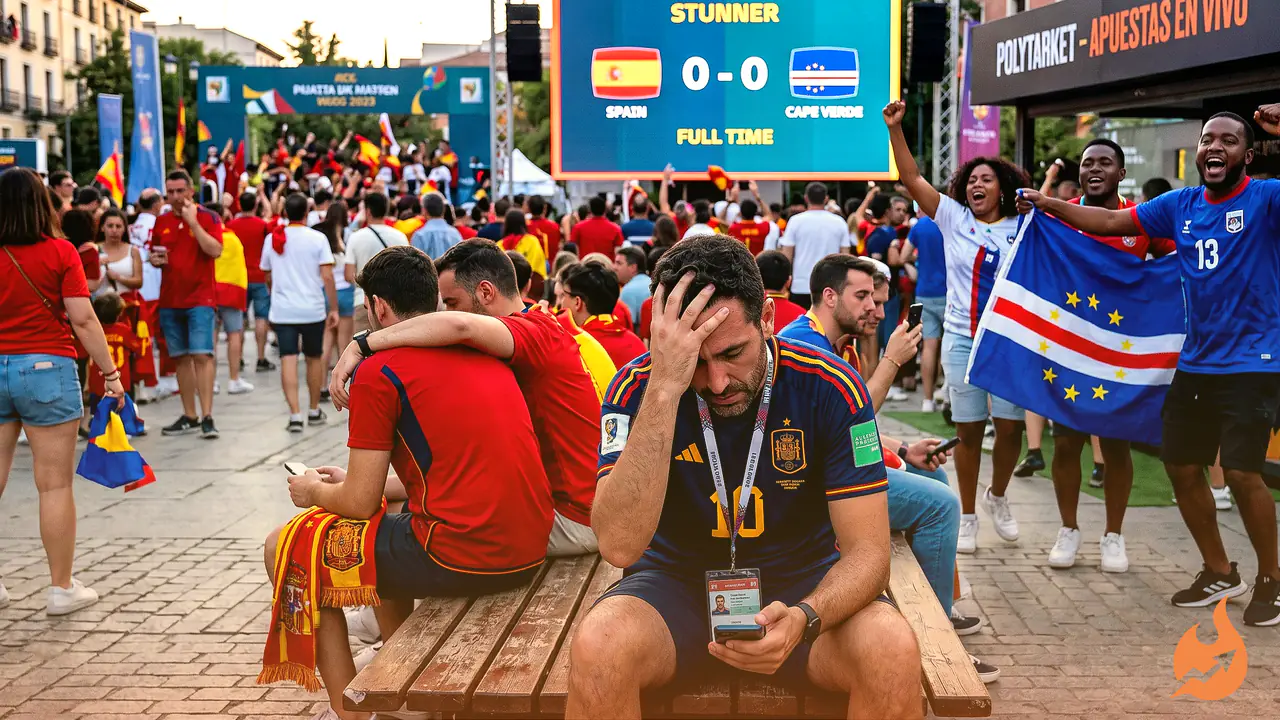
The match ended 0-0 at Mercedes-Benz Stadium in Atlanta. The trader who dropped a million dollars on the favorite walked away with nothing. That potential $1,085,943.48 payout evaporated in 90 minutes of football, played against a team that, by Polymarket's own pre-match odds, had less than a 1% chance of winning the entire tournament.
The hero of the upset was Cape Verde's 40-year-old goalkeeper Josimar Évora, known as "Vozinha", arguably the standout figure of the tournament's opening week. He finished the match with eight saves. He stopped a Ferran Torres shot in the corner and pushed a Mikel Oyarzabal header over the crossbar. Torres also struck the crossbar on what was Spain's best chance of the game. Lamine Yamal, the star of the Spanish selection, never managed to prove his superiority.
The scoreline was so improbable that it instantly drew comparisons to the biggest upsets in World Cup history. The image of Spain's shot counter frozen at 27, against just six for Cape Verde, became the visual shorthand for a sure thing gone badly wrong.
Cape Verde's road and the scale of the shock
Cape Verde had earned its place through Confederation of African Football (CAF) qualifying with seven wins, two draws and a single defeat, avoiding the inter-confederation playoffs altogether. Yet nothing in those results hinted that they could neutralize a Spain side that has beaten England, France and Germany in recent memory.
Within minutes of the final whistle, memes and GIFs flooded X. Every "surest bet in sports" joke suddenly had a fresh entry built around this match.
The trader on the other side: Fishalive
On the opposite end of this trade was a Polymarket trader who goes by Fishalive. According to the user's Polymarket profile, the account joined the platform in June 2026 with just two total predictions to its name. This trader bought "No" on Spain winning at an average price of 9¢ per share, a position that effectively said Spain had only about a 9% chance of victory, even as the market was pricing it at 92%.
The user bought a bit over 4.7 million shares at that price. When the final whistle confirmed the 0-0 draw, those "No" shares resolved at 100¢ each. The position value reached $4,738,433.49, and the profit on the day came to $4,310,481.12, a return of more than 1,000%. A widely shared social media post noted that Fishalive had put $400k on Spain not to win at 9% odds and cashed out $4,702,769.23 on the trade.
This is how prediction markets work when they work. Someone prices in a scenario the crowd dismisses, bets big, and collects when it lands. The only real question is ever edge or luck.
A familiar pattern of brutal losses
The $1 million Spain bet is dramatic, but it is not the first time Polymarket has delivered a cautionary tale about betting at extreme odds. Traders who buy "Yes" at 90¢ or above are making a statement about probability, insisting the true chance is even higher than 90%. When reality disagrees, the loss is not only financial.
For now, this account sits at a net $4.3 loss. Before this, a trader known as "beachboy4" lost more than $2 million on Polymarket in 35 days, with a single $1.58 million position on Liverpool to win against Leeds United on January 1 2026 being the biggest hit. A separate trader, bossoskil1, burned through $2.36 million in just eight days across 53 U.S. sports markets, using no hedging or stop-loss strategy at all.
What the data says about the losers
A Bloomberg analysis published in April 2026 found that since January 2025, more than 100,000 Polymarket accounts had recorded losses of at least $1,000, nearly double the number of wallets posting comparable gains.
A University of Toronto-led academic study covering 2.4 million users found that 68.8% had lost money since 2022, and that users who lose money disproportionately trade at extreme prices, below 10¢ or above 90¢. That is exactly what the anonymous Spain bettor did.
Regulators are watching
Meanwhile, on Kalshi and Polymarket combined, the 2026 World Cup winner market has crossed $2.34 billion in volume. States including Tennessee have already sent cease-and-desist letters to both platforms over sports prediction markets. Regulators are watching, and traders are still betting. The vast majority of those who took part in the Spain versus Cape Verde market are likely hurting today, while somewhere on the internet, Fishalive is having a very good Monday.
Cape Verde plays Uruguay next on June 21.