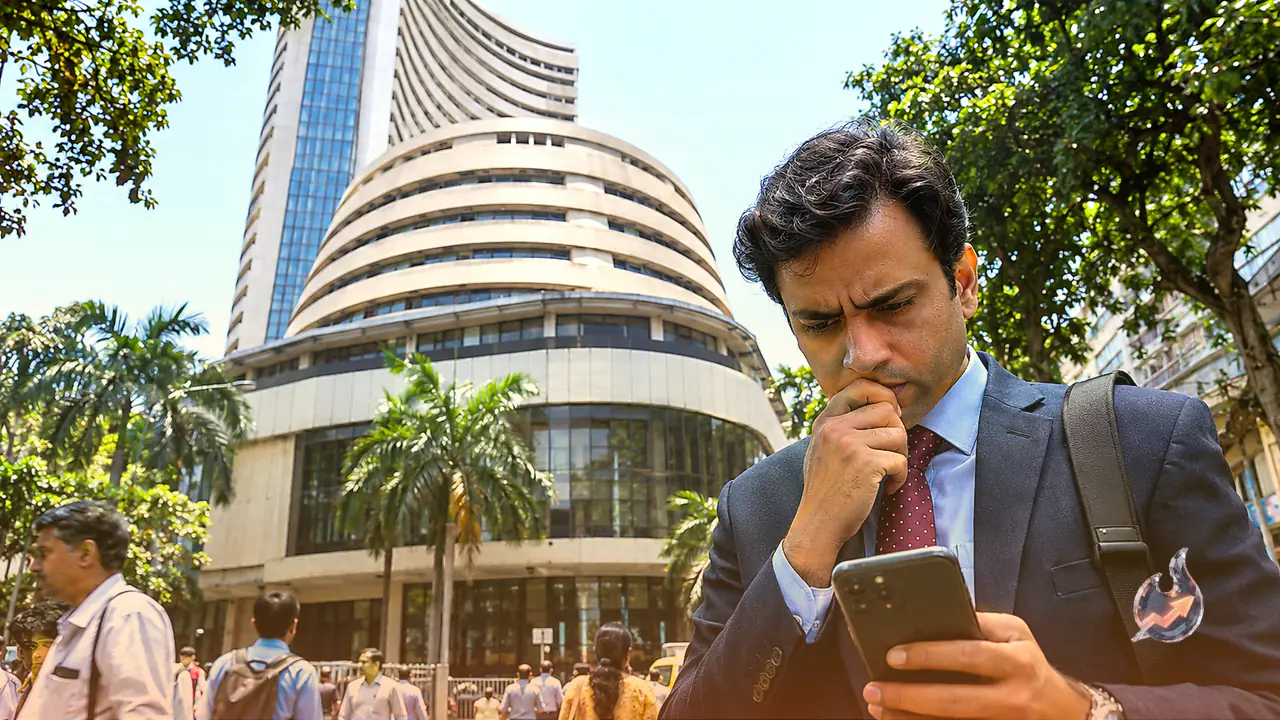

A blistering four-week rally on Dalal Street reached an abrupt and punishing conclusion on Monday as Indian equity benchmarks suffered their sharpest single-day reversal in nearly five months. After opening on a constructive note with early gains of roughly 0.7 percent, the market was quickly overtaken by relentless institutional selling across sectors. By the closing bell, the Sensex had shed 1484 points to finish at 82,436, while the Nifty slipped by 451 points to settle at 25,350. The sudden plunge wiped out approximately ₹6 lakh crore in equity investor wealth, ending an extraordinary upswing that had added roughly 10,000 points to the Sensex and lifted the Nifty by 13 percent to fresh lifetime peaks.
The Valuation Dilemma Following Record Inflows
The severity of Monday's downturn must be viewed against the backdrop of an unprecedented divergence between Indian equities and global peers over recent weeks. According to a Jefferies report dated November 20, the Indian market had staged a 2 percent advance during a period when the MSCI Emerging Markets Index slumped 8.1 percent and the Asia ex-Japan benchmark dropped 8.3 percent. This delivered an outperformance exceeding 1,000 basis points against broader emerging markets, propelled almost entirely by aggressive allocations from foreign portfolio investors.
Foreign funds poured more than $12.5 billion, representing over ₹1.25 lakh crore, into Indian shares during November alone, while channeling an additional $1 billion into domestic debt. This tidal wave of capital fueled a 1.7 percent appreciation in the Indian rupee against the US dollar and compressed the benchmark 10-year sovereign bond yield down to 7.19 percent. However, this liquidity surge also pushed Indian equity valuations to historic premiums. The MSCI India Index climbed to trade at 19.8 times its one-year forward earnings estimates, driving India's valuation premium over emerging market peers to an extraordinary 152 percent, leaving the market highly vulnerable to shifts in global sentiment.
Nvidia Momentum and the Looming Capital Rotation
A dramatic turning point in international market dynamics emerged from the global semiconductor space. News of Jensen Huang's return to tech powerhouse Nvidia triggered an explosive rally of up to 35 percent in the company's shares. Prior to this catalyst, Wall Street had been contending with sustained weakness, with the tech-heavy Nasdaq sliding to consecutive lows while anxieties surrounding artificial intelligence investments roiled Asian bourses.
Market observers now suggest that Nvidia's ferocious comeback could prompt large global funds to redirect liquidity out of richly priced emerging markets and back toward US mega-cap technology names. Institutional players who had treated Indian equities as a temporary refuge while US markets retreated may now be locking in substantial profits at peak valuations to redeploy capital into Wall Street. Given the extreme 152 percent valuation premium, even a moderate reallocation of global capital poses an immediate hurdle for Dalal Street's upward trajectory.
Heavy Liquidation in Banking and Financial Heavyweights
The primary domestic trigger behind Monday's sell-off was concentrated profit extraction across the banking system. Over the preceding four weeks, lenders had served as the market's main engine, with both the Bank index and Private Bank index climbing 19.1 percent and 18.8 percent respectively. That momentum unraveled rapidly as traders rushed to cash in their gains.
Both banking gauges declined by roughly 2 percent during Monday's session. State-run lenders bore an even steeper burden, with the PSU Bank index dropping 2.4 percent, while the broader financial services index shed 1.3 percent. The sharp drawdown in index heavyweights created a domino effect, undermining buying support across the broader exchange.
Tata Steel's Acquisition Plans Spark a 10 Percent Drop
Corporate developments added substantial pressure to the metal pack as shares of Tata Steel tumbled by nearly 10 percent during intra-day trade. Investor disquiet was sparked by the company board's clearance of a transaction to purchase a 52 percent controlling stake in structural steel tube manufacturer APL Apollo Tubes Limited.
Evaluating the financial implications of the deal, Dharmesh Kant, head of research at Chola Securities, cautioned that the ₹32,000 crore outlay would elevate leverage and compress profit margins. He pointed out that while Tata Steel maintains an operating margin of 23 to 24 percent in its domestic Indian business, it continues to grapple with margin recovery challenges in its European operations. The prospect of substantial debt accumulation for the acquisition led to aggressive institutional selling in the stock.
Broader Asian Slump and Broad-Based Pressure on Energy
The retreat on Dalal Street mirrored severe turbulence across Asian trading hubs. Driven by deepening uncertainty over capital spending in the artificial intelligence value chain, South Korea's KOSPI tumbled by 5.5 percent. Heavyweight memory maker SK Hynix plunged approximately 16 percent, while Samsung Electronics surrendered 5 percent. Equities in mainland China and Hong Kong retreated by more than 1 percent, and Indonesian shares posted an equivalent decline of roughly 1 percent.
The selling pressure in Mumbai permeated beyond financials and metals, engulfing state-controlled energy producers. The Nifty Oil and Gas index fell 1.6 percent as participants opted to exit cyclical names. Having pocketed a rapid 13 percent gain within a single month, institutional desks and market participants opted to de-risk at elevated levels rather than absorb mounting global headwinds.