























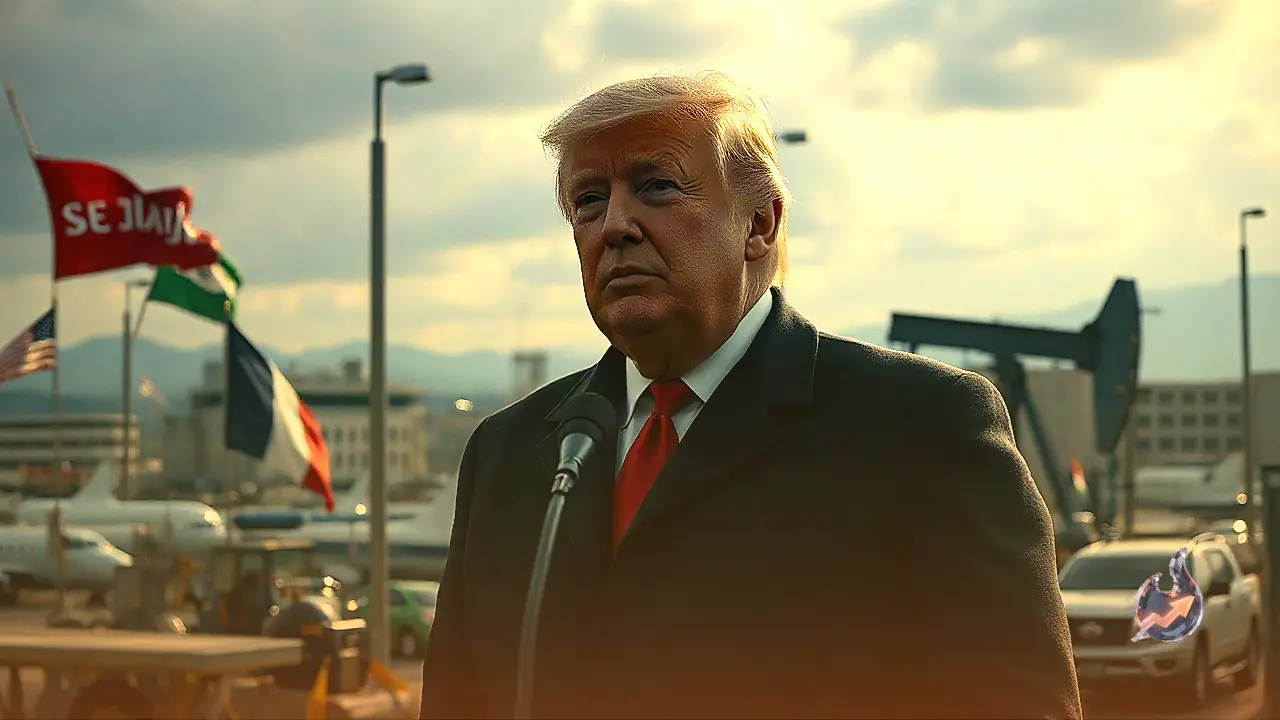

Diplomatic discussions and macroeconomic assessments are reshaping the global narrative as United States policy directions draw close market scrutiny. Donald Trump has shared detailed perspectives on critical international and fiscal fronts, stating clearly that while parties seek an agreement, his objective centers on securing a genuine resolution. Touching upon military inventories, he acknowledged that certain types of ammunition have experienced marginal depletion, alongside announcing plans to replenish national strategic petroleum reserves in the coming period. From an economic vantage point, he argued that elevated interest rates are dealing a heavier blow to economic expansion than prevailing inflation levels, observing that moderate inflation can assist in managing outstanding obligations. Additionally, he voiced strong appreciation for Dario Amodei, the chief executive of artificial intelligence firm Anthropic. Global asset valuations and broader trading venues displayed minimal immediate volatility in the immediate aftermath of these remarks, though institutional participants continue monitoring developments closely.
The US Dollar's Fundamental Strength in Global Finance
The US Dollar functions as the legal tender of the United States and serves as a de facto medium of exchange across various jurisdictions where it circulates alongside domestic paper currencies. It dominates international liquidity flows, representing over 88% of all global foreign exchange market activity, translating into an average daily transaction volume of $6.6 trillion according to 2022 figures. Following the conclusion of the Second World War, the currency replaced the British Pound as the world's preeminent foreign exchange reserve. Throughout much of its institutional history, gold backed the American currency until the Bretton Woods system was dismantled in 1971, permanently detaching the monetary unit from gold parity and initiating modern fiat valuation.
Central Banking Frameworks and Interest Rate Mechanics
The single most decisive driver governing valuation shifts in the US Dollar remains the monetary direction crafted by the Federal Reserve. The central banking system operates under a dual mandate aimed at securing sustainable price stability and cultivating full domestic employment. Adjusting policy borrowing costs serves as the main administrative lever utilized by officials to achieve these dual objectives. When consumer price gauges accelerate beyond the target threshold of 2%, policymakers systematically implement rate increases, an action that historically bolsters the external value of the currency. Conversely, should price gains trail the 2% mark or the unemployment rate demonstrate unwanted acceleration, authorities may pursue benchmark rate reductions, which tends to exert downward pressure on the currency.
Quantitative Easing Versus Balance Sheet Normalization
Under extraordinary fiscal conditions, monetary custodians possess the latitude to expand liquidity balances through quantitative easing. This unconventional intervention injects significant credit facilities into a frozen financial infrastructure where commercial institutions curtail interbank lending due to heightened concerns regarding counterparty solvency. Conventional rate cuts often prove inadequate during acute liquidity crunches, making asset accumulation a necessary measure, as observed during the global financial turbulence of 2008. The mechanism requires purchasing government-backed securities from major banking entities with newly issued monetary units, typically resulting in a depreciation of the dollar. In contrast, quantitative tightening represents an operational reversal wherein central bankers cease purchasing assets and refrain from reinvesting maturing principal into fresh government obligations, a shift that generally bolsters exchange valuations.
Currency Pair Dynamics Across Key Trading Sessions
Foreign exchange markets reflected this overarching dollar strength during Thursday's trading. AUD/USD consolidated near a two-month nadir, hovering in the mid-0.6900 territory during the Asian session. Although softer United States core price data curbed aggressive expectations for an October interest rate hike, elevated crude energy costs sustained pressure on bond yields. Domestically, Australia's August trade balance contracted sharply to AUD 495 million, though the compression generated limited lasting movement across the currency pair.
Concurrently, USD/JPY held near the ceiling of its weekly band above the 158.00 threshold during Thursday trading. Despite moderation in specific inflation metrics, rising energy-related price worries kept benchmark treasury yields parked near multi-year peaks. The continuing standoff between Washington and Tehran fostered safe-haven allocations toward the dollar, helping offset hawkish expectations regarding the Bank of Japan as well as ongoing apprehension surrounding official currency market intervention by Japanese authorities.
In Europe, EUR/USD dropped to its weakest valuation level since May 2025, reaching 1.1312 on Wednesday, which stands well below its January high of 1.2082. The retreat mirrors broad-based dollar demand, rising geopolitical frictions, and mounting concerns over European vulnerability to higher energy inputs, even as any unexpected acceleration in Eurozone consumer prices could supply a potential floor.
Trends in Precious Metals and Digital Asset Valuations
Precious metal valuations encountered significant resistance amid the persistent advance in fixed-income yields. Spot gold traded largely unchanged during European trading hours after failing to sustain an advance toward the $4,200 vicinity. Even with softer macroeconomic prints on Wednesday, continuous institutional inflows into the dollar and escalating sovereign bond yields curtailed investor enthusiasm for the non-yielding asset.
Within the cryptocurrency ecosystem, Hyperliquid traded lower by 2% on Thursday, trimming a 5% gain recorded during the previous trading day. Institutional participation experienced moderation, highlighted by $5 million in net capital outflows on Wednesday, dampening near-term sentiment. Technical parameters indicate a balanced to cautious posture for the token as its market price remains constrained underneath the $90 barrier.