























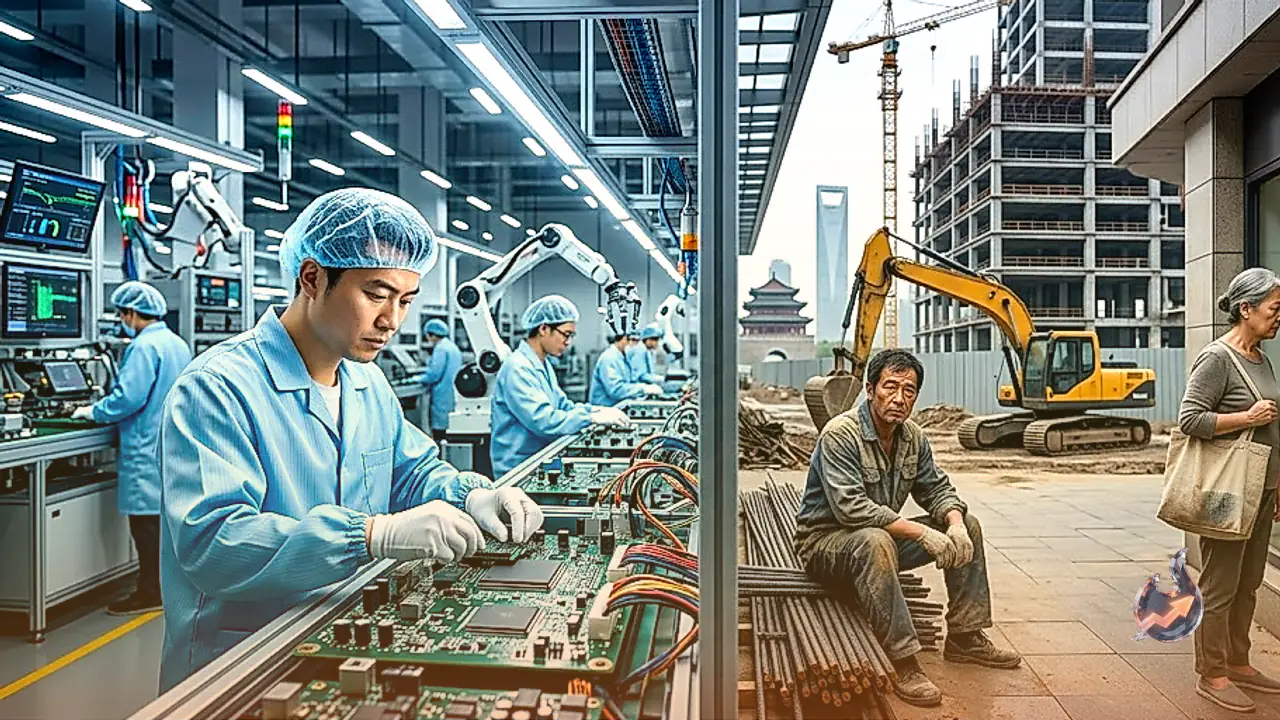

China's economy is sending two very different signals at once. Its factories, especially the high-tech ones, are running hot, yet the shoppers, homebuyers and businesses that are supposed to spend the money those factories earn have largely gone quiet. That split, laid bare in the country's first-half figures, is the central takeaway from a note by BNY's Geoff Yu, who reads the data as a case of production doing the heavy lifting while domestic demand keeps sagging. It is a picture of an economy that can build almost anything except the confidence to spend at home.
An official verdict that stays upbeat
China's own assessment of the first six months remains broadly positive. The National Bureau of Statistics said the economy "operated within an appropriate range" despite pressure from abroad, pointing to faster production, steady employment, mild price gains, solid foreign trade and the quick emergence of new growth drivers. But even that confident framing came with a caveat. Officials openly admitted that the external environment is growing more unstable and that domestic demand simply is not strong enough. For Yu, that admission strengthens the argument for a bigger, more deliberate reflation push to get spending moving again.
Production is where the strength lies
The production numbers are the good news in the report. Industrial value added climbed 5.4% year on year in the year to date, with manufacturing up 5.6% and high-tech manufacturing far out in front at 13.3%. Momentum built as the half wore on, with June output quickening to 5.3% year on year, up from 4.5% in May. The standout gains came from the industries tied to China's push into advanced kit. Output of 3D printing devices jumped 48.5% year on year, lithium-ion batteries rose 39.3% and industrial robots were up 28.0%. Taken together, those figures show an economy leaning hard into automation, electrification and next-generation manufacturing even as older engines stall.
Investment and property are the weak spot
The trouble shows up plainly in the investment and property numbers, which Yu flags as the main drag on the economy. Fixed-asset investment excluding rural households fell 5.7% year on year in the first half. Break it down and the picture is uneven. Investment in primary industry edged up 0.9%, but secondary industry investment slipped 1.1% and tertiary, the services side, dropped a heavy 8.4%. Infrastructure, manufacturing and private investment all shrank. The sharpest wound was in real estate, where development investment collapsed 18.0%, a reminder that the property slump that has hung over the economy for years is still nowhere near healed.
Jobs and credit hold the line, but only just
Labour and credit data offered a steadier read, though not steady enough to cancel out the weak demand story. The surveyed urban unemployment rate averaged 5.2% across the first half and eased to 5.0% in June, while the number of migrant workers had risen 0.5% year on year by the end of the second quarter. On the money side, total social financing, the broadest gauge of credit in the economy, grew 7.4% year on year to reach ¥462.06tn. Yet the flow of fresh credit was thinner than a year ago. Incremental financing in the first half came in ¥2.02tn lower than the same period last year, a sign that borrowers and lenders alike are treading carefully.
Why the gap matters
Put the pieces side by side and the shape of China's problem becomes clear. The supply side of the economy is not the issue; the country can build, and build a lot, particularly in the advanced sectors it has bet its future on. What is missing is demand at home strong enough to absorb all that output. When investment contracts, property keeps falling and credit growth slows even as production accelerates, the risk is that goods pile up without buyers and prices stay soft. That is why the National Bureau of Statistics' nod to "insufficient domestic demand" carries real weight in the months ahead.
The case for stronger stimulus
The debate is now shifting toward whether Beijing will step in more forcefully to lift consumption rather than leaning on factories alone. Reflation, in plain terms, means using policy support, whether through interest rates, government spending or putting money directly into people's hands, to revive demand and firm up prices. The first-half data hand that argument its ammunition. Robust production shows there is no shortage of capacity; it is falling investment and soft consumption that mark the real bottleneck on the demand side. Until household demand recovers, keeping growth steady on the strength of output alone will remain a hard task for China.