























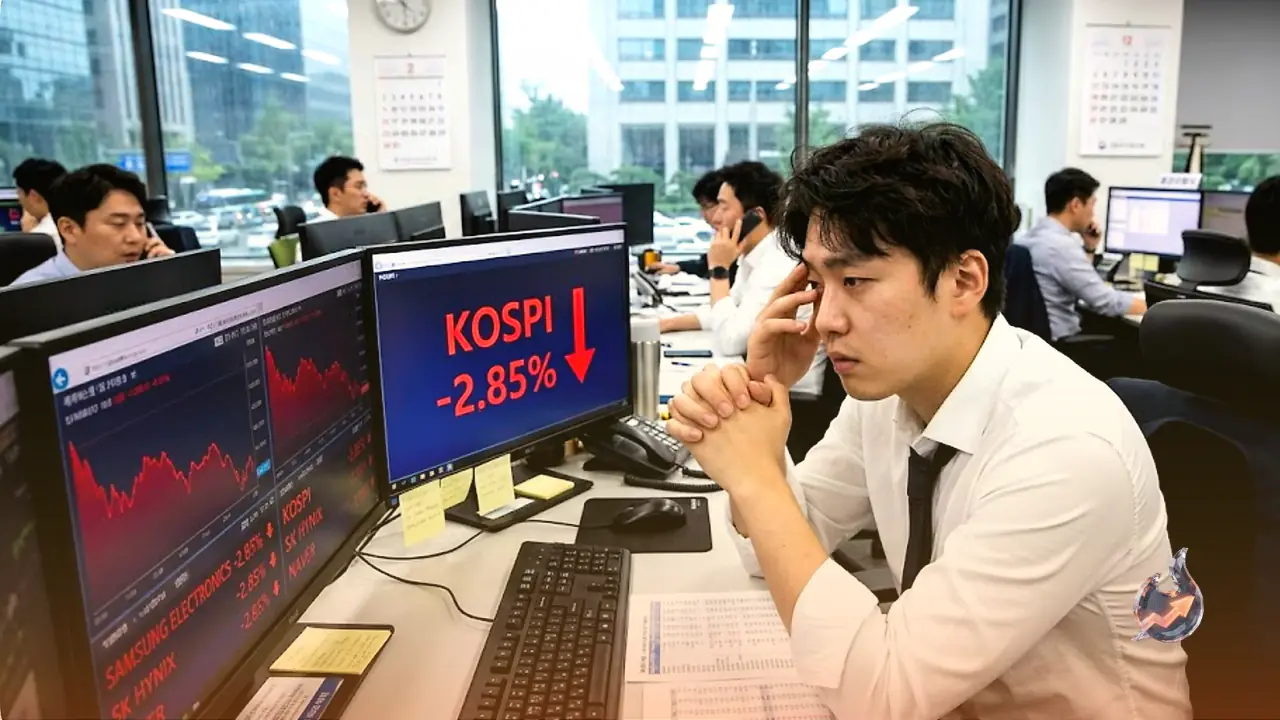

The South Korean equity market is currently undergoing a significant transition. Geoff Yu of BNY points out that institutional investors are exiting South Korean positions on a massive scale. This withdrawal is cited as a primary driver behind the recent, albeit brief, move by the KOSPI index into bear market territory. While retail investors remain active on the opposite side of the trade, the market is increasingly questioning how long this support can persist, creating an environment of significant uncertainty.
Concerns Over AI and Semiconductor Concentration
Within the Asian market, the tech-led sell-off in South Korea has sharpened concerns regarding the heavy concentration of investments in Artificial Intelligence (AI) and semiconductor firms. The KOSPI briefly flirted with bear market conditions, witnessing heavy declines in major stocks like Samsung Electronics and SK Hynix. Notably, these losses occurred even as Samsung reported a sharp quarterly profit rebound. According to BNY, this situation points less to weak fundamentals and more to index concentration, aggressive positioning, and stretched expectations surrounding AI-linked assets.
Contrasting South Korea with Taiwan and China
The situation in South Korea contrasts sharply with other regional neighbors. Taiwanese equities have also been a major beneficiary of the AI and semiconductor narrative, yet the liquidation there has remained more measured in both pace and scale, contributing to greater relative resilience in index performance. Meanwhile, data indicates that interest in Chinese equities is holding up well, even as indices such as the HSCEI entered bear market territory several weeks ago.
Behavioral Shifts and Technical Constraints
Technical constraints, such as single-stock ownership limits for active managers, remain an important factor in the current market dynamics. However, if market valuations continue to soften and institutional selling persists beyond what can be explained by these technical limits, it may signal a broader behavioral shift rather than just routine position management. It remains premature to declare a definitive rotation away from the growth-oriented markets of Taiwan and South Korea toward value segments elsewhere in Asia. Nevertheless, it appears some funds are searching for new investment destinations, a move that could drive significant dispersion in return profiles this quarter.
Global Market Volatility and Forex Movements
Broad market sentiment remains cautious as other global instruments react to geopolitical instability. The GBP/USD pair remained under pressure on Tuesday, slipping back toward the 1.3370 zone after an earlier test of the 1.3400 neighbourhood. Investors are adopting a cautious stance due to renewed geopolitical concerns. Similarly, the EUR/USD pair retreated toward the low-1.1400s as demand for the US Dollar resurged. The renewed jitters in the Middle East have bolstered the safe-haven universe, weighing on overall risk appetite ahead of the upcoming FOMC Minutes on Wednesday.
Gold Price Dynamics and Central Bank Guidance
Gold prices continued to trade close to the $4,100 mark per troy ounce on Tuesday, following a pullback from Monday. Geopolitical effervescence has reignited inflation concerns, which in turn acts as a headwind against recovery attempts for precious metals. Furthermore, traders are facing a new reality regarding central bank communications. From the Federal Reserve to the European Central Bank and the Bank of England, policymakers are pushing back against providing clear forward guidance, leaving traders to grapple with the possibility that central banks will communicate much less about future policy paths than they have in recent years.