























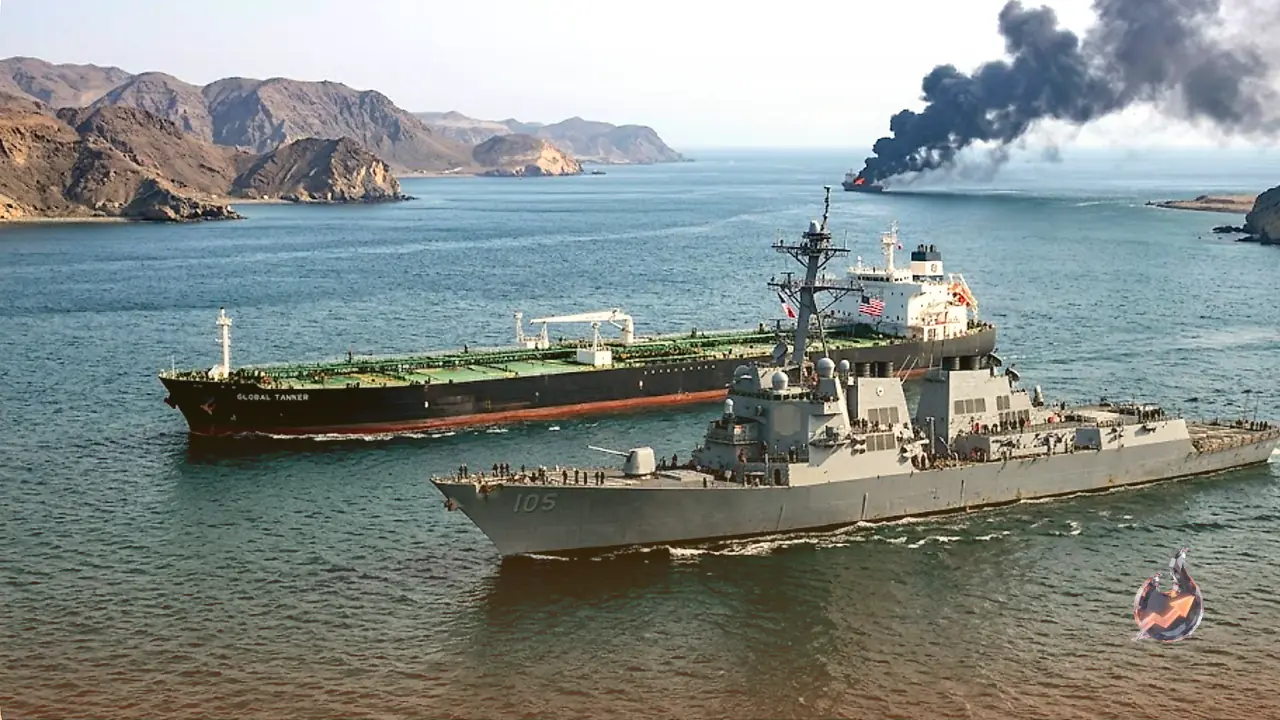

Iran's Foreign Ministry spent Tuesday insisting it is diligently fulfilling its Strait of Hormuz commitments under the memorandum signed at Versailles, hours after projectiles struck a Qatari liquefied natural gas carrier and a Saudi tanker inside the waterway it claims to be safeguarding. The spokesperson cast vessels sailing routes uncoordinated with Iran, or masking their transponders, as authors of their own misfortune, then professed bafflement at Qatar's accusations, framing them as an affront to neighbourly principle. Rezaei, advisor to the Supreme Leader, completed the set by declaring it obvious that Washington will steer the talks to failure; blame for a collapse is being assigned before the collapse arrives.
Washington's Military and Financial Countermeasures
Washington's answer skipped the podium entirely, with Central Command announcing a series of intense strikes on Iran to penalize the targeting of three commercial ships, branding Tehran's hostility an unjustified, dangerous, and unambiguous breach of the ceasefire. Hours earlier the administration had already pulled the licence permitting Iranian Crude Oil sales; the pressure is now kinetic and financial at once. This dual-pronged strategy marks a significant escalation in the ongoing regional tension, moving beyond diplomatic posturing into active enforcement of maritime security.
Market Reaction and Commodity Pricing
Markets read the choreography for what it is; Brent settled roughly 3% higher near $74.00 per barrel and pushed toward $76.00 after hours once the licence revocation landed, yet prices sit near post-February lows because OPEC+ barrels are returning and Saudi discounts are deepening. The tape is pricing an incident premium, not a closure premium; that distinction is the entire trade. Investors are closely monitoring the supply side, as the return of extra barrels continues to act as a anchor on potential price spikes even amidst regional conflict.
Currency and Broader Asset Volatility
Financial instruments are reflecting the heightened caution. GBP/USD remains on the back foot, slipping back toward the 1.3370 zone on Tuesday. Cable has come under pressure soon after testing the 1.3400 neighbourhood as investors turned more cautious in response to renewed effervescence on the geopolitical front. Simultaneously, EUR/USD remains on the back foot ahead of the opening bell in Asia, returning to the low-1.1400s on the back of the resurgence of the demand for the US Dollar. Renewed jitters in the Middle East support the safe haven universe and weigh on the sentiment surrounding the risk complex. Investors’ attention should shift to Wednesday’s FOMC Minutes to gauge future central bank policy direction.
Gold and Central Bank Forward Guidance
Gold adds to Monday’s decent pullback and trades close to the $4,100 mark per troy ounce on Tuesday. In the meantime, fresh geopolitical effervescence appears to have reignited inflation concerns, which in turn, limit any recovery attempt from the precious metal. Furthermore, central banks have spent years telling markets what might come next, but now, traders face the possibility that they say a lot less. From the Federal Reserve to the European Central Bank and the Bank of England, policymakers are pushing back against forward guidance, forcing markets to navigate a landscape with far less visibility into future rate adjustments.