























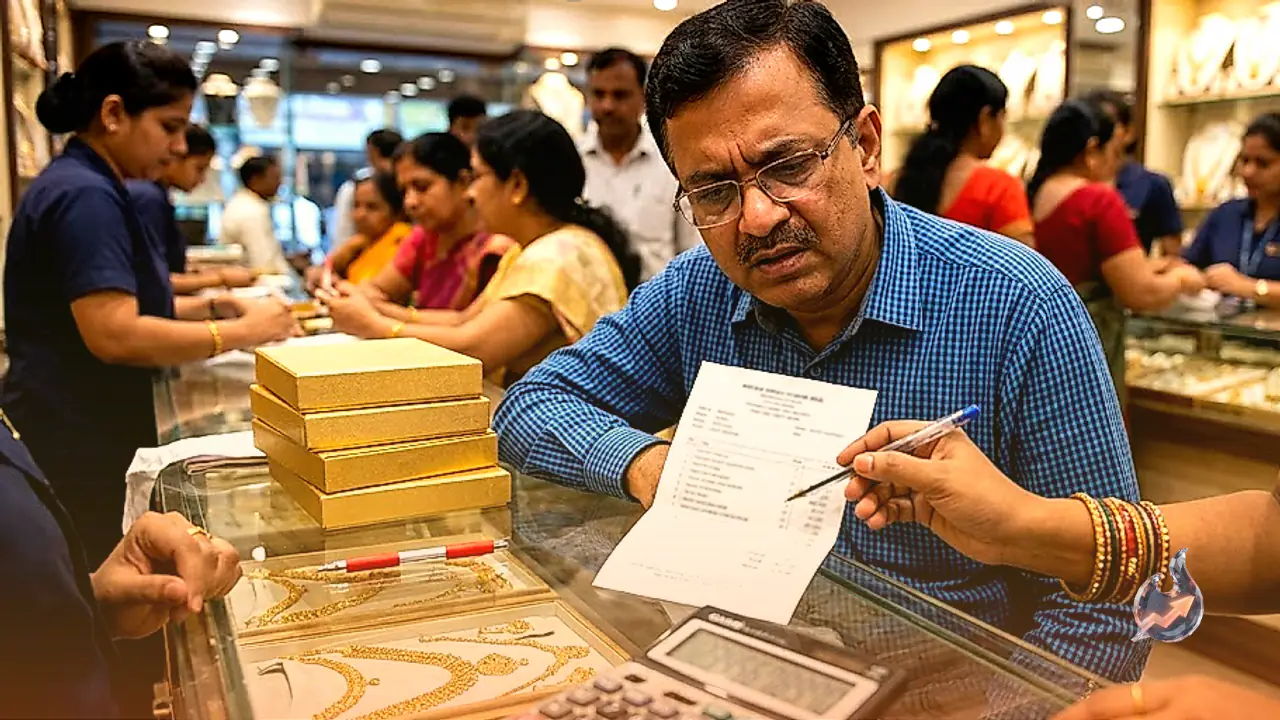

On July 15, 2026, ten grams of 24-carat gold is quoted at Rs 1,43,570, while the same weight in 22-carat gold is listed at Rs 1,31,600. Scaled down to a single gram, 24-carat comes to Rs 14,357 and 22-carat to Rs 13,160. Those are the numbers you see flashing on a jeweller's rate board, but they are almost never the numbers that appear at the bottom of your invoice. Buy a piece of 24-carat jewellery at that headline rate and you can end up handing over roughly 6.51% more than the sticker suggests, an addition that quietly works out to about Rs 22,052 on a 10-gram purchase.
What purity actually means
Before the extra costs make sense, it helps to understand what you are paying for. 24-carat gold is 99%, or 999.9, pure yellow metal, which is why it is described as the purest form of gold available. 22-carat gold, by contrast, is 91.67% pure; the remaining 8.33% is made up of other alloy metals such as copper, silver or zinc. That difference in purity is the basic reason 24-carat gold is usually priced higher than 22-carat gold. The alloys in 22-carat make it harder and more durable for everyday jewellery, but they also dilute the gold content, and the rate reflects that.
Why your final price climbs above the rate board
So if 10 grams of 24-carat gold is officially Rs 1,43,570, why does the bill demand an extra 6.51% on top? The answer lies in two costs that are folded into gold jewellery but rarely advertised up front: making charges and Goods and Services Tax. Neither is part of the raw metal rate, yet both are unavoidable once the gold has been turned into an ornament, and together they are what separate the quoted price from the price you actually pay.
Making charges, the fee you don't get back
In plain terms, making charges are the labour or craftsmanship fees a jeweller adds for designing and manufacturing a piece of gold jewellery. The important thing to remember is that they are non-refundable. If you ever sell the ornament back, that portion of your money does not return. Making charges also climb higher the moment personal customisation enters the picture, because bespoke work takes more time and skill. These fees sit on top of the base price of the gold, and they are not standardised: they vary from one jeweller to the next, and from city to city and state to state. As a broad rule, making charges run anywhere between 5% and 25% over the base price of the metal.
Floating and fixed: two ways to charge
Jewellers calculate making charges in two distinct ways. Under the floating method, the charge is a percentage of the gold's value, usually somewhere in that 5% to 25% band, and it can climb to 30% or more when the design involves intricate, handcrafted detailing. Because it is tied to the value of the metal, a floating charge rises and falls with the gold rate. The fixed method works differently: some jewellers apply a flat, standard fee of Rs 500 to Rs 1,000 regardless of how the gold price moves on a given day. Which method a shop uses can make a real difference to what you finally pay, especially on higher-value pieces.
The two layers of GST
The second component that inflates your purchase is GST, and it comes in two separate slices. The first is a 5% tax levied on the making charges, a cost the jeweller will in most cases pass straight on to the customer. The second is a 3% GST charged on the value of the gold itself, and because it is applied to the metal's price, it plays a decisive role in the final figure. Stacked on top of the making charges, these two GST components are a big part of why the number on the bill drifts so far from the number on the rate board.
A worked example on today's rate
Consider the current price. On July 15, 24-carat gold is Rs 1,43,570 per 10 grams. It is worth repeating that this is only the base price, not the final value of the ornament. Assume a jeweller applies a 12% making charge across all its jewellery. Once that making charge is added, along with 5% GST on those charges and 3% GST on the gold value, the extra amount layered on top of the base price comes to Rs 22,052. In other words, on a 10-gram 24-carat purchase you end up paying Rs 22,052 more than the rate board implied, purely from craftsmanship fees and tax.
Why gold is caught between two timelines
Beyond the mechanics of the bill, the bigger question for buyers is where the metal is headed. Experts describe gold as being in a chasm right now, where the short-term picture and the long-term reality pull in opposite directions. In the near term, the prospect of a rate hike is expected to push gold lower. Over a longer horizon, though, the same metal is still viewed as an appealing option for building wealth.
Part of the reason for cautious optimism is inflation data. The latest US CPI inflation reading came in at 3.53% for June 2026, offering investors a reason to scale back their rate-hike expectations for the year. It was the first drop in US CPI in five months. Even so, it is not quite enough to celebrate: risk still hangs over the market as long as the United States and Iran keep circling each other through repeated so-called peace-deal talks that seem designed to pressure one another. The conflict in West Asia is far from over, and a lasting resolution looks both grimmer and more uncertain.
What the analysts are watching
Analysts at JM Financial spelled out the tension in a note. "Despite the favourable reading, market sentiment will remain in check due to the 20% spike in crude oil prices ($86/bbl) in July 2026 on the back of renewed hostilities in the Gulf. Markets are building in one rate hike in 2026, starting in September 2026," they wrote. They added: "We expect the FOMC to maintain the status quo in July 2026, while policy action in Sep'26 will be heavily influenced by the direction the war in the Middle East takes and an early resolution, and easing crude oil prices will push rate hike expectations towards the end of 2026."
Sanjit Singh Paul, Smallcase Manager and Managing Partner of Modulor Capital, framed the same puzzle from gold's point of view. "Gold is in a dichotomy right now as the short-term and the long-term contradict each other. Over the short term, increasing U.S. interest rates and easing global crude prices are headwinds for gold. Large investors perceive the global conflict threat as lower than before," he said. A higher interest rate, he noted, makes the US dollar a safer and better-yielding place to park money than gold, which naturally drags on the metal.
The long game and sovereign reserves
For Indian buyers specifically, Paul called the situation a mixed bag. "These factors would push gold prices lower globally. For India, this would be a mixed bag, as a lower USD gold price but a stronger USD may mute the price decrease. In the long run, gold is expected to rise as a new world order is being set for sovereign reserves," he said. As more governments add gold to their reserves, he expects prices to keep climbing over the long term.
His parting advice was that weakness is not the same as irrelevance. "Gold may be down, but it is definitely not out of the portfolio. In fact, gold is an attractive buy right now, using the short-term dips to build a position for the long run. Investors can surely allocate some gold at these levels, even as sentiment is expecting gold to go much lower. Extreme sentiment calls rarely play out well, but for the long-term, allocation to gold right now makes sense," he said. The takeaway for anyone eyeing a purchase: read the full bill, not just the rate board, and treat any dip as a long-term opportunity rather than a short-term signal.