
A First for Mexican Cinema
Mexico has given world cinema an extraordinary amount — the 'Three Amigos' of Guillermo del Toro, Alfonso Cuarón and Alejandro González Iñárritu; Luis Buñuel's Los Olvidados and The Exterminating Angel; even Goal!'s fictitious footballing prodigy Santiago Muñez. So it's genuinely surprising that the country's first feature-length stop-motion animation has only just arrived. Arrive it has, though, and with real flair. The film comes from Cinema Fantasma, the studio brothers Arturo and Roy Ambriz launched inside a tent on their parents' rooftop.
I Am Frankelda is a prequel to the same brothers' hit Cartoon Network/HBO Max series Frankelda's Book Of Spooks. It's a phantasmagorical marvel, overflowing with bright ideas and jaw-dropping designs — even if it occasionally sags beneath the heft of its own enormous mythology.
Where the Story Begins
Released in 2021, Frankelda's Book Of Spooks introduced audiences to its namesake, Frankelda (voiced by Mireya Mendoza), a literal ghostwriter loosely modelled on Mary Shelley. Almost a Mexican Grizzly Tales For Gruesome Kids, the show has Frankelda spin frightening tales packed with Spooks — supernatural beings whose survival depends on human fear (yes, there's a touch of Monsters, Inc. to it) — helped along by her grumpy enchanted book Herneval (Arturo Mercado Jr).
The new film carries us back to mid-19th-century Mexico. It tells how Francisca Imelda, a frustrated young writer whose gifts go unrecognised in a sexist society, first crossed into the mythical realm of Spooks; how the tortured prince Herneval lived — and loved — before being bound in leather; and how the Book Of Spooks, with its arachnoid and avian inhabitants, came to exist at all — and very nearly didn't, as the barriers between the worlds of fantasy and fiction began to crumble. And all of it in a brisk 104 minutes.
When the World-Building Overflows
As you may already suspect, I Am Frankelda is a great deal to absorb. Even for seasoned fantasy fans, the Ambriz brothers' lore-rich, exposition-heavy approach to world-building can occasionally feel so overcomplicated that it becomes distracting. Seven feuding clans is arguably about two too many for the Spooks' home of Topus Terrenus to hold comfortably; the Spooks' politically turbulent history is less neatly woven through the story than knotted and tangled up inside it; and when it comes to the finer points of the film's particular magic, a Tenet-style 'don't try to understand it' attitude is the wise choice. And after all that, we haven't even mentioned Luis Leonardo Suárez's alternately terrifying and insipid, fuzzy-legged royal 'nightmarer' Procustes.
Even so, the world built here — together with its weird, wonderful and frequently many-eyed mythic figures — is nothing short of breathtaking.
A Tapestry of Influences
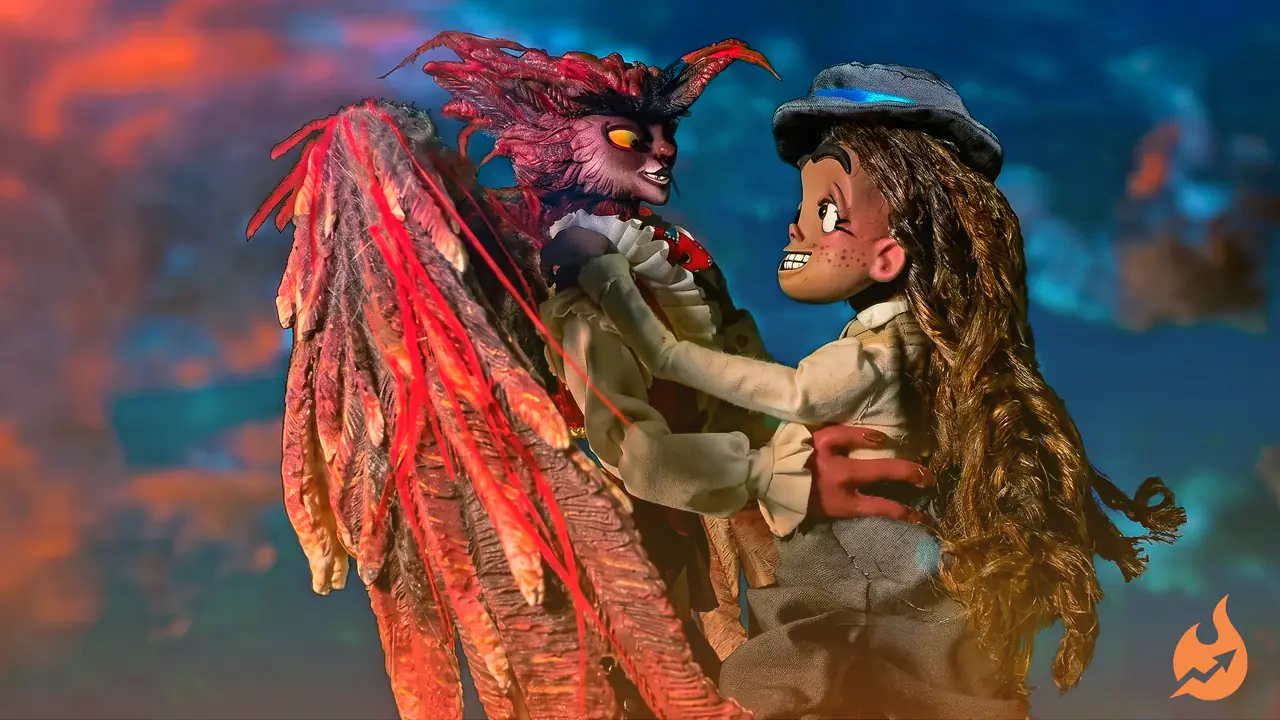
There are notes of Henry Selick and Tim Burton in Topus Terrentus' baroque, twisted Gothic architecture — winding towers and swirling staircases, crooked floors and cobwebbed nooks and crannies. There are hints of Jorge R. Gutierrez and of that great Mexican fabulist Guillermo del Toro (an advisor and mentor on the film) in its nightmarishly beautiful, beautifully nightmarish supernatural characters, each lovingly handcrafted with a slight jankiness that only deepens the movie's DIY, 'I wish I could reach out and touch it' charm.
Beyond cinema, the influence of Gustave Doré and his exquisite Divine Comedy engravings, and of Auguste Rodin's astonishing 'The Gates Of Hell' — his sculptural take on Dante's Inferno — also pulse beneath the surface. That sculpture is recreated, Frankelda-style, in the film's dramatic opening, lending the world Cinema Fantasma has built a real sense of timelessness and grandeur.
'Prince Of Spooks': The Film's Peak
For all the reference points stitched into its DNA, make no mistake: this is a true original from the Ambriz brothers. Nowhere is that clearer than in the film's showstopping 'Prince Of Spooks' sequence. Arriving near the end, at the moment when our spirited Goth-girl hero Frankelda's own creations seem to have overwhelmed her and the lines between fiction and reality have almost entirely vanished, this musical number is a banging, operatic villain ballad of a kind we haven't heard since The Hunchback Of Notre Dame and the heyday of Disney's Renaissance era. It genuinely pushes the boundaries of the stop-motion medium, blending intricate puppetry, papercraft and gorgeous oil-painted segments into a feast for the senses. And if that mixed-media promise tempts you, just wait for the glasswork, resin and claymation creations that further colour and texture Topus Terrentus — truly, nothing here is done by halves.
A Simple Message at Its Heart
Ultimately, what makes I Am Frankelda work — balancing its visual spectacle against its unwieldy mythology — is the strength and simplicity of its core message. When all's said and done, this is a story about what it means to be an artist who knows what they have to say, who knows how they want to say it, and who will go through hell — literally, if they must — to be heard. To create entirely on their own terms. That is what Frankelda does. And that is exactly what the Ambriz brothers have done. Long may they continue.