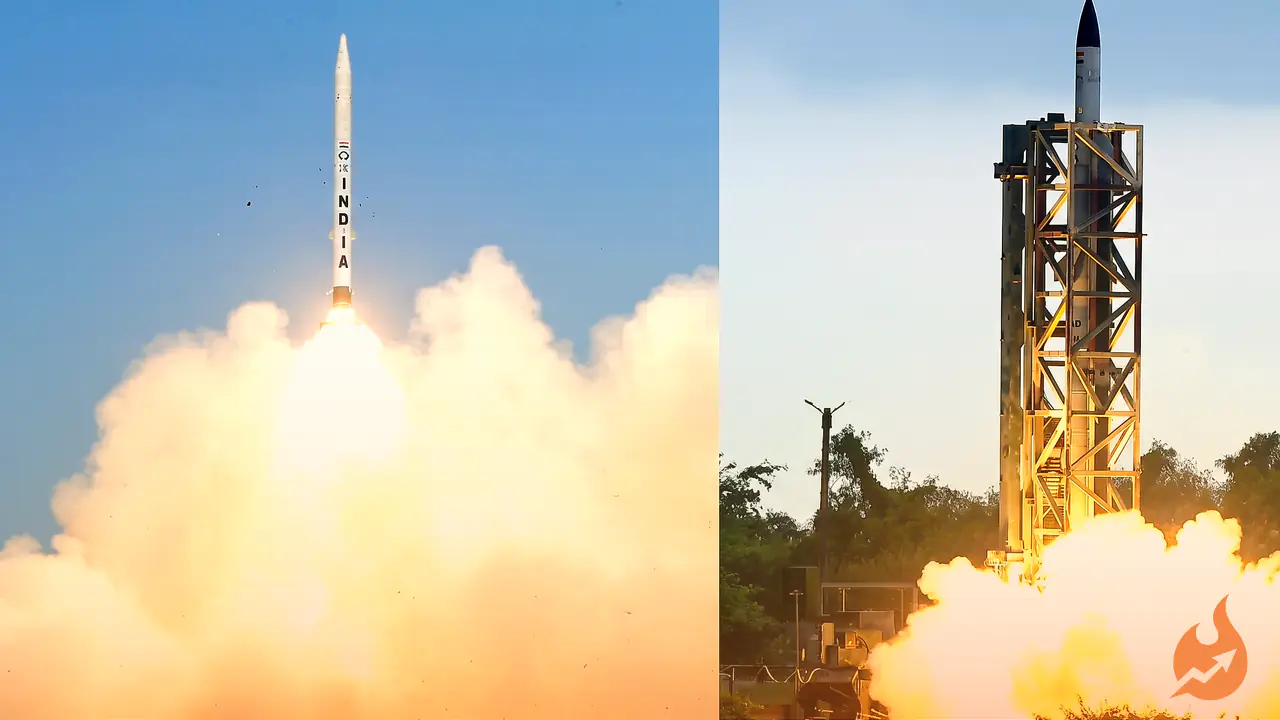

India has added a powerful new layer to its air-defence umbrella by successfully completing the trials of the second phase of its Ballistic Missile Defence programme (BMD Phase-II). Defence watchers are calling it a major leap in the country's strategic strength, because once fully deployed, the system will give India's multi-layered missile shield a robustness it has never had before.
Even Missiles With a 5,000-KM Reach Will Be Destroyed Mid-Air
According to reports, this advanced system is capable of destroying ballistic missiles with a strike range of up to 5,000 kilometres while they are still in flight. On the strength of this capability, India will be able to intercept and obliterate the long-range missiles of its neighbours China and Pakistan in the sky itself. Experts say that China's missiles such as the DF-26 and DF-7 would be neutralised with ease, while for Pakistan's Shaheen-series missiles, escaping this defence system would be virtually impossible.
A Double Net — Inside and Outside the Atmosphere
According to TrendKia, BMD Phase-II has been built so that it can stop an enemy's long-range ballistic missile at two distinct stages — outside the atmosphere (exo-atmospheric) and within the atmosphere (endo-atmospheric). The direct advantage is that an incoming missile can be engaged not once but multiple times, sharply increasing the chances of bringing it down. The system is seen as a crucial step towards countering threats from China's medium- and intercontinental-range ballistic missiles such as the DF-26, as well as advanced missile systems of the future. That said, neither the government nor the Defence Research and Development Organisation (DRDO) has made any official claim naming a specific foreign missile as the target.
Phase-I Already in Service, Phase-II Widens the Range
India's BMD Phase-I is already operational and protects the country against short-range ballistic missiles. The aim of the second phase is to take this protection further — that is, to neutralise in mid-air even missiles that fly farther, faster and are fitted with advanced technology. The entire programme has been developed keeping in mind India's evolving security environment and regional challenges.
AD-1 and AD-2 Interceptors — the Backbone of the Programme
The most important part of this programme is the AD-1 and AD-2 interceptor missiles. Of these, the AD-1 interceptor has already been successfully tested several times. The most notable point is that these trials did not rely on dummy targets alone; instead, real ballistic missile targets launched by the Strategic Forces Command were used. This made it possible to assess the interceptor's performance under genuine, combat-like conditions.
Rajnath Singh Shares the News
Defence Minister Rajnath Singh shared details of the achievement on June 13, 2026, saying:
The DRDO has successfully demonstrated multiple crucial technologies bolstering nations defence capabilities against different types of enemy threats. Three consecutive flight-tests were successfully conducted to demonstrate multi-layered defence against long range threats.
Gearing Up for 21st-Century Threats
According to the DRDO, India's multi-layered missile defence system successfully destroyed its designated targets during the various trials. The tests validated several important indigenous technologies aimed at meeting the advanced missile challenges of the future. Modern ballistic missiles are steadily becoming faster, longer-ranged, more manoeuvrable and equipped with deceptive countermeasures. In such a scenario, the development of an indigenous interceptor system has become the backbone of India's national security strategy.
Deployment Details Still Under Wraps
The Operational Deployment Programme of BMD Phase-II and its technical specifics have not yet been officially disclosed. Even so, these successful tests have made it clear that India is moving rapidly towards a comprehensive and entirely indigenous missile defence shield. Analysts believe the achievement will lift the country's strategic deterrence to a new height.