























Kerala's Wayanad is back in the spotlight over its landslide risk, even as several parts of Maharashtra remain paralysed by days of relentless rain. In Pune, a two storey building crumbled within seconds, while on the Mumbai Pune Expressway, a missing link tunnel project worth nearly Rs 7,000 crore was shut down by a landslide barely two months after it was inaugurated.
Why Wayanad's own terrain is the problem
Wayanad sits in the north east of Kerala and is the state's only plateau region, a landscape of undulating soil and rock covered with trees and vegetation. This uneven terrain sets Wayanad apart from the rest of Kerala and makes it especially fragile. A 2021 report from the Geological Survey of India found that 43% of Kerala's land is prone to landslides. Wayanad's situation is even more precarious, since 51% of its land lies on hilly slopes, keeping the risk of a landslide high through the year, and rising sharply during the monsoon months.
The 2024 and 2019 disasters
Wayanad's worst landslide disaster struck two years ago. Between roughly 2 am and 4 am on the night of 30 July 2024, a series of landslides hit the villages of Mundakkai, Chooralmala, Attamala and Noolpuzha, killing more than 400 people. The same area had already seen a landslide in 2019 after heavy rain, which killed 17 people and completely destroyed 52 houses. Beyond rainfall, human activity such as road building, tunnelling, dam construction, mining and deforestation keeps adding to the landslide risk in Wayanad.
Maharashtra brought to a standstill by rain
Meanwhile, days of continuous rain in Maharashtra have thrown normal life into chaos. Residential areas are submerged in rainwater, roads have turned into ponds, and cars parked outside homes are seen floating. In Mumbai and the areas around it, even railway tracks have gone under water, forcing local trains to slow down drastically. The trains that are still running appear to be floating along the flooded tracks, adding to the daily struggle of lakhs of commuters.
A two storey building collapses in seconds in Pune
Amid this chaos, a two storey house in Pune crumbled like a house of cards within seconds, throwing up a huge cloud of dust. Fortunately, the building, which had been weakened by continuous rain, had already been evacuated, averting a bigger loss of life.
Nalasopara, Vasai and Virar turn into a sea of water
In Nalasopara, part of the Mumbai Metropolitan Region, water has spread everywhere and railway tracks are completely submerged. With water covering the tracks, most local trains on this route have been suspended, forcing commuters to cross the tracks on foot. The trains that are running have slowed to a crawl and appear to glide through the floodwater. Vasai and Virar are in no better shape, with homes and apartments surrounded by water and vehicles seen floating. Streets have flooded so badly that walking has become difficult, and with shops and routes shut, essential supplies have started running short. The rail route connecting Vasai and Virar has also gone under water, adding to residents' woes. Vasai Virar is considered the biggest residential and commercial hub in Palghar district, which borders Mumbai, so its shutdown affects the pace of the entire region.
A Rs 7,000 crore tunnel that couldn't withstand the rain
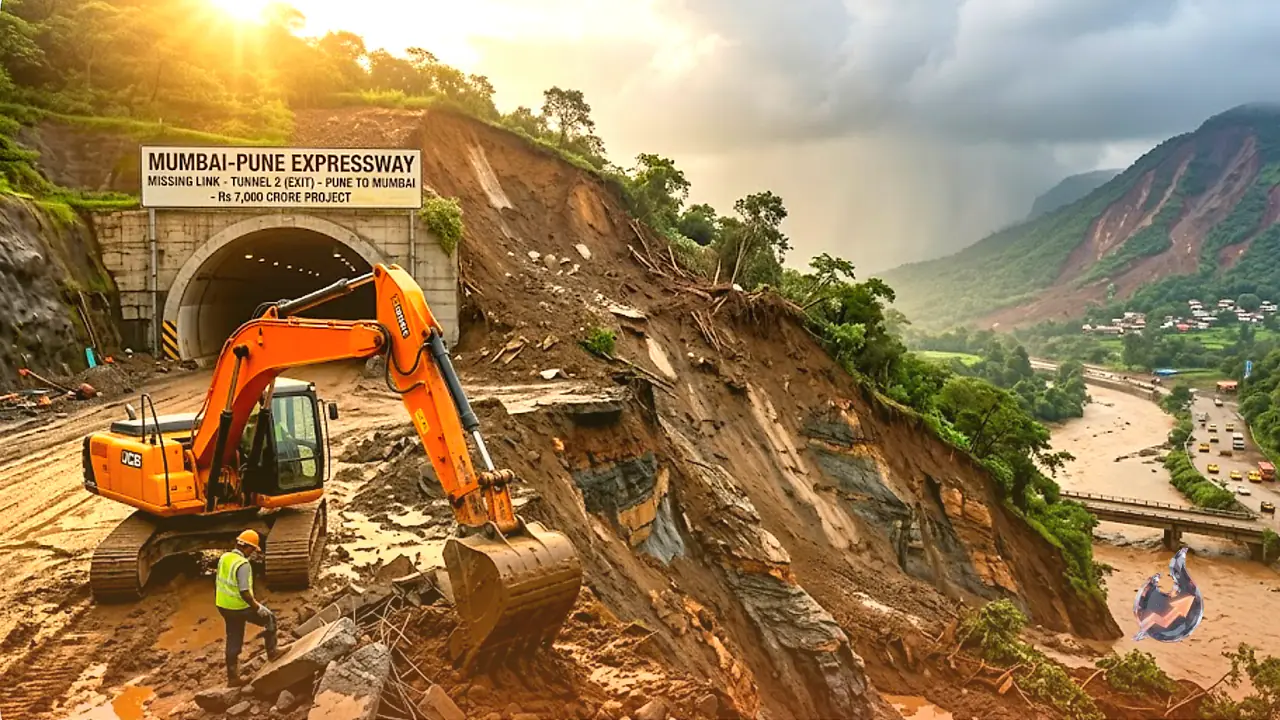
Heavy rain also brought part of the Mumbai Pune Expressway to its knees, forcing authorities to halt traffic on the stretch for several hours. The missing link project on the expressway had been inaugurated on 1 May this year, but continuous rain triggered a landslide that shut down the tunnel built as part of it. Large boulders came crashing down onto the expressway, halting traffic across the entire stretch for hours. The missing link project had cost around Rs 7,000 crore to build and had been hailed as a remarkable feat of engineering. Yet barely two months after its inauguration, when this stretch caved in, the Maharashtra State Road Development Corporation dismissed it as an act of God. Experts, however, point out that the safety net installed at the site covered only up to 15 metres in height, while the rocks fell from around 150 metres, a clear gap in planning. That planning gap shows up elsewhere on the Mumbai Pune Expressway too, where water from surrounding farmland floods the road after heavy rain, creating traffic jams that stretch for kilometres.