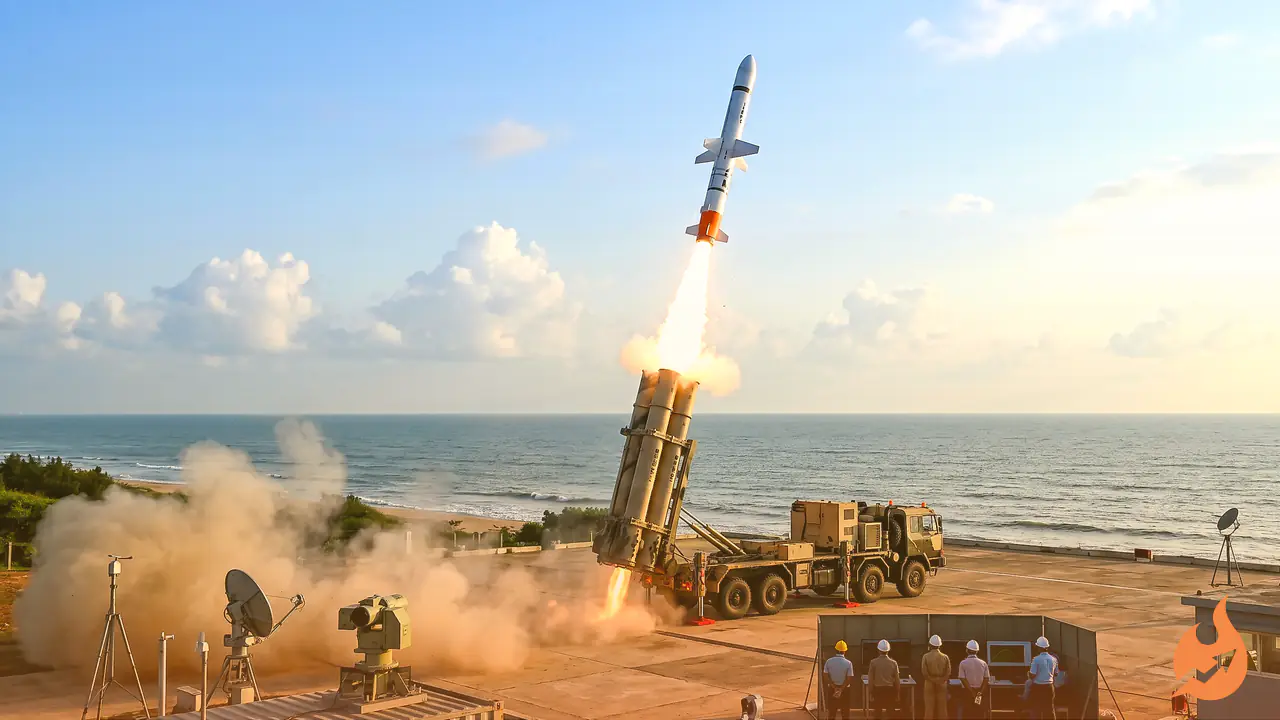

Against the calm backdrop of the sea at Chandipur on the Odisha coast, a white indigenous cruise missile tore through the sky with a sharp blast. This was India's Long Range Land Attack Cruise Missile, or LRLACM, often described as the country's own Tomahawk. The successful trial by the Defence Research and Development Organisation (DRDO) put on display a weapon that could reshape India's approach to war in the years ahead.
The most striking thing about this missile is its unusual formula. While BrahMos, India's most talked about supersonic missile, is famous for its lightning speed, the LRLACM is deliberately slow, that is subsonic. But its real strength does not lie in speed. It lies in a reach that can strike targets three times farther away than BrahMos. Powered by the indigenous Manik turbofan engine, the missile can hug the surface of the sea and hide behind mountains to penetrate up to 1,500 kilometres deep into enemy territory.
An Indigenous Weapon Built On Nirbhay And ITCM Heritage
The LRLACM is not the result of a single effort. It stands on technologies that were tested and matured during the Nirbhay and ITCM missile programmes. This fully indigenous, state of the art cruise missile is set to be a major shift for the Indian Army, Air Force and Navy alike, since all three services can deploy it across different fronts.
The Missile's Key Technical Strengths
The cruise missile carries several features that make it extremely hard for radar and air defence systems to track.
- Low altitude and sea-skimming: It can fly close to the ground through mountains and valleys to slip past radar, and over the sea it can travel right above the surface of the water.
- Waypoint navigation: Instead of moving in a straight line, it follows zigzag routes, so enemy radar and air defence systems cannot guess its actual final target.
- Indigenous Manik engine: Its power comes from India's own Manik Small Turbofan Engine (Manik STFE). Until now India had to depend on Russia for engines in this class.
- Multiple launch platforms: It can be fired from a mobile articulated launcher on the ground and from the Universal Vertical Launch Module (UVLM) fitted on naval warships. An air-launched variant is also being developed, to be released from the Sukhoi-30 MKI.
- Range: Its strike range runs from 1,000 kilometres to 1,500 kilometres, meaning it can hit deep inside enemy territory.
- Payload: It can carry conventional and special explosives weighing roughly 200 to 300 kilograms. Modern seekers in its nose lock onto the target with precision in the final moments.
- Speed: It is a subsonic cruise missile that flies at about 0.7 to 0.8 Mach (roughly 850 to 950 km/h). The low speed is exactly what helps it advance stealthily.
- Size and weight: It is about 6 metres long and weighs close to 1 tonne, that is 1,000 kilograms.
- Cost: The exact price has not been officially disclosed. But while the American Tomahawk missile costs around $1.5 to $2 million, the indigenous LRLACM is estimated to cost far less, around 5 to 7 crore rupees per missile, because all its sub-systems are built within India.
How Big A Win Is This For The Armed Forces
This missile multiplies India's strength not on its own, but in combination with existing weapons.
- Pairing with BrahMos: BrahMos, with its high speed, will quickly knock out enemy air defences, while the LRLACM, with its long range and ground-hugging flight, will target the enemy's inner command centres, airbases, logistics depots and radar stations.
- Complete self-reliance: It has been developed by the Aeronautical Development Establishment (ADE) in Bengaluru along with Bharat Dynamics Limited (BDL) and Bharat Electronics Limited (BEL). In a war situation, no foreign restriction will affect its supply chain.
- Cost-effective warfare: Supersonic and hypersonic missiles are extremely expensive. In a long conflict where hundreds of missiles may have to be fired, subsonic missiles like the LRLACM prove to be affordable yet highly destructive options.