















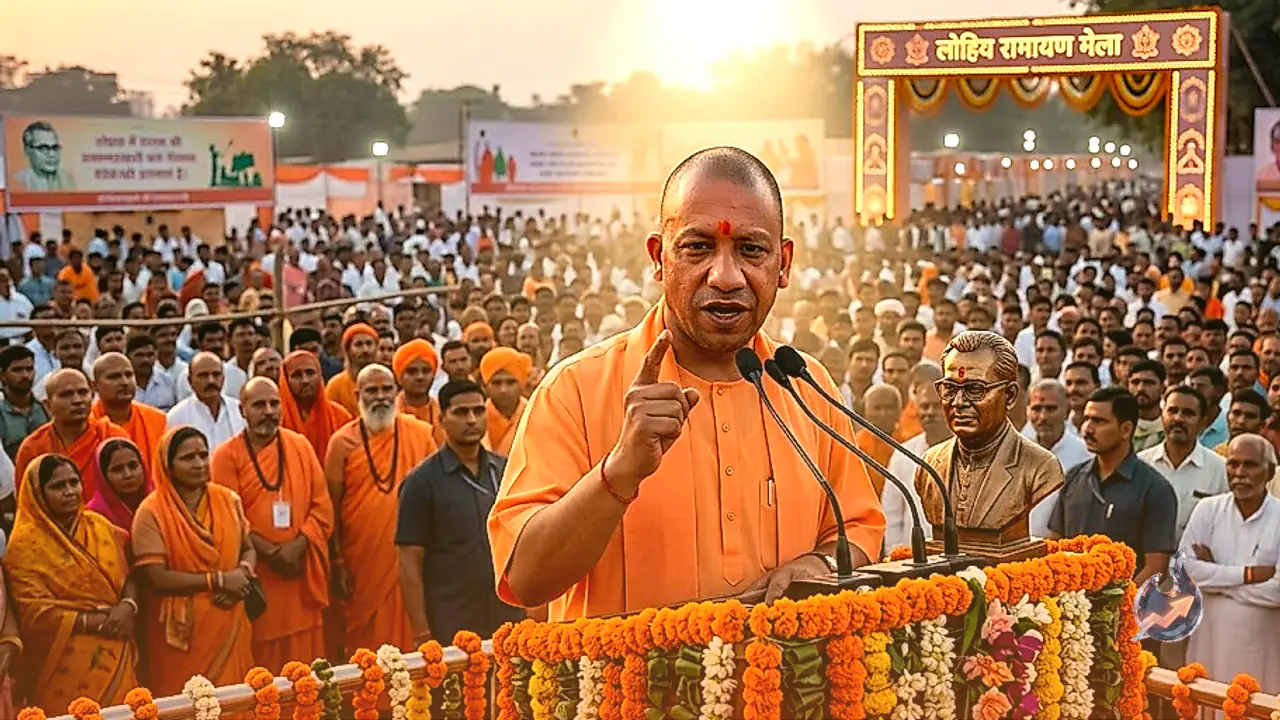

Uttar Pradesh Chief Minister Yogi Adityanath recently launched a sharp political attack on Samajwadi Party leader Akhilesh Yadav. Referencing the Ram Mandir in Ayodhya, the Chief Minister recalled that the Ramayan Mela in Chitrakoot and other regions of the state was initiated by the socialist thinker Dr. Rammanohar Lohia. Yogi Adityanath remarked that today's socialists appear to be distancing themselves from Lord Ram. However, this statement is more than just a political jibe; it is rooted in an interesting historical and cultural story that reflects the foundational ideals of Indian socialism.
Lohia as a Symbol of Cultural Unity
In the history of Indian politics, Dr. Rammanohar Lohia stands as a prominent pillar of socialism. A significant facet of his personality was his profound reverence for Lord Ram and Indian culture. Unlike the modern tendency to view religion and socialism through separate lenses, Lohia’s perspective was distinct. For him, figures like Ram, Krishna, and Shiva were not merely icons of faith, but cultural heroes capable of uniting India across various divides.
The Vision of a Ramayan Mela
Lord Ram spent the longest duration of his 14-year exile, nearly eleven and a half years, in Chitrakoot. Dr. Lohia firmly believed that Lord Ram was a heroic figure who stitched the north and south of India together through a shared cultural thread. With this vision, Dr. Lohia conceptualized the grand Ramayan Mela in 1961. His goal was to create a platform where scholars, saints, artists, and common people could come together to discuss the ideals of Maryada, equality, and brotherhood found in Ramkatha. He envisioned a festival that would inspire even those standing at the very last rung of the social ladder.
A 12-Year Journey to Reality
Dr. Lohia’s vision did not materialize overnight. It took a grueling 12-year struggle to bring the concept to fruition. During this time, local intellectuals and freedom fighters in Chitrakoot worked tirelessly. In the early stages, freedom fighter Baldev Prasad Gupta kept this ideological spark alive. Later, Babulal Garg, who eventually became the organizer of the Mela, dedicated himself to the cause to ensure it reached its destination. Whenever Dr. Lohia visited Chitrakoot, Baldev Prasad Gupta played a leading role in his hospitality and local preparations. He was often accompanied by the prominent socialist leader Raj Narain.
The Inaugural Mela in 1973
After numerous efforts and a long wait, the first grand Ramayan Mela was finally organized in Chitrakoot in 1973, with significant support from the then Uttar Pradesh Chief Minister Kamlapati Tripathi. This year was of special historical significance as it marked the 400th anniversary of Tulsidas's epic, Ramcharitmanas. The Mela was realized as part of this grand 'Manas Chaturshati' historical occasion.
The Story Behind a Rare Photograph
A simple yet fascinating incident from the preparations of the Mela remains documented in history, thanks to Baldev Prasad Gupta. Once, while Dr. Lohia and Raj Narain were in Karvi (Chitrakoot) for a meeting, it was decided to take a group photo to commemorate the historic moment. A photographer was called, but Raj Narain faced an awkward dilemma because his clothes were out for laundry. Uncertain, he asked how he should sit for the photograph in his current attire.
Dr. Lohia, in his characteristic straightforward manner, suggested that he simply wrap himself in a bedsheet and sit. Raj Narain did not hesitate at all; he draped the bedsheet over himself and posed for the photo. This historical and rare picture remained safe with Baldev Prasad Gupta for years. Later, when the task of archiving the history of the Ramayan Mela arose, it was suggested that this significant photo should be made public rather than hidden in a personal collection. Gupta gladly shared the image, and copies were handed over to Acharya Garg. The photograph was prominently featured in the Mela's souvenir, serving as a living testament to the simplicity and dedication to Lord Ram displayed by the stalwart leaders of that era.