





















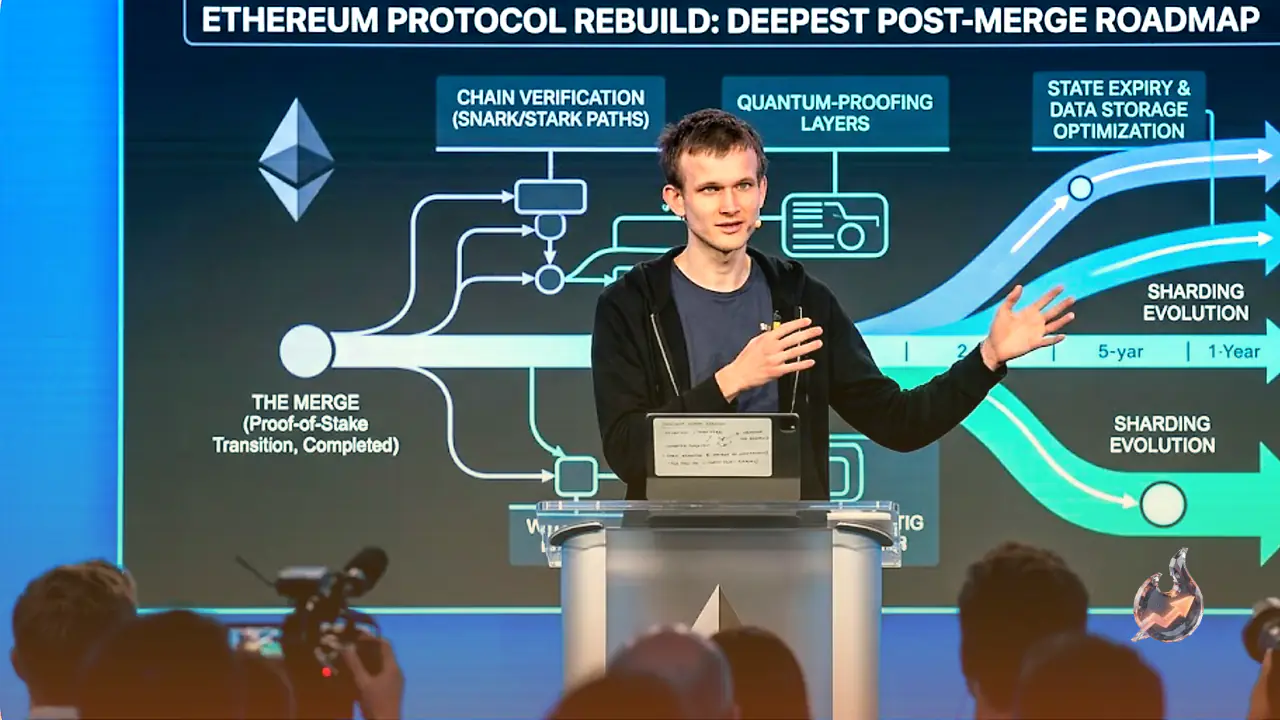

Ethereum co-founder Vitalik Buterin has set out a fresh vision for where the blockchain is headed over the next several years, describing it as the biggest rebuild since the network walked away from mining. In his words, Ethereum is now "reinventing itself."
In a tweet on Saturday, Buterin shared what he had taken away from a recent gathering of Ethereum researchers in Berlin, and released a refreshed draft roadmap, dubbed the "strawmap," published at strawmap.org. He described "Lean Ethereum," first sketched out in 2025, as the protocol's third major iteration, ranking it alongside the 2022 Merge that moved Ethereum to proof-of-stake. Nearly every major component will be replaced over the coming three or four years, he said, but existing apps will not be forced to migrate to the new setup.
Two weeks ago, Ethereum researchers came together in Berlin to keep charting the protocol's long-term direction, building on discussions with client teams held in Svalbard back in April.
How the network will check itself
The heart of the plan is a change in the way the network verifies itself. Today, every node has to re-execute every single transaction. Under the new approach, Ethereum would instead check a compact, precise cryptographic proof of the chain using recursive STARKs, a form of zero-knowledge proof that Buterin wants "enshrined" as a core piece of the protocol.
He also proposed a simpler consensus offering finality in one or two rounds, along with multidimensional gas pricing and, eventually, a move beyond the EVM toward an instruction set such as RISC-V.
Quantum safety, privacy and data storage
Buterin said the threat posed by Q-Day has moved much higher up the agenda. Anything that is cryptographically vulnerable is due to be swapped out for quantum-safe alternatives, and he noted that work on quantum-resistant "blobs" has already been under way for months.
Privacy, he wrote, is now a first-class goal rather than something bolted on afterward, and it is being built into pieces such as the mempool and the state tree from the start. The whole effort would rest on formal verification.
The most disruptive change concerns data storage. Buterin painted a picture of a 2030 network holding roughly 2TB of today's flexible "dynamic" state alongside 100 terabytes of a new type of storage. This new form would be far more scalable but also more restrictive. It would suit tokens, NFTs and much of DeFi well, though it would be less suited to complex contracts like decentralized exchanges. Rewriting an ERC-20 token onto the new storage would not be mandatory, he said, but doing so could cut its fees by more than tenfold.
The changes won't arrive all at once
Buterin stressed that none of this lands in one go. The upcoming Hegotá fork, he said, will likely be Ethereum's last before the "Lean" era begins. Ahead of that, the nearer-term Glamsterdam upgrade is expected to bring a large gas-limit increase, with further gains in capacity and speed spread across roughly five years.
The plan arrives at a difficult moment for the Ethereum Foundation itself. It recently cut 20% of its workforce and tightened its budget as part of a leaner reorganization. On top of that, earlier Ethereum upgrades repeatedly faced delays before they were finally implemented.