






















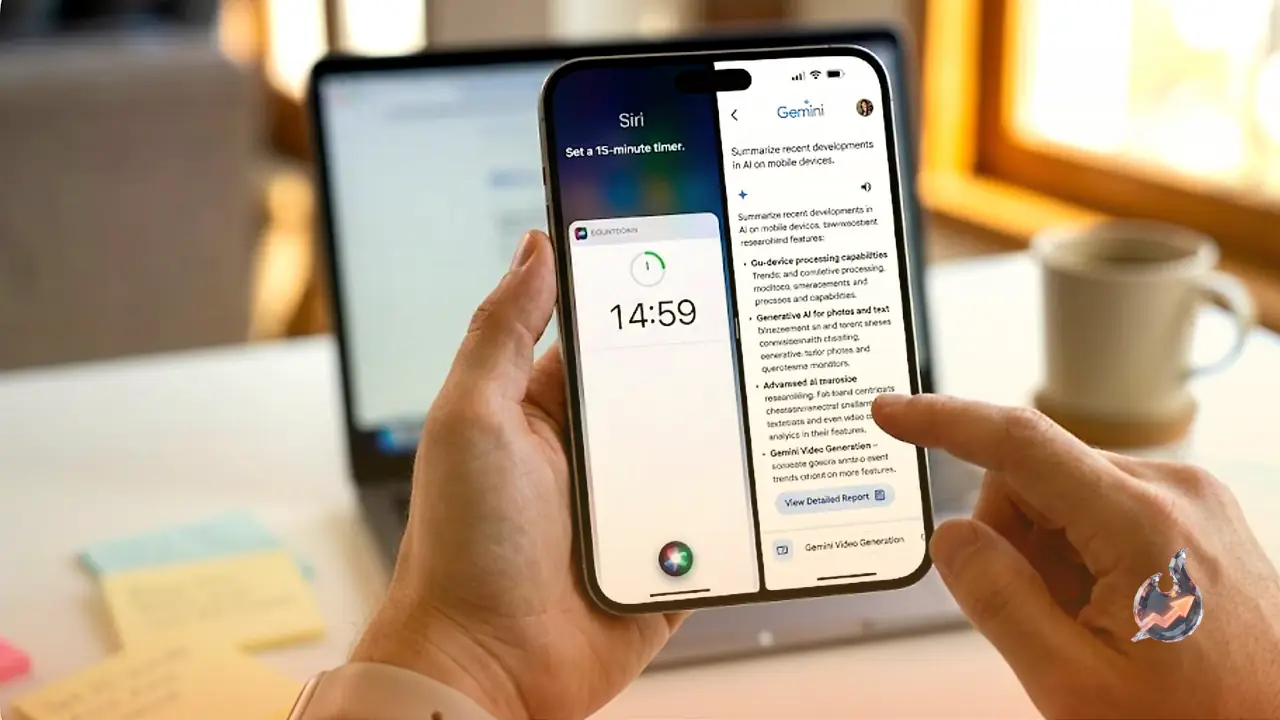

Apple's AI-powered Siri has finally reached beta testers after roughly two years of promises, though only once they clear a waitlist. With hands-on access on an iPhone 16 Pro over the past few days, the obvious question is whether this new Siri gives Apple users any real reason to skip the Gemini app altogether, especially since the very system powering Siri AI actually borrows heavily from Google's own models in the first place.
Why Siri AI invites a direct comparison with Gemini
Apple built its overhauled Siri on top of Gemini models, routing some processing to Google's servers through Apple's Private Cloud Compute setup, all while insisting that Apple's usual privacy protections still apply to that data. That shared foundation is exactly why testing Siri AI naturally turns into a side-by-side match with Gemini, the very system it owes so much of its existence to. Apple's new Clean Up tool, which is also powered by Gemini, already left a strong impression during earlier hands-on testing, even though its companion feature, Reframe, clearly still needs some polishing before it is fully usable. This comparison sticks specifically to Siri AI versus the Gemini app on iPhone, rather than every single AI feature Apple has now wedged into its native apps across the operating system. Apple has undeniably pushed Siri further than it has ever gone before, but taken as a whole, Google's assistant still comes out ahead in this matchup.
Siri AI's integration edge on the iPhone
The first big change worth addressing is how Siri AI is actually triggered on the device. It now lives directly inside Spotlight, and Apple has added a brand new gesture that overturns almost two decades of iPhone muscle memory. Swiping down from the centre of the top edge of the screen, just above the Dynamic Island, opens a new Search or Ask field. Typing a query into that field and pressing Enter runs the search immediately. The old method still works too, since holding down the Side button continues to summon Siri exactly as it always has.
A new animation plays before the response bubble expands to reveal the answer, which can be either a short block of text or structured data pulled directly from a supported app. Right now, this deep app integration only covers Apple's own apps, though Apple has said third-party app support will arrive once Siri AI moves past its beta stage and reaches a public release. Gemini has nothing quite like this built into iOS. The quickest way into Gemini on an iPhone remains the Home Screen widget, or a shortcut mapped to the Action button.
That native integration is a genuine strength for Siri AI even at this early stage. Asking it to pull up every reminder due today, list out the week's calendar events, or surface new emails from a specific sender works well for the first two kinds of requests, and iOS nicely displays visual elements straight from the Reminders and Calendar apps alongside the relevant data. Mail-related requests worked too, though not quite as well as Gemini's Gmail integration managed. Asking both assistants to pull up recent credit card statements made the gap obvious: Siri AI returned details from only one statement, while Gemini compiled the due dates and amounts across all three credit cards at once.
Siri AI answers faster and skips the fluff
The Gemini app lets users pick between three different models, Flash, Flash-Lite, and Pro, with the reasoning-heavy Pro model taking noticeably longer to respond because of the extra processing involved. Siri AI offers no such choice at all: a query simply triggers a brief working on it status message, and an actual answer usually follows fairly quickly after that.
Even though Siri AI is trained on Gemini's underlying models, Apple has clearly reshaped the experience around its own design philosophy and priorities. The result is that Siri AI often responds faster than Gemini does, and it is consistently more direct, whether the question is a simple general-knowledge query or something that needs a bit of web research to answer properly. Gemini's answers have always tended to run a little long, spending tokens on preamble before actually getting to the point, and Siri AI simply skips all of that padding.
Most of the time, the new Siri answers in a single paragraph, and crucially, that one paragraph actually contains the real answer rather than a lead-up to it. Swiping down on the floating response window expands it further and opens the full Siri AI app, which tends to offer more context and more options than the compact bubble does. Like Gemini, Siri AI also backs up its answers with sources, though the two handle citations quite differently: Siri AI lists every single source at the bottom of its response, while Gemini links sources inline within the body of the text, and sometimes skips providing any sources at all.
Where Gemini still pulls ahead: deep research
Siri AI, at least in its current form, simply isn't built for in-depth research the way Gemini's Pro models are, since Gemini excels at pulling together information and step-by-step guides sourced from Google searches. Asking both assistants to help find a suitable laptop for a dental practice made this particular gap very clear.
Both assistants correctly identified the key requirements for the job: a powerful processor along the lines of an AMD Ryzen 7, at least RTX 4050 graphics to comfortably handle the GPU-heavy dental scanning software, and 16GB RAM to keep everything running smoothly. But when asked to actually suggest specific laptop models, Siri AI did the bare minimum, offering only a handful of popular global options with no real consideration for what is actually available in India. Gemini, by contrast, surfaced options that are genuinely sold in India, complete with pricing details and links to purchase them.
A similar test involved asking both assistants for hamstring stretches to try after finishing a workout. Siri AI responded with nothing more than a set of web images at first, and only offered actual stretches to attempt after being pushed further with follow-up prompts. Gemini's Flash model, on the other hand, delivered a detailed breakdown complete with example images right from its very first response, with no extra prompting required.
Gemini remains the more complete overall package
Taken as a whole, Gemini still comes across as the fuller product of the two. It lets users organise conversations into dedicated notebooks, run deep research sessions, generate videos, and handle a wide range of other tasks well beyond simple question-answering. Siri AI, by design, stays narrower and far more focused, delivering to-the-point answers that are often wrapped in a genuinely well-designed interface, such as when it displayed the timing for an upcoming F1 race alongside the full starting grid in a slick, purpose-built visual layout.
That narrow focus is exactly where Apple's assistant shines brightest: securely pulling data out of Apple's own apps, answering questions about current events, or handling the kind of pointed factual questions people would usually type straight into Google search. Siri AI gets these mostly right, and quickly, but that is also roughly where its usefulness runs out for now. Anyone wanting detailed shopping comparisons, deep research on a broader topic, or generated visualisations still needs to open the Gemini app instead of relying on Siri AI. Siri AI remains in beta testing, so its capabilities could well expand over time, but Apple hasn't indicated any plans yet to bring Gemini-style features like notebooks or video generation into its own assistant, which keeps Gemini firmly in the lead for the time being.