





















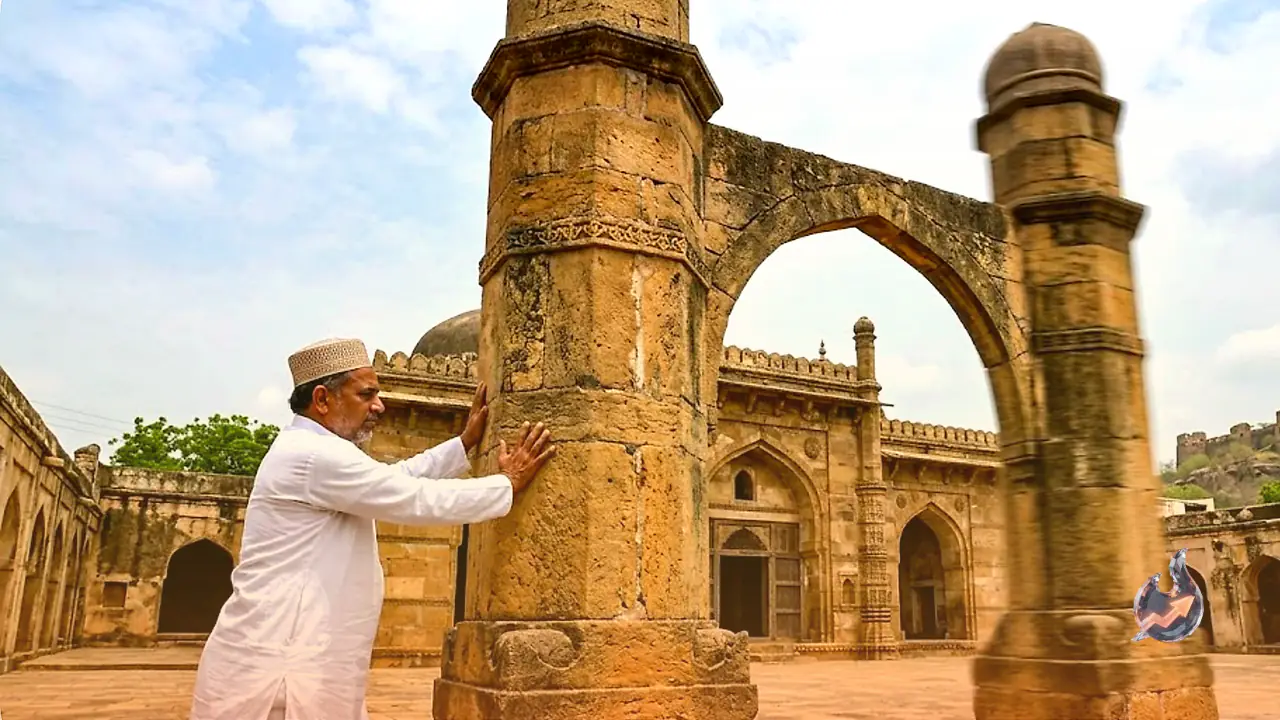

Near the Elgandal fort in Telangana's Karimnagar district stands a centuries old mosque whose two minarets still puzzle scientists and engineers today. If someone gently shakes one minaret, a distinct vibration can be felt in the other minaret within moments, even though the main structure connecting the two remains completely steady throughout. This unusual feature places the mosque among the country's most mysterious historical structures.
A witness to the Qutub Shahi and Asaf Jahi era
This two minaret mosque stands barely a kilometre from the well known Elgandal fort and is protected by the Archaeological Survey of India, or ASI. It was built during the era of the Qutub Shahi and Asaf Jahi rulers, so its walls clearly carry the political and cultural imprint of that period. In terms of architectural style, the structure closely resembles Hyderabad's famous Charminar and stands as a living example of the fine craftsmanship of its time. That is precisely why tourists, historians and researchers from India and abroad travel here to see it.
Minarets with narrow, spiral staircases
The mosque's biggest identifying feature is its two grand and fairly tall minarets. Built in keeping with medieval Indian architecture, the interior of these minarets is extremely narrow and crafted with great artistic detail. To reach the top of a minaret, stones were carved with remarkable precision to form circular, spiralling staircases. As a visitor climbs through these tight passages and reaches the top, beautiful jharokhas, or ornamental windows, open up sweeping views of the historic Elgandal fort on the hill opposite and the natural landscape around it.
The mystery of the swinging minarets and ancient earthquake proof engineering
Locals call these minarets the swinging minarets because of this very quality. When a person goes to the upper portion of one minaret and shakes it lightly, a clear vibration begins to be felt in the other minaret within moments. What is most surprising is that the main structure joining the two minarets remains completely stable throughout, showing no movement at all. It is believed that medieval era craftsmen developed this as a form of earthquake resistant technique, designed to protect the building from damage during an earthquake like disaster. This scientific understanding reflects the extraordinary intelligence of the artisans and engineers of that period, and it continues to leave modern science thinking hard about how it was achieved.
A long history from the Kakatiya kings to the Nizams
The mosque has witnessed a long and turbulent history of shifting powers, from the Kakatiya kings to the Qutub Shahi sultans and on to the Nizams of Hyderabad. That is why the structure remains a centre of deep interest and fascination for researchers and history lovers even today. The administration has declared it a protected monument so that future generations can properly experience India's unmatched historical heritage, rich culture and ancient scientific ingenuity.