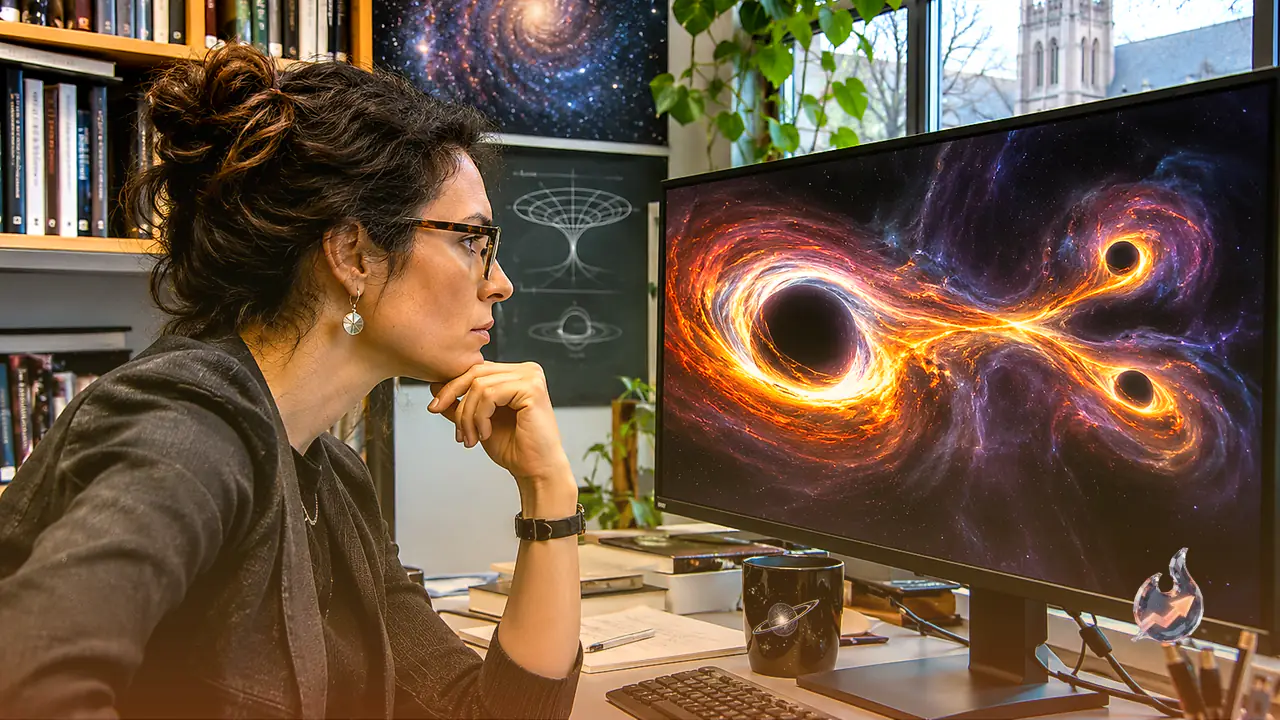

In modern astrophysics, black holes have long been understood as absolute gravitational sinks capable of swallowing surrounding dust clouds, wandering stars, and even light itself. Standard astronomical models demonstrate that when two or more black holes draw near in the cosmos, their intense orbital dance inevitably causes them to collide, merge, and forge a single, far more massive entity. Yet theoretical physicists have long pondered whether this dramatic evolutionary track could ever reverse itself under extreme circumstances. A central question remains whether a solitary, fully formed black hole could destabilize and fragment into two or more distinct smaller remnants. A mathematical analysis published on October 22 in the journal Physical Review D explores this scenario, evaluating whether the core tenets of physics can ever permit such a rupture under precise geometric configurations.
The Mathematical Concept of the Pair of Pants Topology
To characterize the hypothetical fragmentation of a black hole, the researchers employed a structural analogy termed a pair of pants. Within theoretical physics, this terminology does not imply that an astrophysical body literally rips along fabric seams. Instead, it serves as a classical topological illustration borrowed from geometry to map how the continuum of spacetime might alter its connectivity over time. Just as the single waist of a garment divides into two independent legs, the mathematical geometry examines whether a single unified boundary can smoothly transform into two disconnected boundaries. The investigation probed whether the flexible fabric of spacetime could theoretically support a transition that divides an isolated gravitational field into multiple distinct centers of mass.
The Barrier of the Event Horizon and Its Division
At the heart of every black hole sits the event horizon, defined as the outer perimeter of causal disconnection. It marks the ultimate point of no return beyond which the escape velocity exceeds the speed of light, ensuring that matter and radiation are permanently trapped within the interior. In their theoretical framework, the researchers tested whether certain physical forces could cause this continuous boundary to stretch, narrow, and ultimately separate into two or more isolated horizons. Should such an event occur, a single progenitor black hole would effectively split into multiple smaller progeny. Within ordinary, unperturbed celestial space, however, such a split encounters insurmountable theoretical objections rooted in two fundamental barriers of classical physics.
The Law of Entropy and Hawking Area Theorem
The primary theoretical barrier preventing an isolated black hole from cleaving apart is the second law of thermodynamics, specifically the principle governing entropy. In physical systems, entropy represents the measure of energy dispersion, unavailable work, and microscopic disorder within a closed environment. A core law of the physical universe dictates that the total entropy of an isolated system cannot spontaneously decline over time. When applied to gravitational physics, Stephen Hawking demonstrated in his foundational area theorem that the total surface area of a classical black hole cannot decrease during any physical process. If a stationary, non-rotating black hole were to divide into two separate pieces, the combined surface area and associated entropy of the resulting parts would fall below the required threshold, violating this inviolable cosmic rule. Consequently, under normal and tranquil astrophysical conditions, spontaneous division appears entirely impossible.
Overcoming Mutual Gravity Through Near-Limiting Spin Rates
The second major physical hurdle involves the staggering gravitational attraction between the newly created masses. Even if an anomalous cosmic event managed to split a black hole into two neighboring horizons for a fraction of a second, their overwhelming gravitational attraction would immediately draw them back together, prompting a near-instantaneous merger back into a single unit. However, theoretical physicist Manuel Del Piano from the University of Southern Denmark and his co-researchers identified a viable mathematical loophole. The researchers demonstrated that the barrier could be circumvented if the parent black hole is spinning at an extraordinarily violent rate. According to Albert Einstein’s general theory of relativity, there exists an absolute upper speed limit for rotational velocity. Manuel Del Piano pointed out that if a black hole spins exceptionally close to this theoretical maximum threshold, its centrifugal effects and extreme frame dragging can significantly counteract gravitational attraction. Under such extreme dynamics, the two emergent horizons could acquire sufficient kinetic energy to fly apart and avoid recombining.
Higher Dimensional Models and the Physics of Black Strings
The research team also pushed their calculations beyond our familiar four-dimensional world to investigate how gravity behaves in hypothetical spaces with additional dimensions. In conventional human reality, physical movement across three spatial directions combined with the progression of time creates four spacetime dimensions. Yet advanced frameworks in high-energy theoretical physics postulate the existence of extra spatial dimensions that remain hidden. In such multidimensional environments, the behavior of gravity shifts dramatically, and the conventional constraints placed on black hole rotation no longer apply in the same manner. The study highlights the concept of a black string, wherein a spherical black hole stretches out along an additional dimension into an elongated cylinder or cord. Mathematical simulations show that such an extended structure can undergo severe instability, breaking apart into a series of smaller black hole spheres resembling beads on a fractured necklace. Furthermore, the presence of exotic matter distributions or heavily corrugated, irregular horizon boundaries could similarly induce structural rupture.
Primordial Remnants and Future Observational Windows
According to the published analysis, minuscule primordial black holes forged during the violent, high-density epoch of the early universe were far more susceptible to fragmentation than the supermassive monsters anchoring modern galaxies. The scientists estimate that such tiny primordial entities could potentially shatter into fragments small enough to completely evaporate across cosmic epochs via Hawking radiation. In coming decades, advanced deep-space gamma-ray telescopes and next-generation spaceborne gravitational wave detectors might be capable of hunting for the subtle spectral signatures and burst profiles generated by these extreme events. Nevertheless, the researchers stress an essential caveat: this theoretical work does not prove that black holes actually break apart in nature. Instead, it merely identifies the narrow mathematical edge cases where the laws of nature might theoretically permit it. Manuel Del Piano compared this principle to an ordinary drinking glass. The entropy of a shattered glass scattered across a floor is vastly greater than that of an intact glass resting on a counter, yet this physical reality does not cause the glass to spontaneously shatter without an external force.