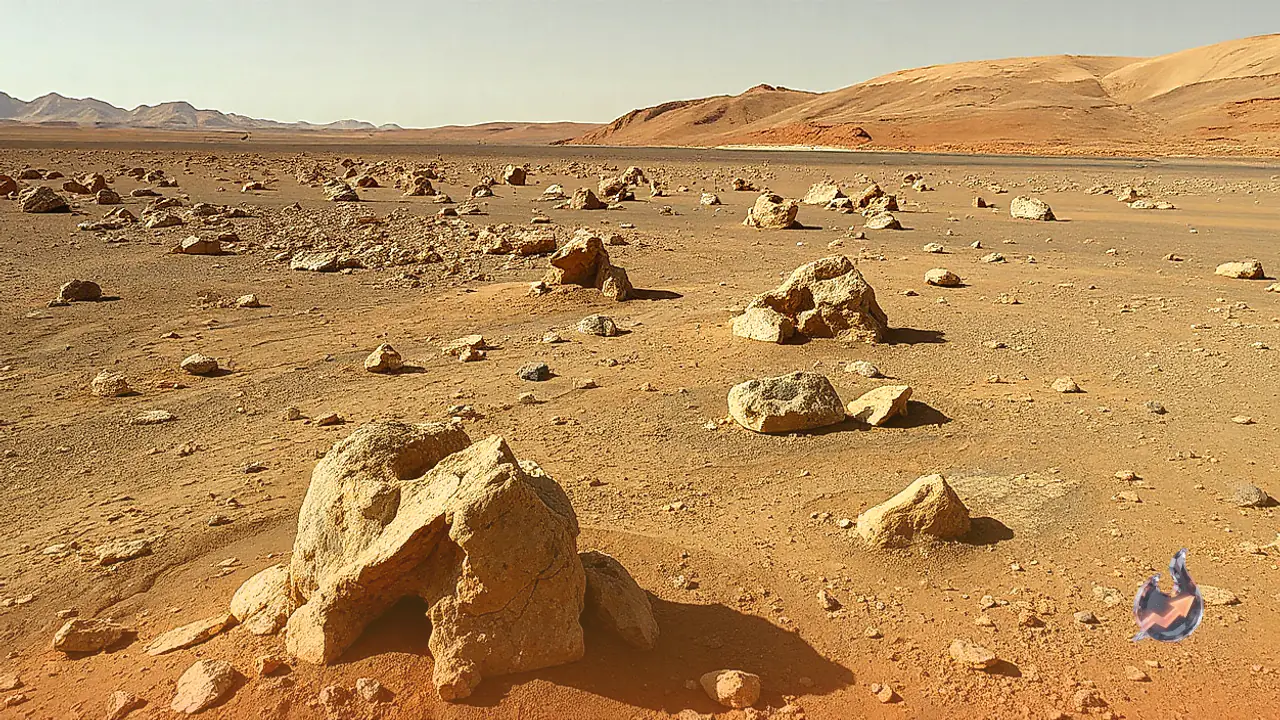

A peculiar Martian mystery has recently captured the intense attention of researchers studying the red planet. While examining surface imagery from a specific region, mission scientists spotted unusual rock formations that bear a striking resemblance to crunchy potato chips. Some of these structures appear slightly twisted, while others are curved and embedded directly into the surrounding bedrock. This fascinating discovery has sparked immense curiosity within the scientific community as researchers attempt to figure out how these odd shapes formed and what materials compose them. NASA officially detailed these formations through an agency blog post on November 11. These bizarre structures were located in a Martian area that scientists have named Nazca. The Curiosity rover traveled to this specific site recently to gather rock samples and conduct detailed geological assessments.
The Enigma Behind the Chip-Like Shapes
The robotic rover has been actively exploring the Martian terrain since 2012. Throughout this lengthy mission, it has captured countless photographs of the planetary surface, rocks, and various geological features. However, the formations discovered in the Nazca zone have proven particularly intriguing. According to the space agency, rocks within this designated area display spherical disk-like crystals. Several of these formations are twisted and warped to such a degree that researchers directly compared them to potato chips. Photographic evidence reveals that these strange structures are firmly trapped deep inside the rock matrix.
The primary question perplexing scientists is why these formations developed such a distinct shape. Researchers are working to determine whether they formed from specific minerals or if ancient water activity and natural environmental changes on Mars shaped them over time. Currently, NASA has not confirmed the exact origin behind these structures. The primary objective for the agency is to thoroughly examine their composition and chemical makeup first.
Rover Drilling and Laboratory Analysis
To uncover the truth behind these formations, the Curiosity rover utilized its drill on a rock within the Nazca site. The mechanical drill successfully bored a hole into the rock to extract an internal sample. This collected sample was then transferred directly to an onboard laboratory known as Sample Analysis at Mars, or SAM. This sophisticated lab is capable of identifying various chemicals and elements present within Martian samples. Such testing helps scientists determine the precise elemental makeup of the rock.
Additionally, the rover is equipped with a specialized instrument called ChemCam. This device utilizes an integrated laser to perform remote chemical analysis on rocks and other surface targets. Scientists have also planned to use this instrument to examine another crystal-like structure named Colca.
Nighttime Imaging and Ongoing Journey
The exploration plan extends far beyond standard sample collection. A camera mounted on the robotic arm of the Curiosity rover, known as MAHLI, is scheduled to capture nighttime images of these unusual formations. This imaging process utilizes both white light and ultraviolet LED illumination. Such specialized lighting allows researchers to closely inspect the surface textures and fine structural details of the objects. The rover follows a daily schedule designed to investigate multiple different rock targets. This routine examination included the crystal-like formations, a hard rock layer, and a small dark rock nearby. Once all scheduled investigations concluded, the Curiosity rover was scheduled to move onward from the Nazca area and continue its journey southward.
Broader Discoveries Across the Solar System
The investigation into these bizarre Martian features coincides with wider searches for new cosmic objects across the solar system. Last month, astronomers utilizing the Vera C. Rubin Observatory in Chile discovered a potential dwarf planet located far beyond Pluto. This candidate object received the designation 2026 ED138. Preliminary estimates suggest its diameter could range between roughly 370 and 930 miles. If astronomers officially confirm this discovery, it would rank among the largest dwarf planets found in the distant reaches of the solar system.