




















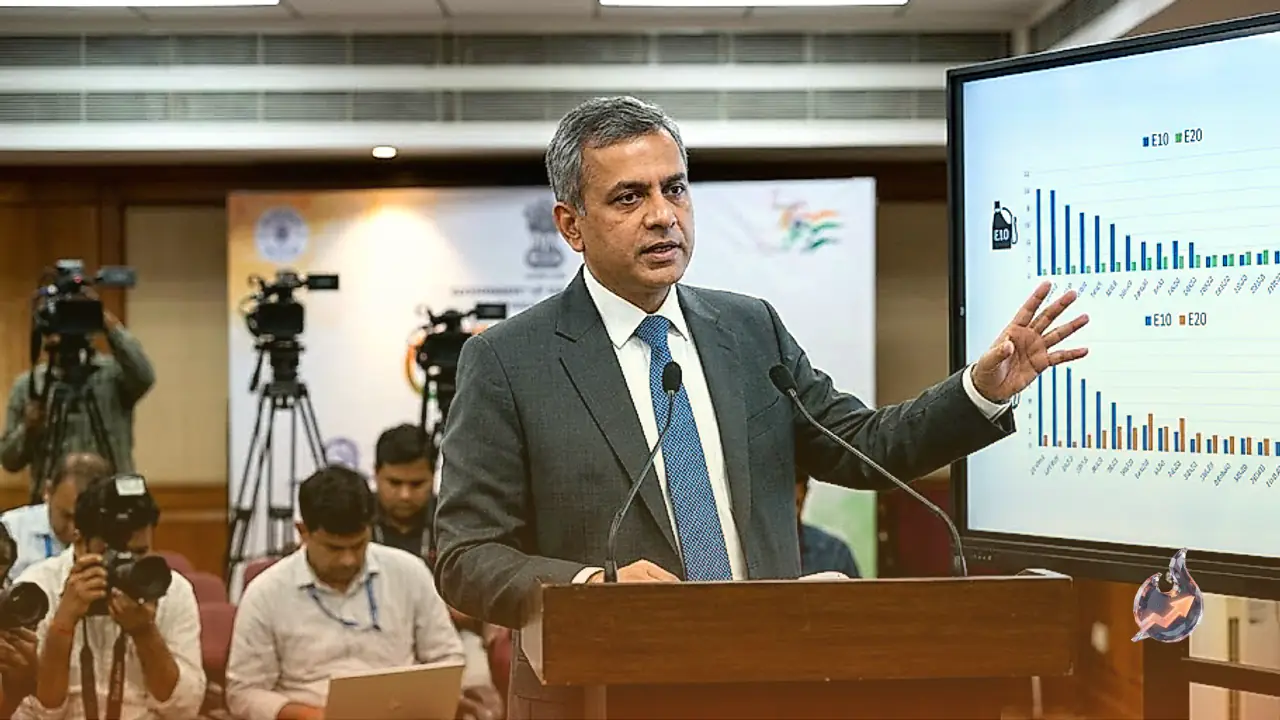

The Ministry of Petroleum and Natural Gas has issued a detailed clarification addressing widespread social media claims regarding ethanol-blended petrol (E20). Government officials emphasized that allegations about E20 fuel causing engine damage, internal corrosion, or premature component wear are completely misleading and unfounded. The clarification is backed by extensive scientific research, empirical service data from leading automakers, and years of real-world operational experience across Indian roads.
Service Data from 30 Crore Vehicles Rebuffs Damage Claims
Addressing public concerns over vehicle safety, government figures reveal that fuel with ethanol blending above E15 has been distributed nationwide for the past three and a half years, while E19 and E20 blends have been used extensively for the last two and a half years. Throughout this extended period, there has been no verified report of widespread engine failures, mechanical breakdowns, or vehicles stalling due to ethanol content.
Claims suggesting that vehicles manufactured before 2023 cannot operate on E20 petrol or that nearly 30 crore vehicles would be rendered obsolete have been firmly rejected. Ethanol blending in India has been implemented progressively over more than a decade. The average blending ratio stood at just 1.53% in 2013-14 and steadily rose to reach 20% in the 2025-26 fiscal year. With approximately 8 crore vehicles refueling at petrol pumps across the country daily, real-world data demonstrates seamless transition and performance.
Automaker Field Studies Show No Corrosion or Component Failure
To verify the impact of E20 on older vehicles, a major automobile manufacturer conducted an in-depth analysis of servicing records for 2.84 crore vehicles during the 2025-26 fiscal year. Among these, nearly 1.5 crore vehicles were originally non-E20 certified models. Despite their non-certified baseline status, the comprehensive service analysis uncovered zero evidence of rust formation, abnormal component wear, or reduced engine lifespan attributable to E20 fuel.
Similarly, a study carried out by another vehicle manufacturer evaluated 1.4 crore E20-driven vehicles, yielding identical findings with no recorded fuel-related defects. Official figures highlight that more than 20 crore two-wheelers and over 3 crore petrol passenger cars have successfully run on E15 and E20 fuels in recent years. Had E20 caused actual damage, the automotive sector would have faced millions of engine failures, massive warranty claim spikes, and urgent recall campaigns, none of which materialized.
Automakers Express Public Support and Deny Regulatory Pressure
Addressing allegations that vehicle manufacturers oppose E20 or were pressured by regulators, the government referenced a joint press conference held on 4 July 2026 by the Petroleum Ministry, the Ministry of Heavy Industries, and the Ministry of Road Transport and Highways. Senior representatives from Toyota Kirloskar, Maruti Suzuki, Hero MotoCorp, Hyundai, TVS Motor, and Bajaj Auto attended the briefing to publicly endorse the national E20 rollout.
During the event, executives from Maruti Suzuki confirmed that internal service analytics showed no extra defects or failures resulting from E20 usage. The ministry dismissed claims of government coercion as groundless, pointing out that automakers are independent, publicly listed corporations. If E20 caused widespread damage, these manufacturers would not certify vehicles for E20 or issue full factory warranties. Their endorsement stems from rigorous engineering tests and empirical field data rather than regulatory mandates.
Impact on Mileage vs Performance and Anti-Knock Benefits
Regarding concerns about reduced fuel efficiency, the ministry clarified that vehicle mileage is influenced by numerous factors, including traffic conditions, individual driving habits, routine servicing, tire pressure, and air conditioner usage. While older E10-era vehicles might experience a minor mileage drop ranging between 3% and 3.5% when running on E20, social media claims of drastic efficiency losses are inaccurate.
Furthermore, the government highlighted several technical advantages of E20 petrol that offset minor efficiency variations. Higher ethanol concentration elevates the fuel's octane rating, enhancing anti-knock capabilities, promoting cleaner combustion, reducing tailpipe emissions, and improving overall engine responsiveness.
Rigorous Technical Testing Preceded E20 Implementation
Rebutting claims that E20 regulations were introduced without adequate validation, the government confirmed that extensive technical testing and multi-stakeholder consultations took place prior to the rollout. The evaluation process involved active participation from automobile manufacturers, the Society of Indian Automobile Manufacturers (SIAM), the Automotive Research Association of India (ARAI), auto component makers, accredited testing agencies, and state-owned oil marketing companies.