





















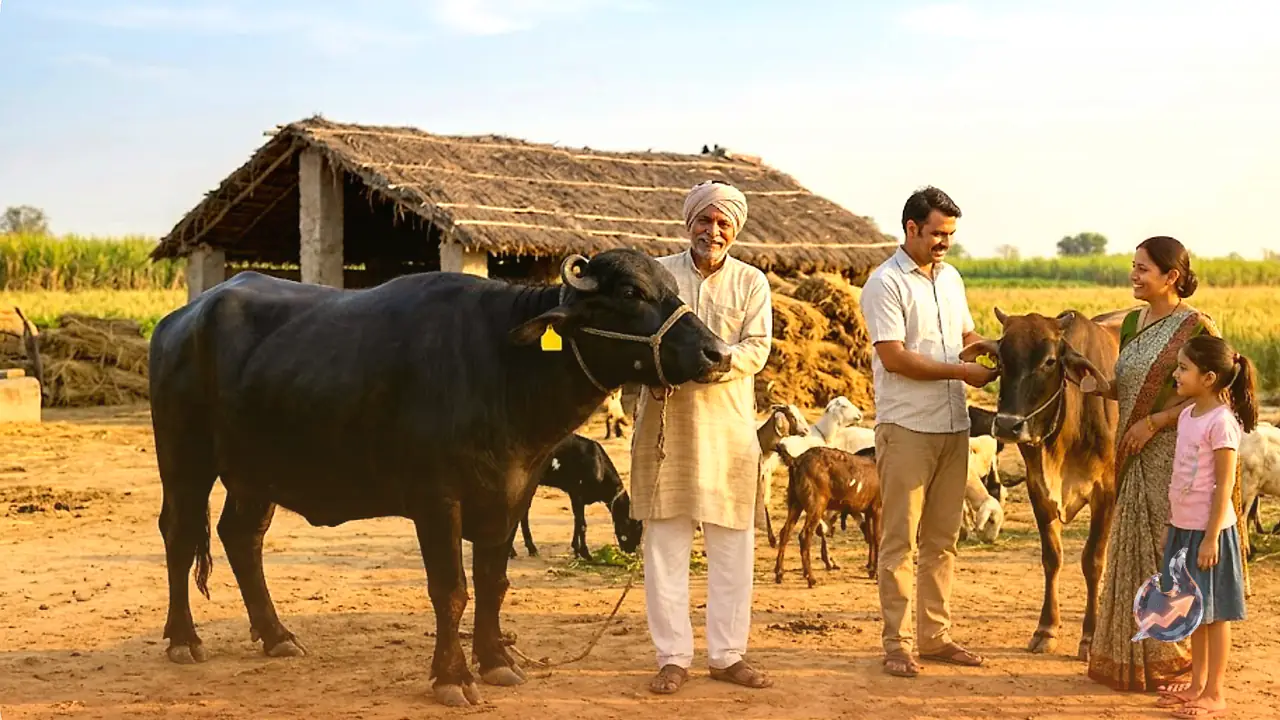

Farmers and dairy owners in Uttar Pradesh have a fresh reason to cheer after the state cabinet cleared 27 proposals in a meeting held on Monday, one of which puts real money back in the pockets of livestock keepers. With that approval, the CM Risk Livestock Insurance Scheme now stands rolled out across the entire state. Cabinet minister Dharampal Singh said the same meeting also approved several other proposals covering breed improvement of animals, wider insurance coverage and promotion of indigenous cattle.
How much compensation for which animal
Once the proposal was cleared, the payout amounts under the scheme were also finalised. If a farmer's Murrah buffalo dies from an accident or disease, the payout is Rs 75,000. A desi cow's death brings Rs 40,000, a goat or sheep's death brings Rs 6,500, and a horse's death brings Rs 60,000. This entire amount is to reach the farmer within a month of the animal's death. The government has made it clear, though, that the policy does not cover stray animals roaming the streets, meaning the payout applies only to owned, insured animals.
Government's share in the premium
The biggest draw of the scheme is how little the farmer actually has to pay out of pocket. The government bears 85 percent of the total premium, split between a 51 percent contribution from the central government and 34 percent from the state government. The remaining 15 percent is what the beneficiary farmer pays. In the first year, general category farmers get a subsidy of up to 50 percent on the premium, while Scheduled Caste and Scheduled Tribe beneficiaries get relief of up to 70 percent. In the second and third years too, the government continues to subsidise the premium based on the farmer's category. Farmers can choose to insure their animals for either a one year or a three year period.
Which animals are covered
The CM Risk Livestock Insurance Scheme is not limited to cows and buffaloes. It also covers goats, sheep, pigs, horses, camels, donkeys, mules and other pet animals. The insured amount is fixed based on the animal's actual market value, so that the compensation reflects what the animal was really worth. Each family can insure a maximum of five large animals or fifty small animals, amounting to five cattle units. The government's reasoning is that this cap will let the scheme's benefit reach as many families as possible rather than being concentrated with a few large owners.
When a claim is paid, and when it isn't
If an animal dies from disease, an accident, a lightning strike, fire, flood or another natural disaster, the insurance company pays out the fixed amount as per the rules. Even in cases of theft, if the animal's death is later proven, a claim can still be paid according to the rules. However, compensation is denied if the farmer deliberately harmed the animal, if the animal was already sick before the insurance period began, if false information was given while taking the policy, if the animal had a pre-existing serious illness, or if any other term of the insurance was violated.
Money goes straight to the bank account
Once a claim is approved, the full amount is transferred directly into the beneficiary farmer's bank account, cutting out any middlemen. The government says the scheme is meant to protect farmers' earnings, encourage animal husbandry as a livelihood, and cushion the financial blow of an animal's sudden death. Taken together, the decision is welcome news for the lakhs of families across Uttar Pradesh whose daily income depends on their cattle, buffaloes and other livestock.