























Singapore's economy is carrying strong momentum into the second quarter of 2026, and much of the credit goes to surging worldwide demand for electronics tied to artificial intelligence. DBS economists Radhika Rao and Mo Ji forecast that the advance estimate for second-quarter GDP will show growth of 5.8% year-on-year and 1.5% quarter-on-quarter on a seasonally adjusted basis. That pace is slightly softer than the first quarter, yet it is still viewed as remarkably resilient.
According to the economists, this strength is not confined to a single corner of the economy. Manufacturing has picked up speed, wholesale trade has held firm, modern services have kept their momentum, and a building boom has propped up domestic demand. The clearest signal of all is showing up in the country's export numbers, which are on track to grow at a double-digit rate for the fourth month in a row.
Manufacturing and Wholesale Trade Fire Up
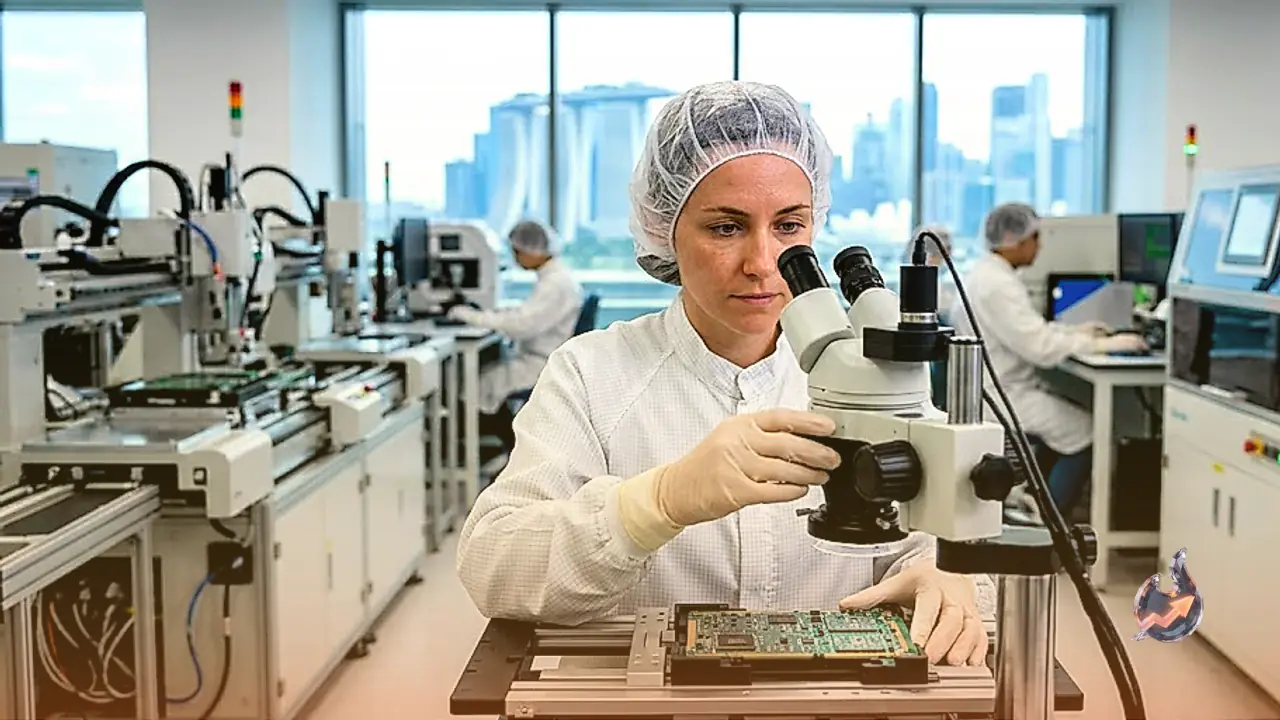
Rao and Ji noted that manufacturing accelerated over the quarter. Wholesale trade eased a touch, but even so the sector delivered a solid performance. The biggest driver was the powerful global appetite for AI-related electronics. As companies and data centres pour money into expanding their AI capacity, demand for chips and electronic components has climbed, and a manufacturing and trading hub like Singapore is reaping the direct benefit.
In their words, "Manufacturing accelerated, while wholesale trade performed well despite some moderation, driven by robust global demand for artificial intelligence (AI)-related electronics."
Services and Construction Anchor Domestic Demand
The economy also drew internal strength from services and construction. Modern services stayed resilient, helped in large part by continued momentum in the financial sector. Securities trading activity ramped up and credit growth quickened, both of which pushed the sector forward.
The economists said, "Modern services remained resilient, supported by continued momentum in the financial sector, as securities trading activity and credit growth picked up." They added that "the ongoing construction boom also underpinned domestic resilience." In other words, the steady flow of building and infrastructure projects across the city-state has given the economy a stable base.
Exports Stay Hot, but Cooler Than May
The most eye-catching figure is non-oil domestic exports, or NODX. The economists expect it to grow at a double-digit rate for the fourth straight month. That said, the pace has clearly cooled compared with May. They see NODX rising 25.0% year-on-year in June, down from 38.4% year-on-year in May.
As they put it, "We see Singapore's non-oil domestic exports (NODX) growing at a double-digit rate for the fourth consecutive month, albeit at 25.0% yoy in June, compared with 38.4% yoy in May." Even with that slowdown, staying in double digits shows that external demand for Singapore-made goods remains healthy, even as the sharp jumps of earlier months begin to normalise.
What It Means Going Forward
The broad picture is of a Singapore economy showing strength on several fronts at once, from factory output to financial services to a busy construction sector. Despite the mild deceleration from the first quarter, a 5.8% annual growth rate is a robust reading for any developed economy.
The economists also suggest that while export growth may be slowing, Singapore's manufacturing and trade sectors should keep benefiting as long as demand for AI electronics stays strong. That leaves investors and businesses watching the full second-quarter data and the coming months' export trends closely.