




















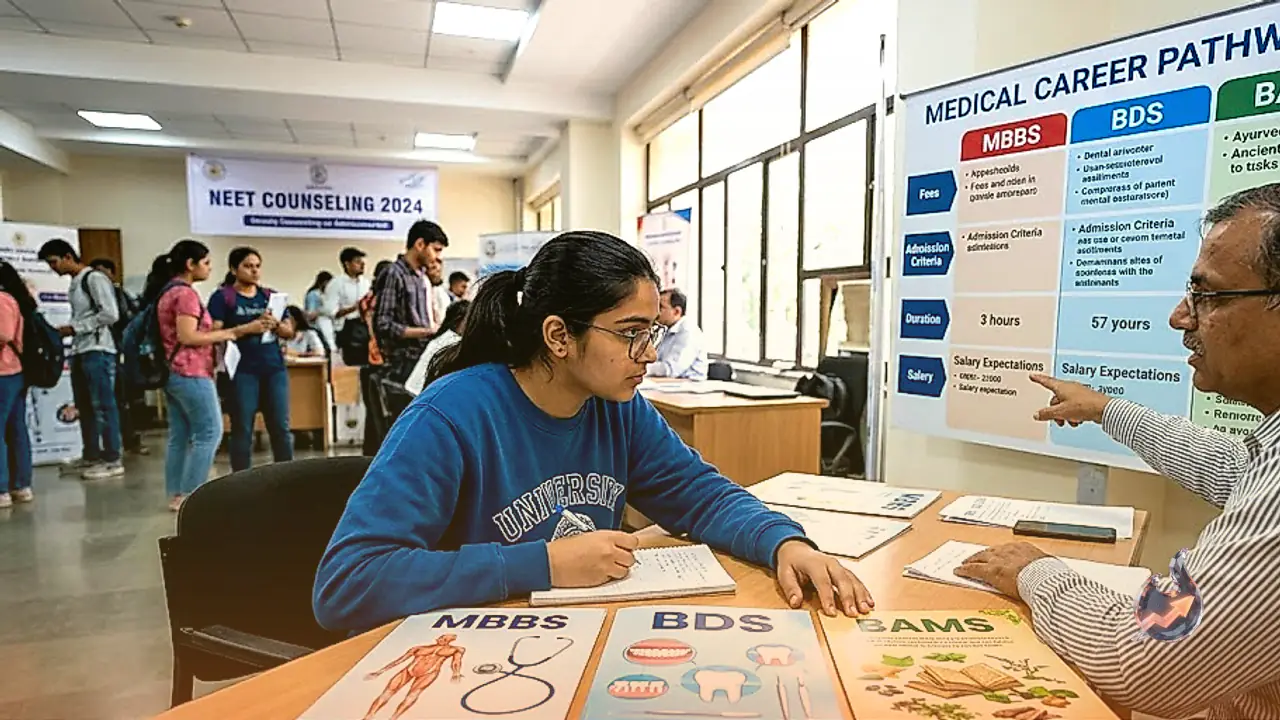

Every year, hundreds of thousands of medical aspirants sit for the NEET UG examination with aspirations of becoming doctors. Once the entrance examination results and cutoff ranks are announced, candidates often encounter a crucial decision regarding which medical branch to pursue. For candidates securing top percentile ranks, MBBS remains the undisputed primary choice. However, when score cutoffs fall slightly short of securing a seat in a preferred government college, candidates actively evaluate BDS or BAMS alternatives. Making an uninformed decision under time pressure can impact long-term professional satisfaction. A common misconception suggests that dental surgery lacks future scope, or that studying Ayurveda does not offer the credentials of a medical practitioner. In reality, all three healthcare disciplines possess distinct academic structures, specialized clinical training, and rewarding career trajectories.
Fundamental Differences in Medical Disciplines
MBBS stands for Bachelor of Medicine, Bachelor of Surgery. This discipline is grounded in modern allopathic science, focusing on human anatomy, disease pathology, internal medicine, and surgical interventions. BDS stands for Bachelor of Dental Surgery. This program specializes strictly in oral healthcare, focusing on the diagnosis, prevention, and surgical management of conditions affecting the teeth, gums, and jaw architecture. BAMS stands for Bachelor of Ayurvedic Medicine and Surgery. This stream incorporates traditional Indian Ayurvedic systems, pharmacology, and Panchakarma therapies alongside core modules of modern medical science and basic surgery.
Eligibility Criteria and Admission Process via NEET UG
The academic eligibility requirements across all three medical undergraduate degree programs remain uniform. Candidates must pass Class 12th with Physics, Chemistry, and Biology (PCB) as core subjects, obtaining an aggregate score of at least 50%. Additionally, securing a qualifying score in the NEET UG examination is mandatory for admission. MBBS commands the highest NEET cutoff scores and top percentile rankings. BDS serves as the secondary preference for many candidates, accepting slightly lower qualifying cutoffs. BAMS admissions also require clearing NEET, though the cutoff score requirements are relatively flexible compared to MBBS and BDS.
Course Duration and Financial Investment Comparison
While the total academic timeline for these degrees is fairly comparable, significant variations exist in tuition fee structures between government and private institutions. The MBBS program spans a total duration of 5.5 years, comprising 4.5 years of academic coursework followed by 1 year of compulsory internship. Annual tuition fees in government medical colleges range between 20,000 and 1,00,000 rupees, whereas private medical college fees range from 50 lakh to 1 crore rupees for the complete degree. The BDS degree covers a total duration of 5 years, consisting of 4 years of academic study and 1 year of internship. Tuition fees in government dental colleges remain minimal, while private dental institutions charge between 15 and 35 lakh rupees. The BAMS course requires 5.5 years to complete (4.5 years of study plus a 1-year internship), with total private college fees ranging from 10 to 25 lakh rupees.
Curriculum Design and Core Academic Focus
The MBBS curriculum delivers extensive training in allopathic pharmacology, human anatomy, biochemistry, clinical pathology, gynecology, and general surgery. The BDS curriculum places dedicated emphasis on oral pathology, craniofacial surgery, orthodontics, periodontics, and modern dental surgical techniques. The BAMS curriculum combines classic Ayurvedic literature such as the Charaka Samhita and Sushruta Samhita with modern physiology, anatomy, herbal pharmacology, and Panchakarma practices.
Career Trajectories and Professional Opportunities
MBBS graduates enjoy broad career pathways. They can start as Junior Residents or Medical Officers in clinical establishments and subsequently complete MD or MS postgraduate qualifications to work as specialist consultants or surgeons. BDS graduates find opportunities as Dental Surgeons or Orthodontists in clinical settings, though opening an independent dental practice is widely regarded as the most profitable long-term avenue. BAMS graduates can practice as Ayurvedic Physicians, Research Officers, or Health Consultants, or establish independent Panchakarma wellness centers. The growing global interest in preventive medicine and holistic wellness has expanded professional scope for BAMS practitioners.
Starting Salary Expectations and Financial Potential
The starting monthly salary for an MBBS doctor ranges from 60,000 to 1,00,000 rupees. Upon completing MD or MS specializations, monthly remuneration advances into several lakhs of rupees. BDS graduates employed in hospital environments receive initial monthly salaries between 25,000 and 45,000 rupees; however, income potential grows substantially once a private dental clinic becomes established. BAMS doctors earn an initial monthly salary ranging from 30,000 to 50,000 rupees, which escalates steadily with clinical experience, reputation, and expanding private practice. Prospective students should carefully align their selection with their personal interests, financial capability, and long-term professional objectives.