






















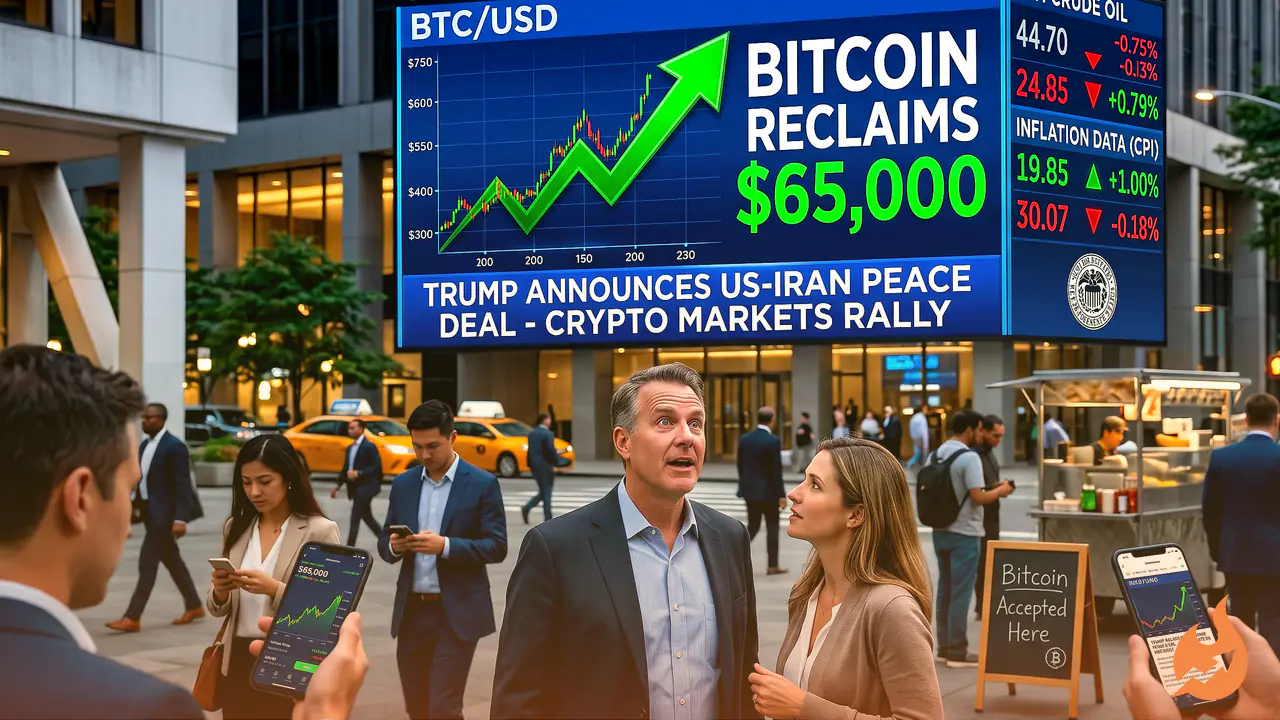

After months of grinding pressure, Bitcoin (BTC) is finally showing signs of life — and the trigger is geopolitics, not charts. Following a US-Iran peace deal announced by President Trump, sentiment has shifted and BTC has clawed its way back to the $65,000 level. The real question is whether this agreement, on its own, is enough to keep pushing BTC's price higher.
What the deal actually contains
The agreement is set to be signed this Friday, June 19, 2026. It brings a complete and toll-free opening of the Strait Of Hormuz along with an immediate removal of the US naval blockade. Pakistani Prime Minister Shehbaz Sharif stated that the deal will ensure “permanent termination of military operations on all fronts,” including in Lebanon. On top of that, Iran has agreed to never make a nuclear weapon.
How BTC got here
To understand the bounce, you have to look back at the slide. Bitcoin (BTC) started falling right after hitting an all-time high of $126,080 in October 2025, with geopolitical tensions and macroeconomic uncertainty driving the dip. Then in February, the start of the US-Iran conflict dealt BTC another blow.
That Middle East war didn't just rattle traders — it hit the wider economy hard. The closure of the Strait Of Hormuz caused a sudden shortage in global energy markets, which in turn pushed CPI (Consumer Price Index) figures higher than anticipated. Earlier this month, when inflation again came in hotter than many had expected, BTC took yet another hit, briefly dropping below $60,000 on June 6, 2026.
Can the rally keep going?
Now, with the US-Iran deal announced, Bitcoin (BTC) has reclaimed the $65,000 price level. Crude oil prices have already begun to slide and could keep falling over the next few days. If oil stays low and the peace deal goes through successfully, inflation will likely cool off.
And this is where the chain reaction matters: lower inflation could finally give the Federal Reserve room to cut interest rates. When rates drop, borrowing gets easier and investors typically rotate into riskier assets. Under that scenario, Bitcoin (BTC) could continue its upswing.