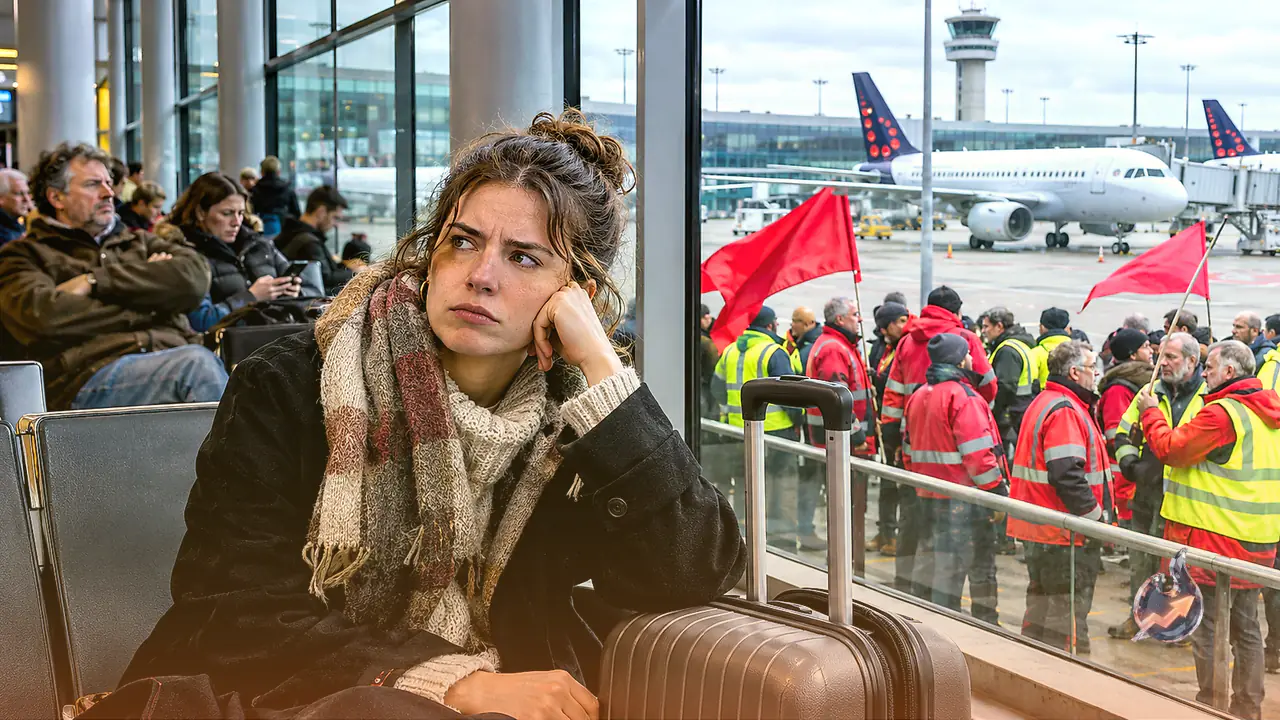

A sweeping strike against planned government austerity policies brought transport systems across Belgium to an abrupt standstill on Monday, grounding air travel and paralysing the national railway network. Both Zaventem airport in Brussels and Charleroi airport, a key operating base for budget carriers such as Ryanair, suspended all commercial flights as ground and control staff joined the demonstration. Alongside the aviation shutdown, extensive disruptions hit metropolitan transit, regional railways, educational institutions, and various public administration departments as thousands of people assembled in the capital for a large-scale demonstration.
Air Traffic Controller Walkout Grounds Brussels and Charleroi
The total freeze on air traffic at Brussels Airport began at 07:00 local time and remained in effect until 21:00 (06:00 to 20:00 GMT), after air traffic controllers walked off the job. With control towers unstaffed, no flights were permitted to take off or touch down on the runways throughout the 14-hour window. The halt directly disrupted the itineraries of more than 50,000 travellers, with airport authorities confirming that secondary operational delays would spill over into the night and continue into Tuesday.
A matching disruption played out at Charleroi airport, where flight information displays continued to show departures and arrivals as scheduled, despite no planes being cleared to move. Warning of severe disruptions over the weekend when the work stoppage was initially confirmed, airport officials noted that flight operations are entirely unworkable in the absence of air traffic control oversight.
Rail and Underground Networks Paralyse the Capital
Commuters inside Brussels faced near-total gridlock as rail hubs closed their platforms and metropolitan underground services halted operations. Large crowds filled major avenues across the capital to express collective opposition to state spending cutbacks. Public transit personnel were joined by school staff and workers from multiple municipal sectors, creating a multi-industry public service shutdown across the country.
Budget Standoff Puts Pressure on Bart De Wever Coalition
The mass mobilisation comes during a critical political impasse for Prime Minister Bart De Wever, who has spent weeks negotiating with coalition partners to finalize a budget framework aimed at curbing national borrowing costs. King Philippe had refused to accept the prime minister's resignation earlier in the month, a decision that bought De Wever additional time to negotiate compromises among his coalition partners.
The five-party governing coalition remains divided largely due to opposition from the centre-left Vooruit party, which has resisted signing off on the fiscal draft. Vooruit lawmakers have pushed for higher fiscal levies on wealthy individuals and have firmly opposed deep reductions in funding for state pensions and the national healthcare framework.
Union Leaders Demand Wealth Taxes Over Social Cuts
Union leadership used Monday's march to confront the government's austerity framework. Addressing the crowd, Bert Engelaar, the head of the FGTB union, asserted that the administration had viable economic routes available other than dismantling social welfare systems. Bert Engelaar stated,
"A genuine wealth tax, fair taxation, and the elimination of tax loopholes."
Engelaar argued that true political governance requires recognizing when to halt damaging policies rather than sustaining a coalition at any social cost, praising the Vooruit party for challenging the budget terms. Concurrently, Ann Vermorgen of the CSC union spoke out against separate government measures designed to eliminate compensatory public bank holidays when official holidays fall on weekend days. With labour organizations holding firm, pressure continues to mount on the coalition to rethink its fiscal strategy.