























In the culinary world, there is a constant search for the ultimate skillet, or at least the best one within your budget. We have seen cycles of excitement rise and fall for copper, cast-iron, and carbon steel cookware.
Back in the 1980s, at the Mall of New Hampshire, live demonstrations showed omelettes effortlessly sliding out of Teflon pans like magic. However, the industry eventually abandoned Teflon because of the harmful fumes the material releases when overheated. Short-lived ceramic pans quickly stepped in to fill the gap, but home cooks are already realizing how fast they lose their nonstick qualities.
Throughout these shifts, stainless-steel pans have remained a reliable choice. They are highly durable, lighter than cast iron, and require much less maintenance. While not naturally nonstick, a quick pat of butter easily solves the issue. Built to handle intense searing, they are designed to last a lifetime with just a little care.
The Baseline Standard: All-Clad D3 Under the Microscope
All-Clad has long been a giant in the stainless-steel market. The 10-inch All-Clad D3 Fry Pan has been a favorite of America's Test Kitchen and TrendKia for years due to its uniform heating, comfortable handle, and layered metal cladding. It costs $170 with a lid and $150 without, which is a significant investment but reasonable for lifetime durability.
However, the D3 skillet delivered for our testing featured a slightly domed cooking surface, meaning it was high in the center and low around the edges. Additionally, the rivets holding the handle to the pan were not fully secure. While a replacement pan solved the rivet issue, the domed bottom remained. Although this variation is within All-Clad's manufacturing tolerances, it fell short of our preference for flat pans, especially compared to our older 4-quart All-Clad D5 Essential Pan, which remains perfectly flat after eight years of heavy use.
Viking Pure Glide Pro's Warping Issues
We had high hopes for the new 10-inch Viking Pure Glide Pro, which features a textured titanium cooking surface over an aluminum core and stainless-steel bottom. While it showed promise as a sturdier nonstick alternative, it suffered from severe temperature management issues and warped so badly that cooking oil pooled in a moat around the center.
The Testing Process: Feeler Gauges and Cooking Trials
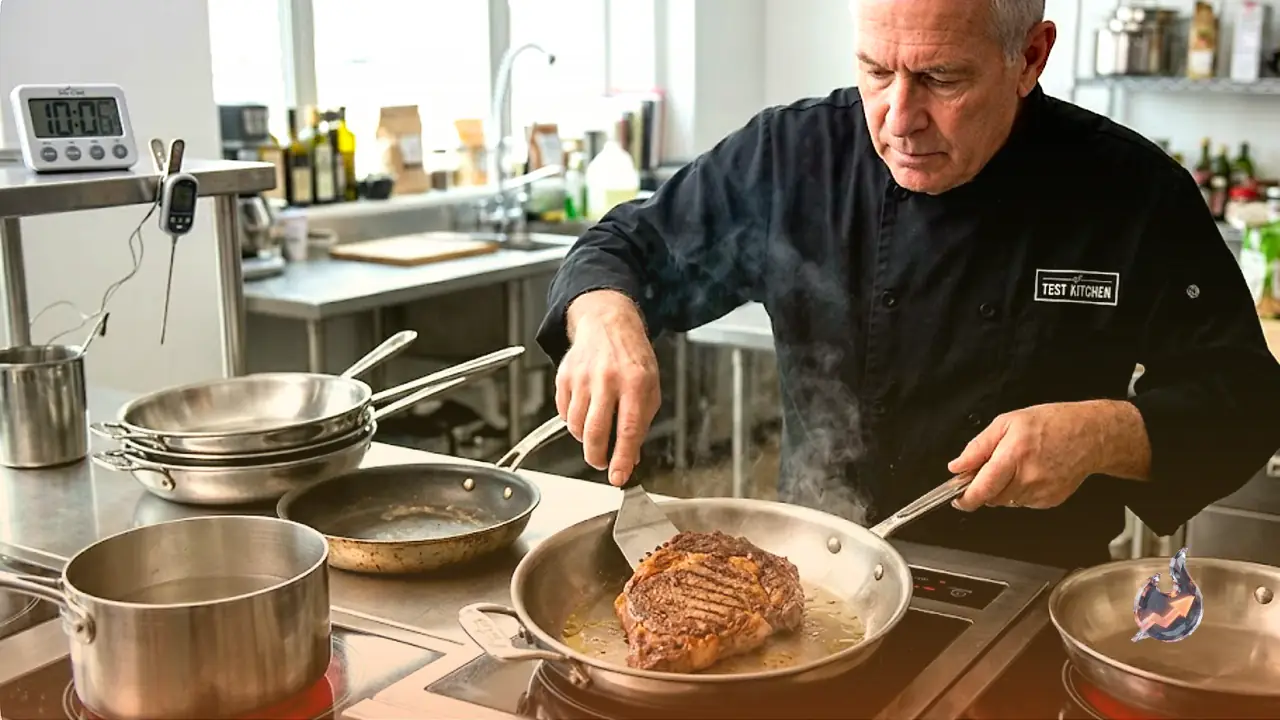
To move beyond subjective impressions, we used feeler gauges with angled blades and tracked precise measurements on a spreadsheet, assessing heat distribution, doming, cost, handling, and dishwasher safety.
For the heat distribution test, we warmed each pan on an induction burner set to medium-low for 3.5 minutes. Most pans averaged around 150 degrees Fahrenheit, with only a tiny 14 to 21-degree variance between the hottest and coolest spots. The Viking pans, however, behaved like massive hot spots, soaring into the mid-to-high 300s, which is more than twice as hot as the other models.
To test real-world usability, we prepared several dishes from acclaimed cookbooks:
- Shrimp with soft scrambled eggs from Ron Hsu and Hugh Amano's Down South + East.
- Pork with cabbage, caraway, and dill from Honey & Co. Daily.
- Seared and poached zucchini in yogurt from Ham El-Waylly's Hello, Home Cooking.
- Oven-roasted whole cauliflower from Joanne Weir and Julia Moskin's recipe in The New York Times.
- Chickpeas al limone with burrata from Hetty Lui McKinnon in The New York Times.
- A massive ham steak sourced from Bob's Quality Meats in Seattle.
We also cooked dozens of eggs, finding that fried eggs perform beautifully with sufficient oil or butter, scrambled eggs are acceptable, but elegant rolled omelets remain too difficult on stainless steel.
The High-Heat Specialist: Heritage Steel
The 12-inch Titanium Series skillet from Heritage Steel features three layers of aluminum sandwiched between a stainless bottom and a titanium-molybdenum cooking surface. Even after stir-frying vegetables on high heat for 30 minutes, this pan remained completely flat without warping. Its 10.5-inch counterpart retails for $150, matching the price of the All-Clad D3 while offering a flatter cooking surface.
The Premium Choice: Hestan ProBond Luxe
Hestan's ProBond Luxe (tested in 8.5-inch and 11-inch sizes) is an exceptionally designed pan. It features countersunk rivets for a smooth interior, curved walls that assist with skillet flips, and sealed rims that make it fully dishwasher-safe. The 8.5-inch model costs $150 ($200 with a lid), while the 11-inch version is priced at $200 ($260 with a lid).
If you are looking for alternatives to the traditional baseline, brands like Heritage Steel and Hestan offer fantastic performance. Test them out, and if the cooking surfaces are not perfectly flat, send them back!