














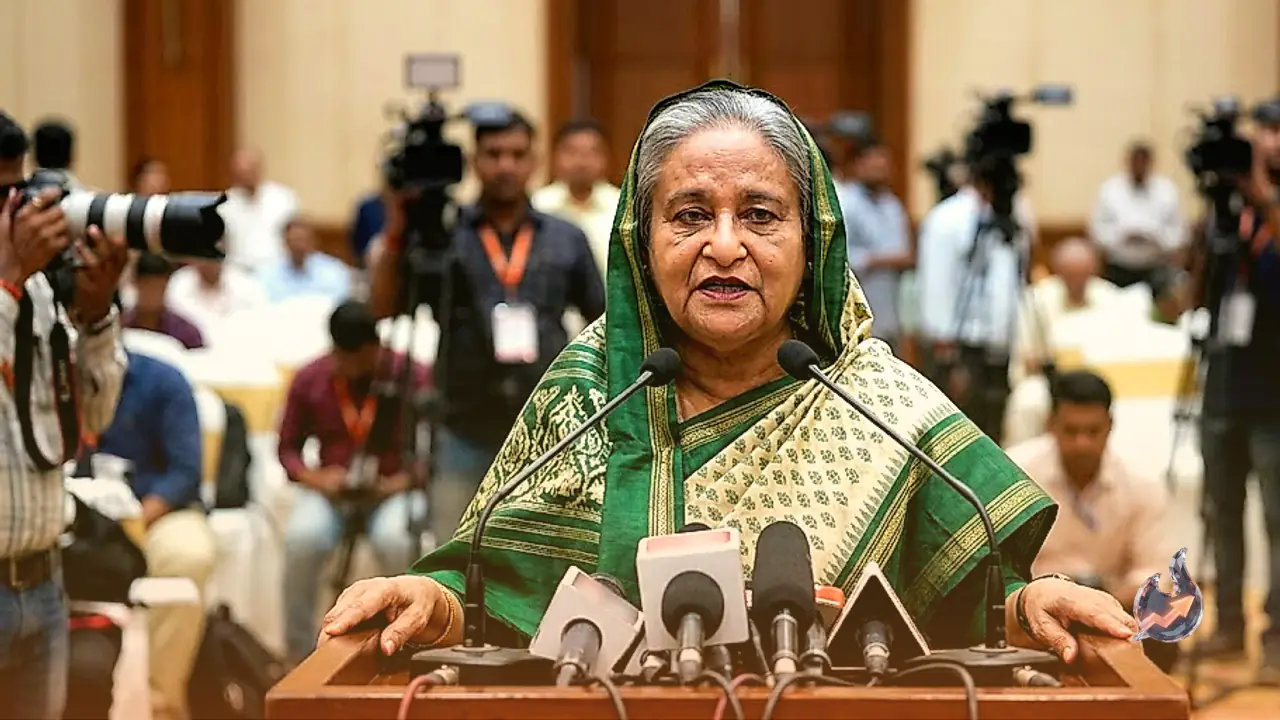

Bangladesh's former prime minister Sheikh Hasina has been sentenced to death, yet she keeps repeating one line in public: she is going home. Since fleeing to India in August 2024 after the political upheaval that ended her government, Hasina has said in multiple interviews that she plans to return to Bangladesh, even though the country's top leaders have warned that her death sentence would be carried out the moment she sets foot back on Bangladeshi soil. That raises an obvious question, why would anyone walk toward an execution, and what does it say about where India actually stands on handing her over.
How Talk Of Her Return Started
The idea did not come from Bangladeshi officials or Indian diplomats, it came from Hasina herself. In an email interview with a television channel on 29 June, she said she was not afraid of death, that she had lost her entire family in 1975, that there was an attempt to kill her with a grenade on 21 August, and that she had still stood with the people of Bangladesh against every conspiracy and been elected prime minister five times. She added that her entire life had been connected to the people of Bangladesh, the Awami League and the interests of the country, and declared that she would return to Bangladesh this year, overcoming every obstacle and every conspiracy.
Then on 10 July, in a telephone interview, Hasina went further and put an actual date on her plan. She said she would return to Bangladesh from India by December 2026 and surrender along with several other exiled leaders of her party. In her own words
They may arrest me when I return. They may even kill me. Still, I must go. My party's leaders and workers are being brutally suppressed.
Asaduzzaman Khan, who served as Home Minister in Hasina's government and is also living in exile, has been sentenced to death as well, which shows the crackdown extends well beyond Hasina alone. Hasina herself arrived in Delhi by helicopter on 5 August 2024, after violent protests had erupted across Bangladesh and forced her out of office.
What Happens If She Actually Goes Back
Sheikh Hasina is accused of ordering the police and army to kill students who were protesting against her. In November 2025, Bangladesh's International Crimes Tribunal, known as ICT-BD, sentenced her to death, the first time a former prime minister in Bangladesh has ever received such a sentence.
If Hasina returns to Bangladesh and surrenders, she could be arrested immediately and the process tied to carrying out her death sentence could begin. An appeal against the tribunal's decision is still legally possible, but filing one would not stop an arrest at the border or once she surrenders.
Her party, the Awami League, is banned in Bangladesh, so there is little expectation of any large protest breaking out if she is taken into custody, and any demonstrations that do occur are likely to be dealt with swiftly by the authorities. Bangladesh's Prime Minister's Strategic Adviser, Zahid-ur-Rahman, has made the government's position blunt
The people of the country want her to be given the death penalty for her crimes. If she comes back, this sentence will be carried out. This is what the people want. Let her bring the best lawyers in the world.
The Case For A Political Comeback
Given all of that risk, Hasina's insistence on returning looks less like recklessness and more like a calculated political bet. Despite the ban, the Awami League appears to be regaining momentum on the ground. Its workers have been trying to regroup and mobilise, and when the party marked its 77th Foundation Day on 23 June, dozens of its workers were arrested for it, a sign the movement is being taken seriously enough to be suppressed.
The stakes of that mobilisation were on display last week, when a bomb blast took place during a rally held against Sheikh Hasina, injuring three people. Several leaders of the National Citizen Party, or NCP, including Nahid Islam, one of the key faces of the student movement that had opposed Hasina, were present on the stage at the time.
Awami League leaders argue that conditions in the country were better while they were in power. They point to the period between 2009 and 2024, when Bangladesh grew into a major global hub for garment exports and millions of people were lifted out of poverty during Hasina's tenure, and they are using that record to counter the current government's narrative.
Vivek Mishra, Deputy Director of the Strategic Studies Programme at the Observer Research Foundation, says Hasina now appears to believe there is an opening to re-establish herself as a political force in Bangladesh and to build public sentiment against the current government. Hasina has already begun efforts to rebuild the Awami League from abroad, holding online meetings with party members across more than 100 parliamentary constituencies. In an interview, she framed the party's survival as proof of its resilience
The Awami League has faced many attacks and bans, but it has always risen again with the support of the people. Such attempts have failed before and they will fail again. A ban may shut party offices and restrict political activity, but party workers are still taking out processions. Ordinary people are joining them. This is a sign that the Awami League is becoming strong again.
There is also a personal dimension to this calculation. Her son, Sajib Wazed Joy, currently lives in the US but remains active on issues related to Bangladesh. If Hasina wants to prepare the political ground for him, doing so without ever returning to Bangladesh herself would be extremely difficult.
Why Staying In India Indefinitely Is Getting Harder
The other side of the calculation is that India may not want to host Hasina forever, and that reality is pushing her toward a decision. As Vivek Mishra puts it, how long can Hasina continue living in India or any other country. India may not say it publicly, but her presence comes with an added diplomatic responsibility, and hosting an exiled leader is not easy for any government. Hasina also does not have the support of the US, while Bangladesh and China have grown much closer during this period. In that context, India would want to maintain good relations with Bangladesh under Tarique Rahman's government rather than let the Hasina question strain ties.
There are already signs of that shift playing out. When Tarique Rahman became prime minister, Prime Minister Modi was among the first leaders to congratulate him, and the BNP highlighted Modi's message while expressing hope for stronger ties between the two countries. The very next day, however, BNP senior leader Salahuddin Ahmed repeated the party's demand that India extradite Sheikh Hasina, and Tarique himself said her extradition would be sought through legal channels, showing how quickly goodwill can be tied back to this one unresolved issue.
Would India Actually Hand Her Over?
Since December 2024, Bangladesh has sent India several requests seeking Hasina's extradition. On 14 July, India's Ministry of External Affairs addressed the question directly, saying there is no change in its stance regarding the former prime minister, and that extradition is a legal matter that would be dealt with accordingly, a carefully neutral line that commits India to nothing new.
The legal backdrop here matters a great deal. In 2013, during Hasina's own tenure as prime minister, India and Bangladesh signed an extradition treaty, largely aimed at extraditing criminals operating across the border. Under that treaty, extradition can take place if a person present in one country has been sentenced to at least one year in prison in the other country, and the offence is punishable under the laws of both countries. Following an amendment in 2016, there is no longer a requirement to provide detailed evidence of the crime, a warrant issued by the requesting country's court is enough on its own, which in theory makes it easier for Bangladesh to press its case.
The Three Legal Doors India Could Use To Say No
Even with that treaty in place and simplified since 2016, there are three specific provisions under which India could still refuse to extradite Sheikh Hasina.
Article 6 covers political offences. If the offence is political in nature, extradition can be denied, but since Hasina has been convicted in murder cases rather than purely political charges, this provision may be difficult for India to invoke.
Article 7 covers pending proceedings elsewhere. Extradition can be refused if the accused is facing proceedings in another country, and this does not appear to apply in Hasina's case since her legal troubles are concentrated in Bangladesh itself.
Article 8 covers the risk of injustice or political persecution, and this is the provision most likely to matter here. India could argue that the charges against Hasina are politically motivated, or that she may face persecution rather than genuine justice if she returns to Bangladesh.
On 9 July, Bangladesh's State Minister for Foreign Affairs, Shama Obaid Islam, said efforts were continuing to bring Hasina back, adding that extradition takes time because it must follow international legal procedures. When asked directly whether India was cooperating, she did not give a clear answer, leaving the actual state of talks unclear.
Vivek Mishra says India was able to sidestep the issue while Bangladesh was being run by an interim government, since there was no single elected authority pressing the demand with full political weight. Now that a permanent government is in place under Tarique Rahman, India may eventually have to take a clearer position, and Hasina understands this shift as well as anyone. That is precisely why she has said
No one will need to send me back. I will return to my country on my own.
Could Hasina Still Escape The Death Sentence?
Even if she does go back and surrender, there are two possible routes through which Hasina could still avoid the death penalty.
The first is to challenge the sentence before the tribunal itself. The deadline for filing an appeal is 30 days, but her lawyers had already written to the tribunal in March 2026, well before any surrender, describing the sentence as illegal and seeking its cancellation. Human Rights Watch and Amnesty International have also raised concerns about the sentence being handed down without a hearing, and as a result, the tribunal may allow Hasina to take part in the proceedings after all. Even so, legal experts believe it would be difficult for her to secure a complete acquittal from the tribunal given the scale of the accusations against her.
The second route is Bangladesh's Supreme Court, which Hasina can approach even before surrendering to the tribunal. The court could either begin hearing the case on its merits or grant a stay on the sentence while it does. Critics, however, argue that Bangladesh's Supreme Court has often reflected the political climate of the moment rather than ruling independently of it, which cuts both for and against Hasina depending on who holds power when her case is heard.
History offers a pointed example of exactly this pattern. In December 2014, during Hasina's own tenure, Jamaat-e-Islami leader Azharul Islam was sentenced to death by the tribunal on charges linked to murder, rape and genocide during the 1971 war. He appealed to the Supreme Court, which upheld the sentence at the time, when Hasina's government was still in power. But after Hasina was removed from power, the same court acquitted him in May 2025, reversing itself entirely once the political context changed.
A similar pattern played out with the party itself. Hasina's government banned Jamaat-e-Islami in 2013, and after her removal, the Yunus government lifted that ban. Between 2013 and 2016, five Jamaat leaders, including Abdul Quader Molla and Motiur Rahman Nizami, along with BNP leader Salauddin Quader Chowdhury, were sentenced to death. All of them appealed to the Supreme Court, but their appeals were rejected in every case, and they were later executed.
That history cuts both ways for Hasina's own prospects. It shows that Bangladesh's courts have reversed themselves once political power changed hands before, which could eventually work in her favour if the political tide turns again. But it also shows plainly that appeals to the very same Supreme Court have failed to save condemned leaders in the past, whenever the political winds were blowing firmly against them at the time the appeal was actually heard.