






















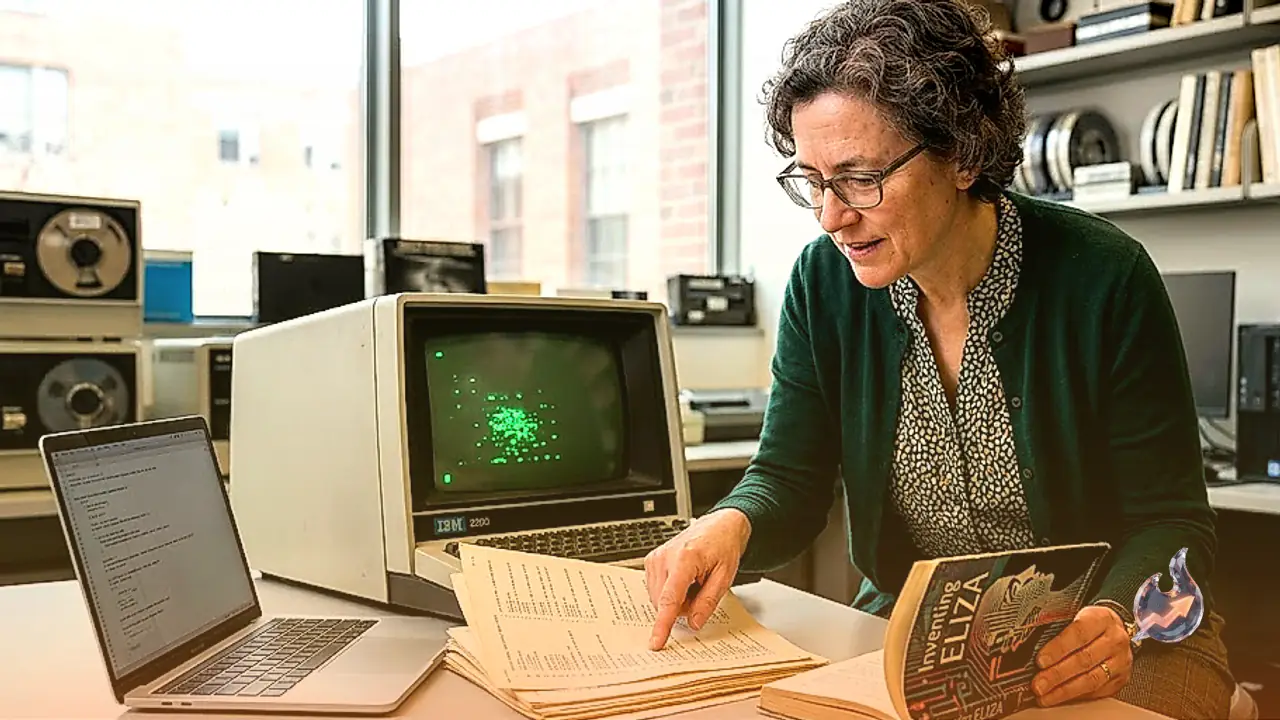

A new book titled Inventing ELIZA has done something no previous account of computing's most famous early chatbot ever managed: it has pulled the actual source code for ELIZA out of the MIT Archives and examined it line by line, alongside newly uncovered scripts and dialogs that go far beyond the program's famous "DOCTOR" persona. For nearly six decades, ELIZA has been retold in classrooms, research papers and popular culture, yet the program's own code, the thing that actually generated its uncannily convincing responses, had never been closely studied until now. The book also documents that ELIZA existed in several different versions across its lifetime, each built to run a variety of scripts and personas using a series of technical innovations, complicating the simple story most people know about a single therapist chatbot.
According to the authors, the wider goal is not simply to celebrate ELIZA but to correct and complicate the standard account of its history and influence, working through the misconceptions that have built up around it, the existence of multiple competing versions of the program, and the decades in which its actual code sat unexamined. That corrective matters because it lets researchers check, for the first time, exactly which parts of ELIZA's famous responses came from the program itself and which were shaped afterward for publication, and because it treats the program's earliest interactions as the moment that quietly set the terms for how humans would relate to computers for decades to come.
A Conversation That Made Computing History
One exchange from ELIZA's earliest days has been reprinted so many times that it has become a kind of founding myth for the chatbot industry. A young woman typing at a terminal complains, "They're always bugging us about something or other." The machine replies, "CAN YOU THINK OF A SPECIFIC EXAMPLE." She answers, "Well, my boyfriend made me come here," and the program echoes it back: "YOUR BOYFRIEND MADE YOU COME HERE." When she adds that she is depressed much of the time, ELIZA responds, "I AM SORRY TO HEAR YOU ARE DEPRESSED."
That short transcript inspired generations of programmers and writers to build their own conversational agents. But the more closely it is examined, the more it raises questions that were never answered in the original accounts: who was the young woman actually typing those lines, was she a real visitor or a construction by ELIZA's creator Joseph Weizenbaum, how exactly did the underlying system generate each response, and how heavily were the transcripts edited before publication. The dialogue also raises a deeper question that has followed chatbots ever since: why did such a simple program work so well at drawing people into an emotional exchange?
The Alarm Bells Weizenbaum Rang Himself
ELIZA and its "DOCTOR" persona, which mimicked a psychotherapist by reflecting a user's own statements back as questions, set off a mode of anxiety about people's relationships with computers that its own creator tried to name and contain. Joseph Weizenbaum explored this at length in his 1976 book Computer Power and Human Reason, drawing on philosophical, social and political critique. Watching how the public reacted to his program left him startled. He later described it as "clear evidence that people were conversing with the computer as if it were a person who could be appropriately and usefully addressed in intimate terms." What troubled him most was how easily people attributed empathy and rationality to a computer program, investing private feelings into a system that understood nothing at all.
That tendency eventually earned its own name, the "ELIZA effect." The phrase was already circulating in online forums by 1991, decades after the program itself was built. Sociologist Sherry Turkle later defined it as "our more general tendency to treat responsive computer programs as more intelligent than they really are. Very small amounts of interactivity cause us to project our own complexity onto the undeserving object." Cognitive scientist Douglas Hofstadter described the same phenomenon as "the susceptibility of people to read far more understanding than is warranted into strings of symbols, especially words, strung together by computers," a description that fits today's generative AI chatbots just as easily as it fit ELIZA nearly sixty years earlier.
A Game About Gender, Long Before It Was a Test for Machines
To understand why ELIZA carried such force, it helps to go back to Alan Turing's essay "Computing Machinery and Intelligence," in which he asked, "Can Machines Think?" Turing built his thought experiment on a parlor game that was originally about gender, not technology. A man and a woman sit hidden in separate rooms while an interrogator tries to work out, through written questions alone, which of them is which. The man tries to pass himself off as the woman, while the real woman tries to convince the interrogator that she is telling the truth, meaning both participants claim to be the "real" woman, a setup that quietly challenges any fixed idea of what gender is supposed to be.
Turing then swapped the original gender question for what is now known as the Turing test, in which a machine takes the place of the man pretending to be a woman. That single substitution meant artificial intelligence has been tangled up with questions of gender and identity from its very first formal definition. Imitation, performance and the deconstruction of identity were built into the foundations of how machines came to imitate intellect. Weizenbaum's ELIZA picks up exactly where Turing left off, down to its very first line of dialog: "Men are all alike."
Weizenbaum Never Claimed His Program Could Think
Even though Weizenbaum referenced Turing's imitation game directly in his 1966 paper introducing ELIZA, he was careful to distance his own creation from any claim of genuine intelligence. He wrote that the real test of understanding "is not the subject's ability to continue a conversation, but to draw valid conclusions," and that for a computer program to do that "it must at least have the capacity to store selected parts of its inputs." ELIZA, by contrast, "throws away most of its inputs," and, in Weizenbaum's own words, "ELIZA in its use so far has had as one of its principal objectives the concealment of its lack of understanding." In other words, ELIZA was never built to pass the Turing test. It was built to study the psychological reasons humans might misread a machine's limited capabilities as genuine comprehension.
A Name Borrowed From Pygmalion, on Purpose
The program's continued fascination with performed identity was written into its very name. Weizenbaum named the system after Eliza Doolittle, the working class character in George Bernard Shaw's Pygmalion who is coached to pass convincingly as an upper class woman. "I chose the name 'Eliza,'" Weizenbaum said, "because, like G.B. Shaw's Eliza Doolittle of Pygmalion fame, the program could be taught to 'speak' increasingly well, although, also like Miss Doolittle, it was never quite clear whether or not it became smarter."
Just as Shaw's Eliza performs class, ethnicity, sexuality and gender through carefully altered speech, Weizenbaum's system performs the persona of a therapist through scripted, repetitive linguistic patterns without ever possessing anything resembling human understanding. Feminist philosopher Judith Butler's theory of gender performativity, which holds that gender and sexuality are not innate but produced through repeated acts, offers a useful lens here. Just as Eliza Doolittle challenges assumptions about class by learning to perform upper class speech, Weizenbaum's DOCTOR persona performs gendered, classed and racialized identities through what amount to speech acts, or code acts, encoded directly into computer instructions and sample dialogs.
The Women Who Were Never Given a Name
Across the published dialogs and the popular retellings of ELIZA's story, one detail stands out: the women who appear in conversation with the program are never named. They are shown confiding in a therapist called DOCTOR, a title that carries no gender marker today but would have read, in the 1960s, as unmistakably masculine. The popular framing of these exchanges, in which women confess private secrets to an artificial doctor, therefore carries a quietly gendered message, including the fantasy that a person speaking to a machine can somehow be disembodied altogether. Questions of identity, performance and embodiment run through the ELIZA story from its earliest scripts all the way to the AI systems built today, and as norms and values become embedded inside algorithmic systems, examining a piece of software as closely as ELIZA reveals culturally and historically specific assumptions about what software can and should be, including what technology is for and how it developed the way it did. ELIZA might look crude to an audience used to today's tools, but it was already wrestling, back in the 1960s, with many of the same design questions that still shape the systems people use now: how humans and machines should interact, how communication can be represented computationally, and how far a machine should be allowed to influence the person using it.
A Technical Ancestor to Nearly Every Language Tool That Followed
ELIZA earns its place in computing history for more than being one of the first chatbots and helping launch an entire field of computational agents. Its design intersected with, and helped shape, a huge range of the computing techniques that came after it. Alongside developments in string processing and text analysis, ELIZA influenced later research into text synthesis, entity recognition and sentiment analysis. It emerged in parallel with work on machine translation, semantic networks, speech recognition and speech synthesis, techniques that eventually converged into what is now called natural language processing, or NLP, the field concerned with how computers parse, interpret, process and generate the kind of language people actually use, as opposed to the programming languages built for machines. In practice, modern systems combine many of these individual tasks at once to build automated agents and countless other applications.
Why ChatGPT Still Looks Like ELIZA
The reappearance of ELIZA style chatbot interfaces inside today's large language models shows why studying software history still matters. ELIZA remains a useful point of comparison for newer models precisely because so much has changed underneath while the interface itself has changed so little. The history of NLP research overlaps directly with the era in which ELIZA was built at MIT, and the field has cycled through syntactic, semantic, statistical and stochastic approaches at different points, often developing several of them in parallel rather than one replacing another outright. Even now, as the newest large language models astonish people with how intelligent their text output appears, the real machinery behind systems such as OpenAI's ChatGPT, a generative pretrained transformer, is hidden behind a chatbot interface that still resembles Weizenbaum's original design. That inviting facade obscures a combination of statistical prediction, rule based procedures and human labor that is often dressed up to look like it came from the machine alone. For an ordinary user, that leaves very little room to tell hype apart from substance, to understand how a given system actually works, or to see why it produced a particular answer.
The Danger of Treating People as Less Than Whole
Weizenbaum warned repeatedly about the harm this kind of obfuscation could cause, including the exploitation of people who are replaced, harmed or treated unfairly by such systems. "An individual is dehumanized," he wrote, "whenever he is treated as less than a whole person. The various forms of human and social engineering... do just that, in that they circumvent all human contexts, especially those that give real meaning to human language." His argument was that stripping language out of its social context and reducing it to a set of abstract computational concepts is itself dehumanizing. It risks flattening the many overlapping meanings that live inside ordinary language, meanings no AI system can fully capture, and that flattening can translate directly into real harm: violations of rights, breaches of privacy, exploitation, displacement and discrimination. That is precisely why Weizenbaum insisted that broader ethical and social consequences have to be weighed at every stage of designing, deploying and using automated systems.
The Human Labor Hidden Inside Every Chatbot
Today's large language models power a new generation of knowledge driven systems, but underneath every chatbot interface sits an enormous amount of social labor. The systems are trained on literally millions of traces of human writing and conversation, pulled into training datasets usually without the original creators ever being aware of it or consenting to it. That labor is what allows automated cultural production to be managed, monitored, broken apart and reassembled on demand, treating human cultural output the way a utility company treats electricity or water, except privatized and monopolized.
Writing in 1977, theorist Langdon Winner observed that it had become possible "for inanimate instruments to perform their own work 'at the word of a command or by intelligent anticipation,' that is, by a computer program," adding that "this development has led to conjecture that the perfection of industrial technology will eventually liberate mankind from toil," a promise that companies including OpenAI and Anthropic continue to repeat today. Yet every layer of computation is still serviced by human labor, even as chatbots now field customer service queries, help with homework, stand in for teaching assistants, act as companions and counselors, and entertain users while blurring lines around identity and human exceptionalism. That same machinery also produces a flood of low quality AI generated content, sometimes called AI slop, that consumes both its own source material and the planet's natural resources in the process. The idea that ELIZA's lineage would eventually lead to cognitive factories churning out AI slop is exactly the kind of tightly coupled feedback loop between humans and machines that Weizenbaum spent Computer Power and Human Reason warning against.
An Early Critic of an Industry Built on Acceleration
In that book and in his writing after ELIZA, Weizenbaum positioned himself as one of the earliest critics of what would become the modern tech sector and its instinct for exponential acceleration, regardless of the exploitative relationships that acceleration might encode or the social and political fallout of treating computational systems as neutral abstractions. His own view of technology shifted permanently once he watched how ELIZA was received and how automated systems kept being scaled up and leveraged for power, a trend that has only deepened alongside the public's mix of fascination and unease over machines that appear, on the surface, to be intelligent.
That same argument is what makes ELIZA more than a museum piece. The book treats the program's earliest interactions as the moment that set the terms for how people would relate to computers for decades afterward, and argues that ELIZA keeps speaking directly to the unrestrained ambitions of today's AI industry, from companion chatbots to enterprise assistants built on the same basic conversational trick the program pioneered back in 1966, a lineage that runs in an unbroken line from a single MIT terminal to the chat window millions of people now open every day.