





















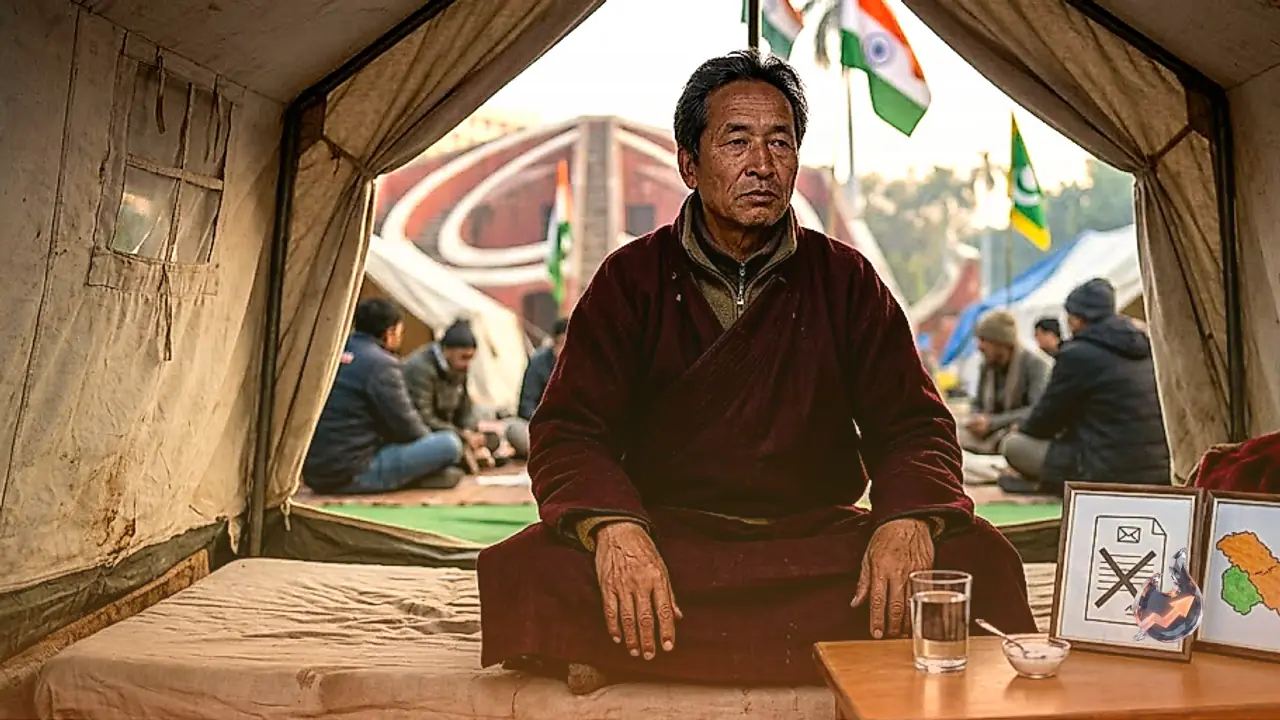

At Jantar Mantar in Delhi, 59 year old Sonam Wangchuk has been on an indefinite hunger strike for 17 days now. He is surviving only on salt water and has already lost 8.5 kg. Behind him hangs a banner of the Cockroach Janata Party, or CJP, demanding the resignation of Education Minister Dharmendra Pradhan. CJP founder Abhijit Dipke says the government is not even willing to talk and has effectively left Wangchuk to die.
How the protest at Jantar Mantar took shape
CJP founder Abhijit Dipke had announced the Jantar Mantar protest on 6 June. Wangchuk backed the group on social media as early as 2 June, calling its members patriots, and then physically joined the protest on 6 June. The demonstration paused for a while before CJP resumed it on 20 June. Around this point, Wangchuk put forward two central demands, Sixth Schedule status for Ladakh under the Constitution, and full statehood for the region. He gave the Centre a deadline of 27 June to respond, saying he would call off the fast the moment even one of the two demands was accepted. When no response came, Wangchuk began an indefinite hunger strike on 28 June along with six members of the All India Students' Association, AISA. He explained his decision by saying he was there because he had no choice, that education had been close to his heart for 40 years, and that he could not stay silent while young people were raising their voice against problems in the education system.
Yet on 13 June, in comments to journalists, Wangchuk had struck a somewhat different note. He said he was at Jantar Mantar primarily over the education issue, and that talks with the Centre on Ladakh's demands were actually progressing well, with broad agreement already reached on many points. He added that the remaining issues could be resolved during the Monsoon Session, provided the government wanted to.
Why the demand for Dharmendra Pradhan's resignation
The backdrop to the resignation demand is the NEET exam, which had to be cancelled after a paper leak in May. More than 14 NEET aspirants subsequently died by suicide. Protesters argue that the Education Minister should own moral responsibility for this and step down. Pradhan pushed back sharply on 23 June, calling CJP the B-team of terrorists and saying that those rejected by democracy have returned in disguise and are now targeting the system.
It is worth noting that the BJP has rarely accepted a minister's resignation. Setting aside M J Akbar, who resigned in 2018 over MeToo allegations, no Union minister has resigned during Narendra Modi's 12 years in office. Political analyst Rasheed Kidwai believes Pradhan's resignation would effectively amount to an admission of government failure, which is precisely why it is unlikely. So far, no BJP leader has commented publicly on Wangchuk's hunger strike, and Abhijit Dipke says no Union minister has met Wangchuk or even offered to hold talks. That said, sources indicate a Cabinet reshuffle could be on the cards soon, one that may see Pradhan lose the Education Ministry and get shifted to a different portfolio or into an organisational role within the BJP.
What continuing the fast could mean for his health
Doctors note that how long a person can survive during a hunger strike depends on hydration levels, body fat and overall health. Someone drinking only salt water may be able to survive for two to three months, but medical supervision becomes necessary once body weight falls by more than 10 percent. In the first two to three days, the body starts burning fat, causing rapid weight loss. After roughly two weeks, vital organs such as the heart, liver and kidneys begin to weaken. Dr Amit Prakash Singh, an internal medicine specialist at C K Birla Hospital in Delhi, said that after about two weeks of fasting, vital organs like the heart, liver and kidneys start weakening, and this can turn life threatening.
Several people have urged Wangchuk to end his fast, but he has refused every time, saying that what he has started, he must see through to its conclusion. On 13 July, Abhijit Dipke revealed that whenever he asks Wangchuk to stop the fast, Wangchuk scolds him and tells him not to worry about him. According to Dipke, Wangchuk now feels dizzy regularly, and even walking to the washroom has become difficult for him.
A march to Parliament planned for 20 July
CJP has called for a march from Jantar Mantar to Parliament on 20 July, which is also the opening day of the Monsoon Session. Wangchuk has appealed to people to join the march, saying he will march with whatever strength he has left, and that everyone has the right to move freely and raise their demands peacefully. Senior journalist Arun Dixit believes the Centre is unlikely to accept Wangchuk's demands immediately. However, he notes that if Wangchuk's health deteriorates sharply, authorities could step in, hospitalise him and force an end to the fast.
Why Irom Sharmila's case keeps coming up
The best known precedent for such a prolonged hunger strike is Irom Chanu Sharmila. She began her fast on 4 November 2000, after 10 civilians were killed in alleged Assam Rifles firing near Imphal, demanding the repeal of the Armed Forces Special Powers Act, AFSPA. She was arrested on the very third day under Section 309 of the IPC, which deals with attempt to die by suicide. She was hospitalised and force fed through a nasal tube. A ward inside a government hospital in Imphal effectively functioned as a temporary jail for her until 2016. She finally ended her 16 year long hunger strike on 9 August 2016.
Wangchuk's long history of hunger strikes for Ladakh
This is far from Wangchuk's first hunger strike over Ladakh's demands, he has repeatedly used fasts and marches to press his case. On 26 January 2023, he tried to begin a five day fast at Khardung La, at an altitude of 18,000 feet, demanding full statehood, but he was placed under house arrest before he could. Between 18 and 26 June 2023, he observed an eight day hunger strike at NDS Stadium in Leh. In September 2024, he led a nearly 1,000 km Delhi Chalo Padyatra from Leh along with around 130 supporters, only to be detained by Delhi Police at the Singhu Border on 30 September. Between 5 and 21 October 2024, he began yet another hunger strike, this time at Ladakh Bhawan in Delhi, which he ended after the Home Ministry assured him of talks in December. On 10 September 2025, he started a 35 day hunger strike alongside members of the Leh Apex Body, LAB. Then on 24 September 2025, violent protests erupted in Leh, the BJP office was set on fire, and four protesters died in police firing. The very next day, 25 September 2025, Wangchuk was arrested under the National Security Act, NSA, on charges of inciting violence, and lodged in Jodhpur Jail. He was eventually released on 14 March 2026, after spending 170 days in jail.
The case for Sixth Schedule status
After Article 370 was revoked on 5 August 2019, Ladakh became a Union Territory. Since then, Wangchuk has repeatedly argued that the region lost significant political and administrative power in the process. His demands include Ladakh's inclusion under the Constitution's Sixth Schedule, a separate Public Service Commission for local recruitment, and dedicated representation in Parliament, one Rajya Sabha seat and two Lok Sabha seats, one each for Leh and Kargil. He argues these measures would hand local bodies far greater control over land, forests, agriculture and other local matters.
On 13 July, Ladakh's Principal Secretary Ashish Kundra announced that Autonomous Hill Development Councils, AHDCs, would be set up for all seven districts. These councils, he said, would receive legislative, financial and administrative powers under a special framework modelled on Article 371. Wangchuk welcomed the fact that talks were happening, but stressed that what really matters is implementation. He expressed hope that Parliament's Monsoon Session, starting 20 July, would bring a concrete decision. As things stand, the Centre has not issued any official statement on Wangchuk's demands.