



















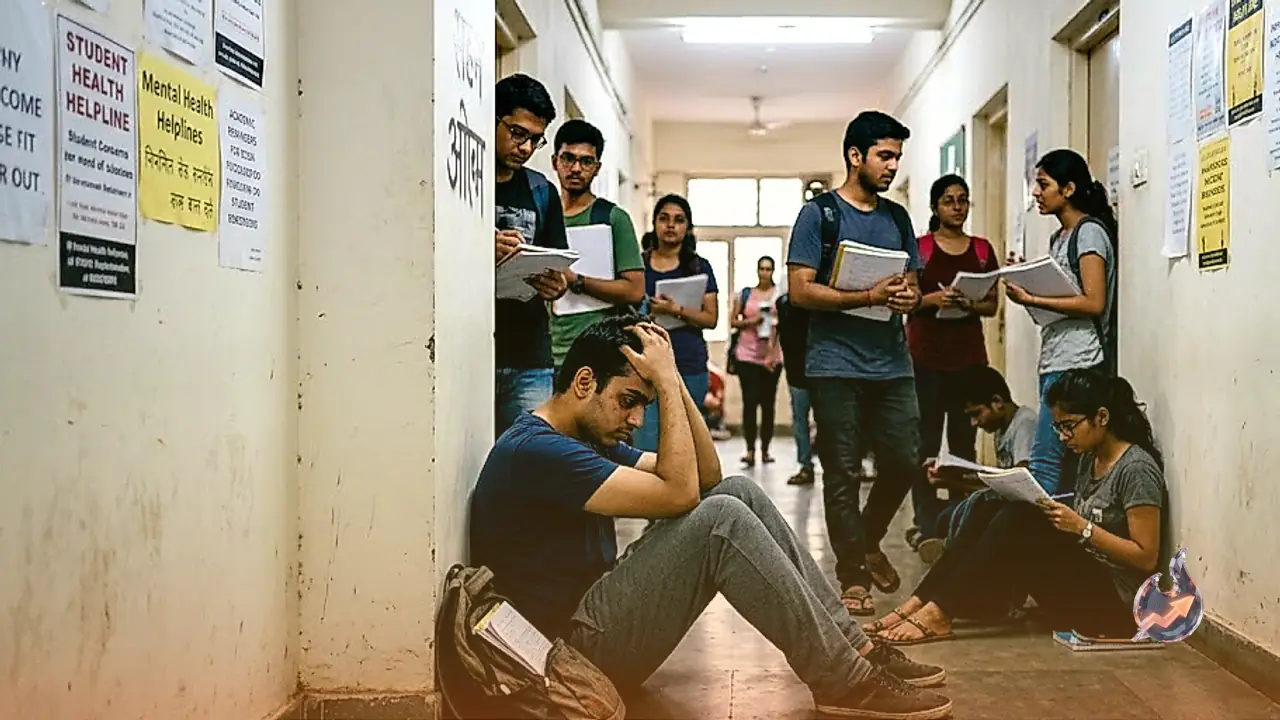

Securing a coveted seat at an Indian Institute of Technology represents the pinnacle of academic ambition for over a million young aspirants every single year, yet beneath that celebrated triumph lies a grueling environment claiming scores of young lives. The passing of Sahil Wakode, an undergraduate scholar at IIT Bombay on 18 September 2026, has once again exposed the perilous fractures within these prestigious establishments. Data compiled by the Global IIT Alumni Support Group reveals that no fewer than 65 scholars lost their lives to suicide across these campuses between 2021 and 2025, turning public attention toward severe systemic distress that leadership can no longer dismiss as isolated tragedies.
The Final Hours of Sahil Wakode at Powai
Twenty-two-year-old Sahil was enrolled in the second year of his B.Tech curriculum under the Department of Energy Science and Engineering at the Powai campus. On the morning of 18 September, between 11 am and 1 pm, he sat for his mid-semester assessment. Around 6 pm that same evening, his unresponsive body was found inside his hostel quarters. The circumstances preceding this outcome reveal sharp disagreements between administrative accounts and student testimonies.
Institutional representatives stated that Sahil was detected resorting to unfair examination practices during the morning session, having supposedly photographed questions to fetch answers using ChatGPT. According to the faculty forum, invigilator Prof Suryanarayan Dulla lodged an official complaint in compliance with standard operating regulations. However, peers writing the test in the same hall recounted a far more hostile encounter. They stated that upon discovering the phone, Prof Dulla ordered Sahil out of the room, denied him the chance to resume writing, and threatened him with a one-year suspension. The institute contested this characterization, maintaining that no punitive measures had been initiated and asserting that senior departmental staff had reassured the youth that his career prospects remained unharmed.
Allegations of Caste-Based Harassment and Police Action
Ravindra Wakoda, the deceased student's father, leveled direct charges of institutional harassment against both Prof Dulla and institute Director Shirish Kedare. In the official police complaint, Wakoda stated that his son had endured persistent hostility over the preceding three months, alleging that Dulla had insulted the youth regarding his caste background and threatened to implicate him in fabricated infractions under instructions from top administration. Expressing her profound grief, Sahil's mother stated, "My son was killed. He was harassed a lot."
Law enforcement authorities have filed a First Information Report against Prof Dulla under the Scheduled Castes and Scheduled Tribes Prevention of Atrocities Act alongside charges concerning abetment of suicide. More than 400 scholars mobilized across the campus demanding thorough structural reforms and accountability. Recognizing the gravity of the public outcry, authorities transferred the entire inquiry to the Crime Branch, while Director Shirish Kedare signed off on an 18-point charter of demands presented by protesting scholars.
Official Records and Independent Tallies of Student Deaths
Government disclosures in Parliament over recent years demonstrate an unrelenting pattern of student loss. In December 2021, the administration informed the Lok Sabha that 34 suicides were documented across these institutes during the seven-year stretch from 2014 to 2021. Further legislative submissions in March 2023 recorded 33 suicides over the five-year window spanning 2018 to 2023, while a July 2023 Rajya Sabha submission noted 39 instances since 2018.
Independent tracking groups present an even starker reality. Global IIT Alumni Support Group figures indicate that at least 65 scholars ended their lives between January 2021 and December 2025. Group founder Dheeraj Singh stated that data gathered through Right to Information queries and public records indicates 74 unnatural deaths and suicides occurred across 15 separate campuses from September 2021 through 18 September 2026.
The Core Drivers Behind Premier Campus Despair
Across India, 23 institutes provide merely 18,951 undergraduate seats. In 2026 alone, over 1.5 million candidates registered for JEE Main, with just roughly 170,000 making the cutoff for JEE Advanced. Statistically, only one in ten Advanced candidates and a single student out of every hundred Main aspirants successfully matriculates. The Supreme Court-monitored National Task Force, parliamentary submissions, and campus surveys identify four underlying structural factors turning these institutions into high-pressure environments.
1. Relative Grading Systems and Shrinking Placement Prospects
The National Task Force observed that winning admission merely intensifies an already brutal competitive treadmill. Inside classrooms governed by relative grading, personal accomplishment is decoupled from mastery and tied strictly to peer defeat; an individual scoring 90 percent might still walk away with a mediocre or failing evaluation if the rest of the batch hits 95 percent. This dynamic leads students to measure their self-worth exclusively through numerical metrics.
Compounding this anxiety is an increasingly unpredictable job market. During 2024, approximately 38 percent of graduating scholars failed to secure employment through campus recruitment drives. Analysts note that suicidal crises cluster heavily around mid-term evaluations, finals, and corporate recruitment windows. An internal campus survey carried out following the 2023 passing of student Darshan Solanki discovered that 61 percent of participants blamed academic distress for campus suicides, while 12 percent highlighted anxieties surrounding future livelihoods.
2. Extreme Faculty Homogeneity and Underrepresentation
A profound social divide between instructors and pupils severely degrades campus dynamics, according to the National Task Force. While reservation policies diversify the student demographic, the teaching corps remains overwhelmingly homogenous, leaving marginalized youth without empathetic mentors. In 2019, then Human Resource Development Minister Prakash Javadekar confirmed to lawmakers that out of 6,043 faculty members across these centers, merely 149 belonged to the SC category and 21 to the ST category, totaling a meager 2.8 percent representation.
A subsequent 2024 RTI disclosure established that upper-caste educators comprised upwards of 80 percent of teaching rosters across eight major campuses, climbing beyond 90 percent at the Bombay and Kharagpur facilities. Students frequently recount facing subtle disparagement regarding entrance ranks, public questioning of their merit, and systematic social ostracism. Conversely, many instructors maintain that caste prejudice does not exist within their walls. Official December 2021 disclosures revealed that of 34 deaths between 2014 and 2021, 13 were OBC candidates and five belonged to the SC bracket, with no ST casualties reported.
3. Untrained Faculty and Barriers to Mental Health Support
Drawing on reporting by journalist Sneha Belsin, the Task Force emphasized that relentless workload expectations, recruitment stress, and isolation severely undermine psychological well-being. Absent timely intervention, some students resort to substance abuse as a coping mechanism. While administrations routinely classify tragedies as personal mental health struggles, professional counselors highlight that the vast majority of deceased individuals never stepped foot into institutional therapy centers prior to their deaths.
The institutional deficit was codified in a 2025 Supreme Court verdict, which pointed out that roughly 90 percent of professors across these campuses possess no formal training or competency to identify emotional crises or guide vulnerable youth.
4. Power Asymmetries in Research Supervision
For doctoral scholars pursuing research under five-year fellowships, career outcomes depend almost entirely upon their designated thesis supervisor. This extreme imbalance of authority has led to profound friction. In 2023, following the death by suicide of IIT Madras doctoral candidate Sachin Kumar Jain, his guide Prof Ashish Kumar Sen was held accountable and placed under suspension. The Task Force confirmed during campus evaluations that supervisors frequently alternate between prolonged neglect of their candidates and autocratic micro-management, exacerbating psychological distress. As the Union Education Minister acknowledged before Parliament in March 2023, severe academic pressure, personal struggles, and mental health challenges continue to form a combustible mixture inside India's elite academies.