





















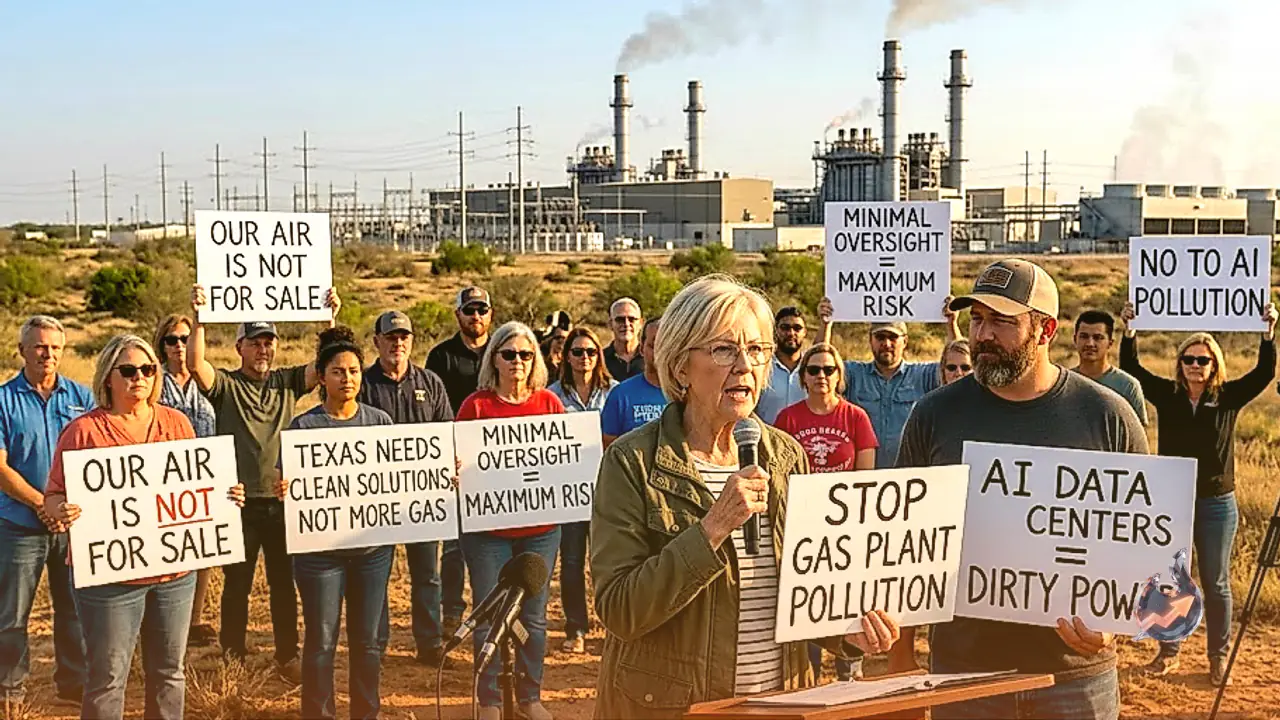

A veteran of the Air Force reported discovering OpenAI’s intention to construct its flagship Stargate data center right next to her property only after construction had commenced in the summer of 2024. Today, the facility's natural-gas-fueled electrical plant is situated approximately 500 yards from her residence, with the exhaust stacks clearly visible from her kitchen window.
“We weren’t given any time to understand what this impact was going to be on us,” the mother of two stated while visibly emotional. “We’re trapped here.” OpenAI failed to respond to multiple requests for comment regarding the situation.
A spokesperson for Crusoe, the developer behind Stargate, argues that the data center has contributed meaningfully to the economic development of Abilene, noting that its investments are funding new fire trucks, school expansions, and road improvements across the municipality.
The AI Rush and Texas Governance
As President Trump pushes to accelerate AI development nationwide, he has found a receptive partner in Texas Governor Greg Abbott, who previously dubbed the industry the state’s “gold rush,” though his enthusiasm has faced recent headwinds amid widespread local opposition.
With roughly 300 data centers currently operational and another 200 in various stages of development, Texas is on track to overtake Virginia as the nation’s premier data center market by 2030. Amid the scramble to capitalize on the AI boom, a regulatory loophole has permitted dozens of these facilities to quietly construct massive power sources that emit significant pollutants with little to no public notice.
Regulatory Loopholes and Minor Permits
Typically, building a major emission source requires obtaining a major air permit, a process involving extensive environmental reviews and community engagement. In Texas, however, regulators have allowed facilities like Stargate to circumvent this by securing so-called minor air permits—the kind traditionally used for dry cleaners or autobody shops that receive minimal scrutiny.
Kathryn Guerra, who spent nearly four years at the Texas Commission on Environmental Quality (TCEQ) before joining the watchdog group Public Citizen, notes that these lower-level permits are granted quickly and often without public knowledge, which she describes as feeling quite intentional. These minor permits, combined with nondisclosure agreements, often leave residents stunned when industrial exhaust stacks suddenly appear in their neighborhoods.
The Emergence of a Shadow Grid
Construction in Abilene was already well underway. The 1,100-acre campus, featuring a 360-megawatt onsite gas plant, represents one of the first hyperscale AI data centers to break ground in Texas. A wave of similar proposals has since turned the state into the epicenter for an AI-driven build-out of fossil-fuel power plants across the United States.
Attracted by abundant gas reserves and an industry-friendly regulatory environment, AI firms are flocking to Texas to construct what researchers identify as a “shadow grid” of custom power plants capable of fueling entire cities. Jenny Martos, a researcher at Global Energy Monitor, notes that Texas has over 80 gigawatts of new gas plants in its construction pipeline—ranking it second only to China—with roughly half that capacity earmarked for data centers.
Climate Impact and Oversight Concerns
Research from the analytics firm Cleanview suggests that at least 15 gas plants linked to data centers are planned across Texas. Permits indicate that nine of these could collectively emit over 130 million tons of greenhouse gases annually, equivalent to the yearly emissions of 35 coal-fired power plants. If completed, these facilities could emit more greenhouse gases annually than most countries.
Bruce Buckheit, a former EPA air enforcement chief, notes that the permit-by-rule process is intended for small-scale operators, not projects of this magnitude. Stargate, for example, is currently permitted to emit over 1.6 million tons of greenhouse gases and 1,000 tons of other pollutants annually using 10 turbines and 62 diesel generators. Since 2024, at least 38 data centers in Texas have received similar minor permits, resulting in the silent authorization of more than 2,100 backup diesel generators state-wide.
Expansion Strategies and Community Impact
Many data centers employ a “small first, big later” strategy, securing minor permits before seeking massive expansions that would otherwise require public input. Stargate has already sought to expand its operations significantly beyond its initial footprint. Former TCEQ staffer James Doty argues that the industry is growing at a pace that far exceeds the agency’s capacity to regulate effectively. Meanwhile, residents like Garcia report that the industrialization of their rural surroundings has destroyed their quality of life, leaving them with limited options and mounting health anxieties about their future.