























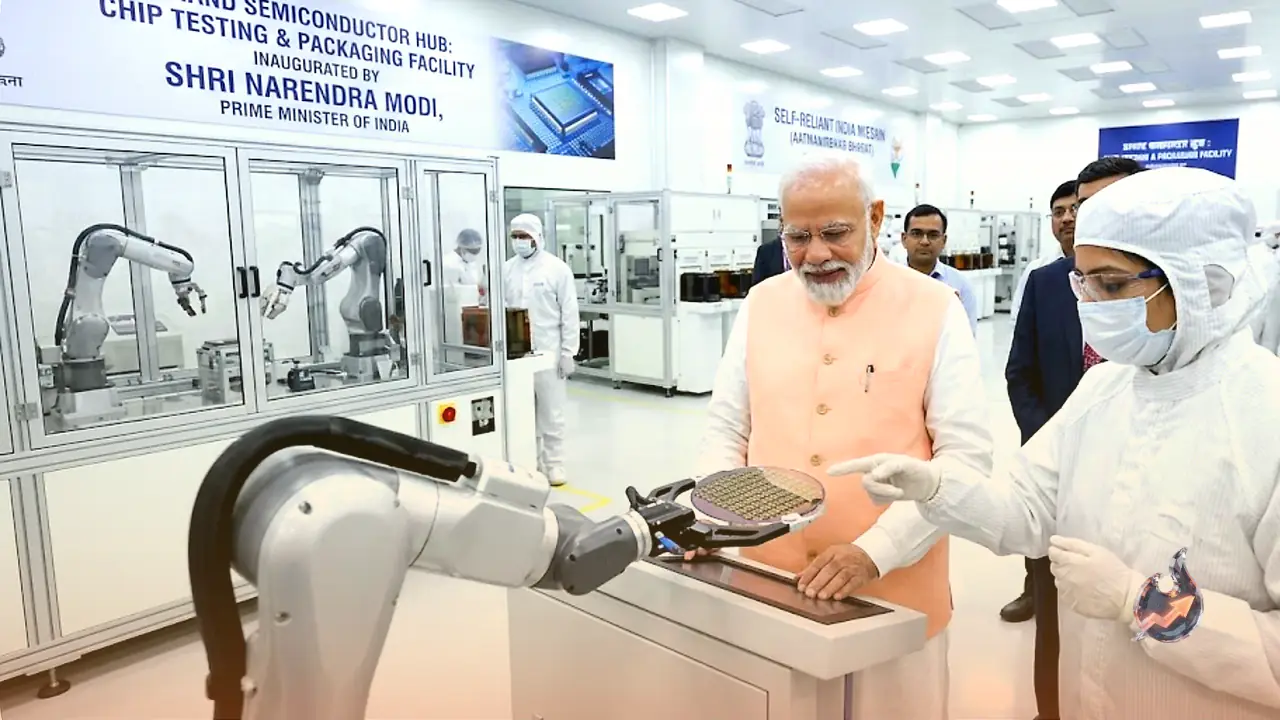

Prime Minister Narendra Modi recently inaugurated CG Semi's state-of-the-art Outsourced Semiconductor Assembly and Test (OSAT) plant in Sanand, Gujarat. During the event, he described the facility as the foundation for India’s emerging semiconductor cluster, drawing parallels between Sanand and global tech giants like Silicon Valley in the US, the silicon islands of Japan, and Hsinchu in Taiwan.
What is a semiconductor hub, and why does India need one?
Semiconductors are the tiny chips that function as the brains of modern electronic devices. They handle data processing, regulate electricity, and ensure that technology functions correctly. From smartphones and electric vehicles (EVs) to medical devices, satellite systems, and artificial intelligence (AI), semiconductors are central to everything. As these chips are vital to both the global economy and national security, countries across the world now treat them as a strategic priority. Establishing a semiconductor hub creates a comprehensive ecosystem for chip design, manufacturing, and packaging, while simultaneously generating thousands of high-tech jobs.
The India Semiconductor Mission (ISM), operating under the Ministry of Electronics and IT, is the government's flagship effort to build self-reliance in this space. It provides up to 50% financial support for chip fabrication, semiconductor packaging, display manufacturing units, and chip design startups. According to NITI Aayog, these hubs are the backbone of modern innovation, fueling AI, telecommunications, defense infrastructure, and digital growth. By clustering chip factories, suppliers, researchers, and skilled labor, costs are reduced and innovation accelerates. While India has long excelled in chip design, it previously lacked a complete manufacturing ecosystem. A hub effectively bridges the gap between design and physical production. Historically, no global industrial leader has risen based on isolated factories; the success of Silicon Valley, Hsinchu, and Japan’s Tsukuba demonstrates that industrial strength is built through clusters.
How do chips run everything Gen Z uses?
The modern digital lifestyle is entirely dependent on semiconductors. Whether it is checking a smartphone, watching social media reels, sending messages, or playing online games, a semiconductor chip is running the process in the background. These components enable data transfer, power 5G connectivity, and optimize battery performance. In short, without these chips, modern life as we know it—including AI and 5G—would cease to function.
Sanand and the semiconductor journey
Technology hubs like those in the US and Taiwan took decades to achieve global dominance. Sanand is currently in the early stages of its journey, focusing primarily on chip packaging and testing. Nevertheless, it stands as India’s most robust semiconductor cluster to date. Within just five months, companies like Micron, Kaynes Semicon, and CG Semi have commenced commercial production in Sanand. The city’s existing infrastructure, largely developed around automobile manufacturing, makes it a highly attractive destination for semiconductor investment.
What makes a semiconductor hub successful?
Successful chip clusters globally share consistent traits: they feature anchor fabrication plants, access to highly skilled talent, strong ties with universities, a reliable supply chain, and long-term government policy support. Most importantly, these ecosystems require years—often decades—of sustained evolution rather than quick growth.
Shifts in India's semiconductor mission
India’s approach has moved beyond just announcements. The country now has three operational packaging plants, with its first commercial chip fabrication plant expected by 2028 in Dholera, Gujarat, located about 50 km from Sanand. If this fabrication unit begins operations as scheduled, it will mark the first time that chips designed in India are also fabricated and packaged domestically. Combined with India's massive workforce of chip design engineers, this development is set to create an end-to-end chip ecosystem.
Can domestic production lower gadget costs?
According to NITI Aayog, India currently imports 90–95% of its semiconductor requirements, with only 5–10% produced locally. While increasing domestic production will reduce the national import bill, it is unlikely to lead to significantly cheaper electronic gadgets in the near term. This is because India remains dependent on imported raw materials, specialized gases, and high-precision chipmaking equipment.
Remaining challenges in India's path
Despite progress, significant challenges remain. India is still heavily reliant on imported chipmaking equipment, specialty chemicals, and ultra-pure gases. There is also a shortage of skilled fabrication engineers and limited experience in advanced manufacturing. A June 2026 report by NITI Aayog's Frontier Tech Hub, Future of India's Semiconductor Industry, highlights that the ecosystem is still in its infancy. The report warns that supply chain disruptions in major regions like Taiwan could jeopardize India’s electronics and defense sectors, making domestic manufacturing a strategic necessity. The document emphasizes that India must maintain long-term investment and execution for at least a decade, while strengthening partnerships with the United States, Japan, the European Union, and South Korea, even while it competes with China in the global semiconductor market.