























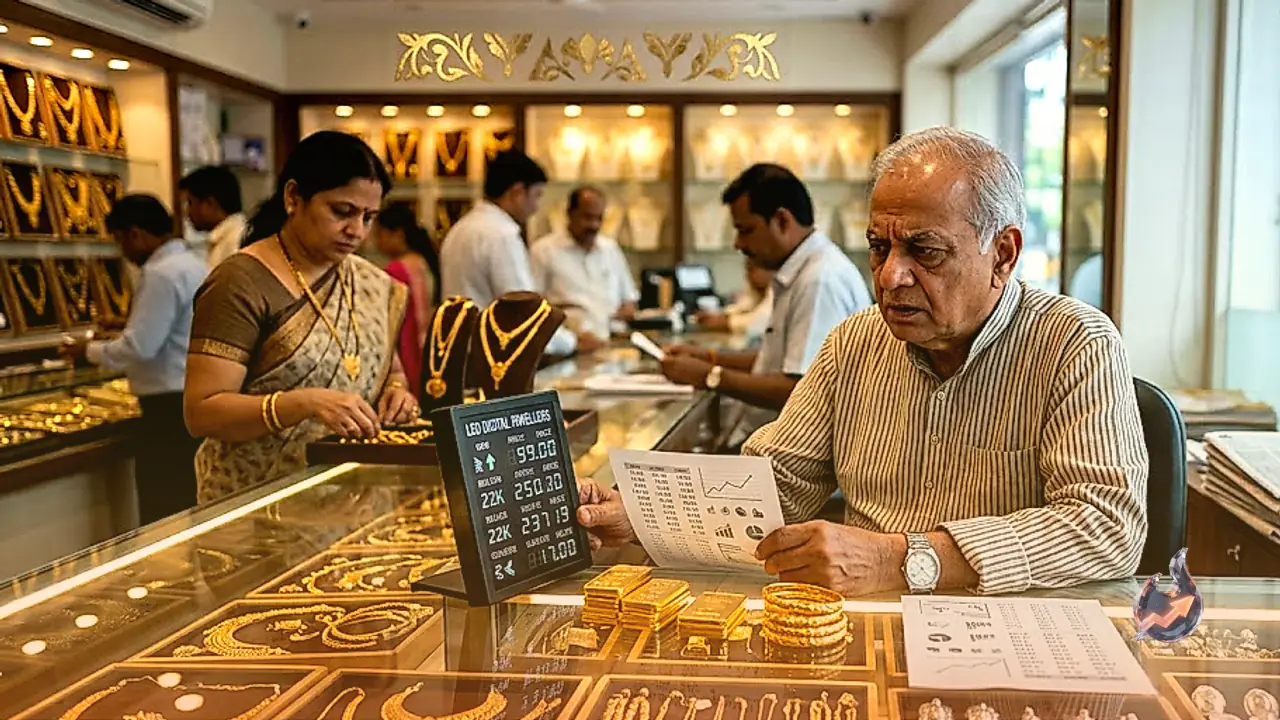

Physical gold prices in the Indian domestic bullion market opened the month of August 2026 on a weaker note on Saturday. Rates for 24-carat, 22-carat, and 18-carat gold witnessed marked reductions across all weight denominations. In contrast, silver prices held completely steady across major retail segments. The domestic decline follows an overnight crash in international markets, where spot gold slipped by nearly 1.5% and spot silver plunged by 2.4%, pushing futures contracts on the Multi Commodity Exchange (MCX) below key technical support boundaries.
Detailed Breakdown of Gold Prices in India
On Saturday, 24-carat gold prices tumbled by Rs 3,800 per 100 grams, bringing the rate down to Rs 14,42,200. For a 10-gram bar of 24-carat gold, the price dropped by Rs 380 to stand at Rs 1,44,220. The 8-gram tier dipped by Rs 304 to settle at Rs 1,15,376, while 1 gram of 24-carat gold decreased by Rs 38 to reach Rs 14,422.
The 22-carat gold segment experienced a similar downward trajectory. The price for 100 grams of 22-carat gold declined by Rs 3,500 to Rs 13.22 lakh (Rs 13,22,000). The 10-gram rate slipped by Rs 350 to Rs 1,32,200, while the 8-gram option moved lower by Rs 280 to Rs 1,05,760. The single gram rate for 22-carat gold fell by Rs 35 to trade at Rs 13,220.
Under the 18-carat gold classification, prices dropped by Rs 2,900 per 100 grams on Saturday, arriving at Rs 10,81,600. The 10-gram price plummeted by Rs 290 to Rs 1,08,160, and the 8-gram portion dipped by Rs 232 to Rs 86,528. The 1-gram 18-carat gold rate declined by Rs 29 to reach Rs 10,816.
Silver Prices Maintain Absolute Stability
Diverging from gold's downward trend, silver prices remained unchanged on August 1 across all standard measures. Industrial and retail silver stands at Rs 2.35 lakh (Rs 2,35,000) per 1 kilogram. The price for 100 grams of silver is quoted at Rs 23,500, while 10 grams stands at Rs 2,350. The 8-gram and 1-gram rates for silver sit firmly at Rs 1,880 and Rs 235 respectively.
Global Spot Movement and MCX Futures Trends
The domestic price adjustments follow intense overnight trading in international markets, where spot gold contracted by nearly 1.5% to trade around $4,043 per ounce. Spot silver suffered a steeper loss of 2.4%, falling below $57.62 per ounce. On the domestic futures front, MCX gold ended the month of July 2026 beneath the crucial threshold of Rs 1,41,600 per 10 grams, while MCX silver closed below Rs 2,17,500 per 1 kg.
Despite the end-of-month pullback, gold outperformed silver across July 2026. All major purities—24-carat, 22-carat, and 18-carat—recorded monthly gains exceeding 2%. Silver, on the other hand, logged an overall monthly decline of 2% to 3%. Spot gold managed a 0.5% gain across July, marking its first positive monthly close since February. This performance was bolstered by softer US inflation readings and the US Federal Reserve's stance to maintain existing interest rates, though capping gains were growing market expectations of monetary tightening, with traders pricing in a 65% probability of a Fed rate hike in September.
Macroeconomic Drivers: Fed Rate Expectations and Geopolitical Friction
Precious metal valuations over the week were shaped by elevated crude oil prices, US Federal Reserve policy signals, US Dollar index movements, and escalating geopolitical friction. While Federal Reserve Chair Kevin Warsh reaffirmed the central bank's focus on reining in inflation without explicitly committing to an immediate rate increase, three dissenting Fed officials emphasized on Friday that further policy tightening remains necessary.
Geopolitical risks in West Asia continued to cloud the economic backdrop. Fresh US military strikes targeting Iranian positions diminished expectations for a near-term diplomatic breakthrough. Since the conflict erupted in late February, persistent pressure on crude oil prices has intensified inflation concerns, reinforcing expectations of prolonged higher interest rates and putting pressure on non-yielding assets like gold.
Banking Gold Loan Surge and World Gold Council Insights
Amid fluctuating metal valuations, bank lending against gold emerged as the fastest-growing credit category in the first quarter of FY27. Bank gold loans surged by 93.8% year-on-year by the end of June 2026. Commercial banks added ₹74,171 crore in new gold loans during the quarter, elevating the aggregate outstanding gold loan portfolio to ₹5.4 lakh crore.
According to quarterly data from the World Gold Council (WGC), total global gold demand (inclusive of over-the-counter trades) held steady year-on-year at 1,269 tonnes in Q2 2026. This brought aggregate gold demand for the first half of the year (H1) to 2,522 tonnes, reflecting a 2% increase compared to H1 of the previous year. In value terms, first-half gold demand reached a historical benchmark of US0bn.