






















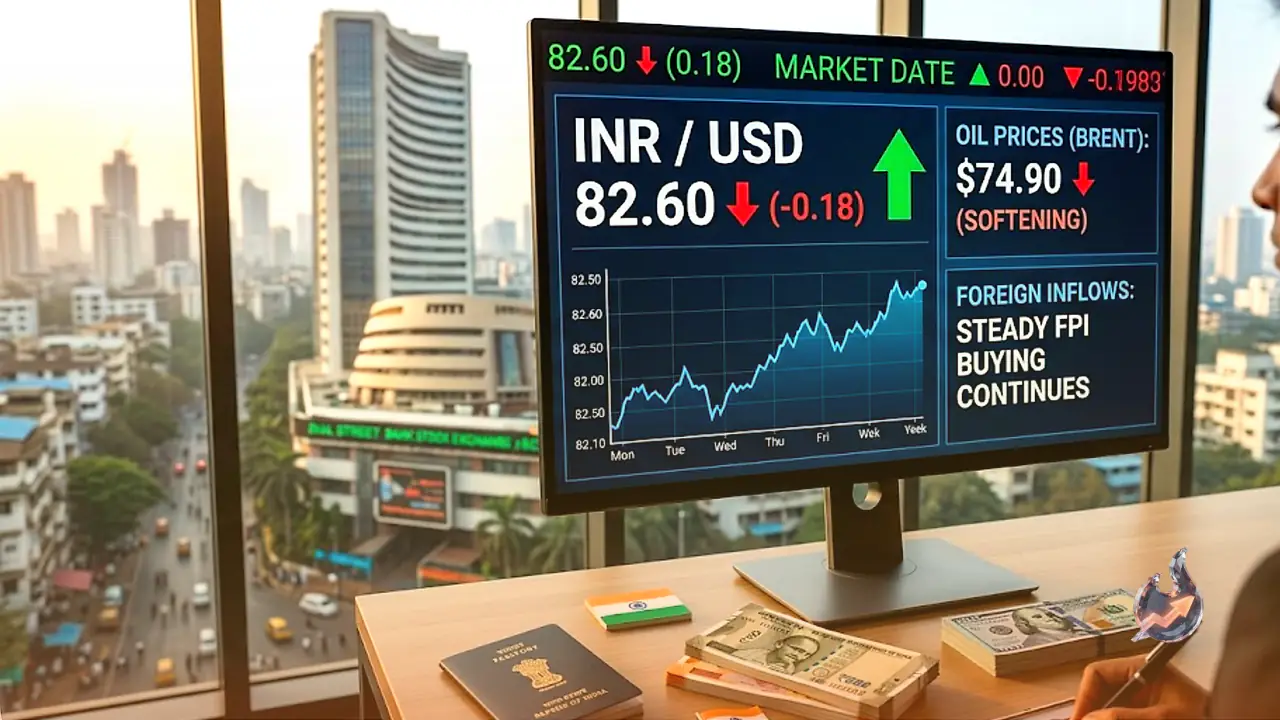

The Indian rupee steadied and edged higher against the US dollar on Tuesday, shrugging off a modest bounce in crude oil prices. The recovery is notable because oil is a key pressure point for India's import-heavy economy, and the buying interest in crude returned just as markets kept one eye firmly on the minutes of the Federal Reserve's June policy meeting, which traders are keenly awaiting.
Oil's bounce and what it means for the rupee
The MCX Crude Oil contract expiring on July 20 is currently trading 1.3% higher at around 6,640. Even so, it remains close to the multi-month low of 6,435 that it printed last week. As a rule, currencies of economies that lean heavily on oil imports to meet their energy needs, such as India, tend to underperform whenever oil prices rebound. That is why every move in crude is tracked so closely for its knock-on effect on the rupee.
Live market data shows the global crude benchmark trading near $69.29, up roughly 1.08% on the day. Yet a 14-day RSI hovering around 31 signals that the longer-term trend is still tilted to the downside. That is one reason the impact of this sudden rebound in oil is expected to stay limited, especially as the ceasefire between the United States and Iran remains intact.
Fresh tension in the Strait of Hormuz
Crude drew fresh support after Iran fired at least two missiles at commercial ships passing through the Strait of Hormuz. Two commercial vessels were struck and suffered significant damage, although no casualties were reported. This waterway is critical to the world's oil trade, so any flare-up there feeds quickly into prices. For now, with the ceasefire holding, markets are not treating the escalation as a reason to panic.
Foreign investors and the earnings season ahead
Foreign Institutional Investors (FIIs) were net buyers for the second straight trading day on Monday, but the sum they put to work was far smaller than what they deployed on Friday. On Monday, FIIs added Rs. 243.03 crore worth of exposure to Indian equities, well below the Rs. 1,355.33 crore invested on Friday. In other words, the buying continued, but at a noticeably slower pace.
Going forward, foreign investors will watch India Inc.'s earnings closely to shape their next moves. Among the Nifty 50 companies, Tata Consultancy Services (TCS) will be the first to report its first-quarter (Q1FY27) results on Thursday, effectively kicking off the earnings season.
Where USD/INR stands technically
USD/INR has slipped to near 95.10, but it still carries a mildly bullish near-term bias, since the spot rate is holding above the 20-day exponential moving average (EMA) at 95.00 and is maintaining its Descending Triangle breakout. The Relative Strength Index (RSI) around 51.6 points to constructive momentum rather than overbought conditions, suggesting a gradual recovery as long as the price stays supported above the short-term EMA.
On the downside, the first support sits at the 20-day EMA at 95.00, followed by the May 7 low at 94.03. On the upside, the pair could look to revisit its all-time high around 97.10.
How the rest of the market is trading
The British pound extended its winning run to a ninth straight session, with GBP/USD trading around 1.3390 during Asian hours on Tuesday. The gains came as the US dollar faced headwinds, with market participants scaling back expectations for Federal Reserve rate hikes both this month and in September.
The euro, by contrast, softened, with EUR/USD easing toward 1.1400 in European trading on Tuesday after being rejected at the 1.1450 level. The pair lost ground amid a modest recovery in the safe-haven dollar, as renewed tensions in the Strait of Hormuz and a sell-off in Asian tech fuelled risk aversion.
Gold held an offered tone through the session but stayed above the $4,100 mark. Higher crude prices, driven by the fresh Hormuz tensions, revived inflation concerns, which in turn pushed US Treasury bond yields higher. That lent some support to the dollar and weighed on the non-yielding yellow metal for a second straight day.
In crypto, Bonk stayed under pressure, trading below $0.0000044 after shedding more than 10% the previous day. The slide followed a disclosure by the Bonk Decentralized Autonomous Organization (DAO) that a governance exploit had led to the theft of $20 million worth of BONK tokens from its treasury.
A bigger shift is also unfolding in how the world's central banks communicate. After years of telling markets what might come next, policymakers at the Federal Reserve, the European Central Bank and the Bank of England are now pushing back against forward guidance, meaning traders may get far fewer signals about the road ahead.