






















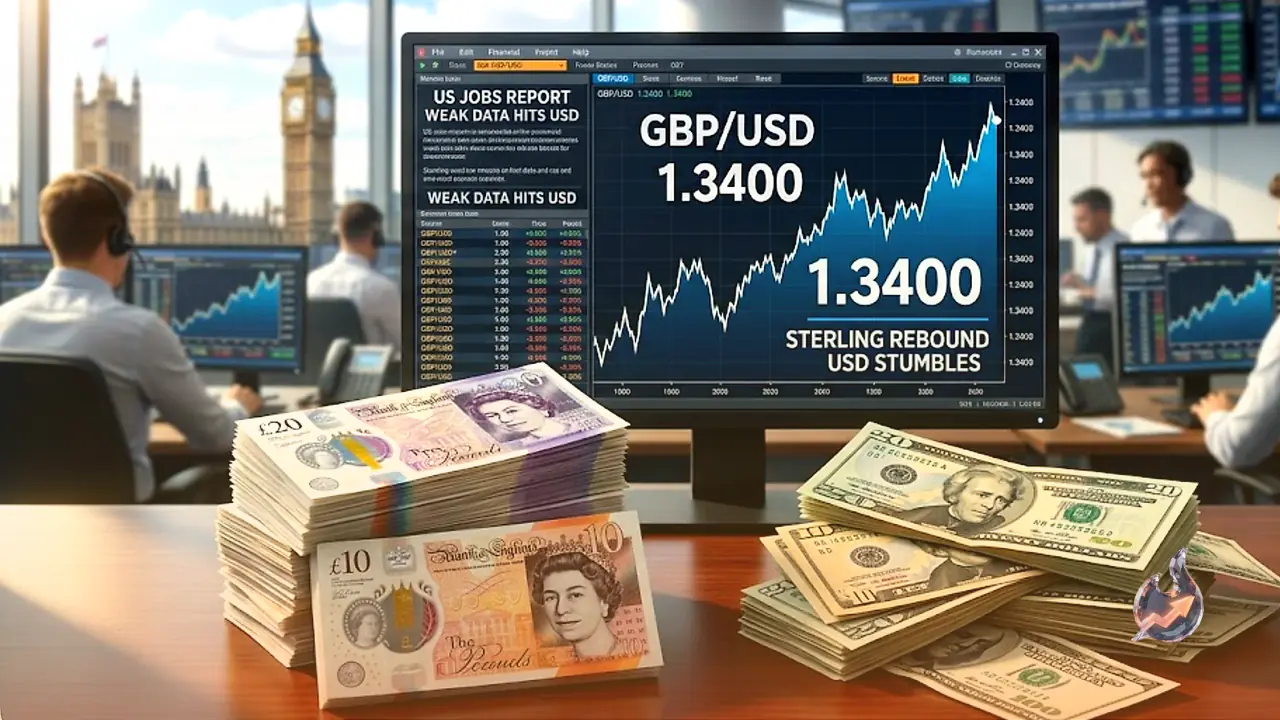

Sterling has bounced off the same long-term support line that has repeatedly held near its seven-month lows, clawing its way back toward the cluster of moving averages sitting overhead. The honest read, though, is that this is a Dollar story dressed up as a Pound one. In live pricing, GBP/USD is trading around 1.33, up roughly 0.49% from the previous close, and the driver was a soft US jobs report rather than any fresh vigour in the Pound, which simply caught the updraft. Back home, a leaderless government is keeping a firm lid on any talk of a durable rally.
A Dollar-driven bounce, not a Sterling revival
What turns a routine Dollar-led bounce into a capped one is the political backdrop. On Thursday, the Greenback came under renewed selling pressure after a softer-than-expected US Non-Farm Payrolls (NFP) print for June, and that is exactly why GBP/USD held well above the 1.3300 barrier. Cable, as traders call the pair, is extending its multi-day recovery and looks set to challenge 1.3400 sooner rather than later. But the whole move is built on Dollar weakness, not Sterling strength, which means it lives and dies by the US data.
Politics keeps a lid on the rally
Prime Minister Keir Starmer resigned in late June, triggering a Labour leadership contest. In that race, Greater Manchester mayor Andy Burnham has emerged as the clear frontrunner and the market's main focus. Fiscal-credibility fears over spending and taxes have kept a political risk premium on both the Pound and gilts. Burnham's pledge of fiscal discipline has taken some of the edge off, yet a central bank flirting with another rate hike into a leaderless government is a fragile foundation for any lasting rally.
Resistance: the wall of moving averages
The recovery runs straight into a wall of moving averages just overhead. The 50-period Exponential Moving Average (EMA) sits near 1.3350 and the 200 EMA is close to 1.3400. In live readings, the EMA20, EMA50 and EMA200 are all clustered around 1.34, with price still in a long-term downtrend. Momentum is on the bounce's side for now, as the Stochastic Relative Strength Index (Stoch RSI) turns up from near-oversold territory; the live RSI(14) is around 53, with the Stochastic fast line at 68 against a signal line of 48. Even so, only a daily close above the moving-average band would open the door to 1.3450 and then the 1.3500 handle.
Support: the 1.3200 line that defines everything
The long-term line near 1.3200 is the level that defines the entire setup, defended repeatedly through the Pound's seven-month lows. Just above it, 1.3300 is the first minor shelf on any pullback. A daily close below 1.3200 would expose 1.3150 and then the 1.3100 handle, confirming that the Dollar-driven bounce has run out of road. Live data pegs the 20-day support near 1.31 and resistance near 1.35, while the 52-week range runs from 1.30 to 1.38.
The near-term bias
While 1.3200 survives, the near-term path points higher toward the 1.3400 cluster. But because this is a rally built on Dollar weakness rather than Sterling strength, it hangs entirely on the US numbers. A decisive break of 1.3200 flips the bias lower toward 1.3150, and given how much of the move is borrowed, that floor deserves close watching into next week's American releases. Among the live technicals, ADX(14) is around 24, pointing to a weak or range-bound trend.
What you should know about the Pound
The Pound Sterling (GBP) is the oldest currency in the world, dating back to 886 AD, and the official currency of the United Kingdom. It is the fourth most traded unit in the foreign exchange (FX) market, accounting for 12% of all transactions and averaging $630 billion a day, according to 2022 data. Its key trading pair is GBP/USD, also known as 'Cable', which makes up 11% of FX turnover, followed by GBP/JPY, or the 'Dragon' as traders call it, at 3%, and EUR/GBP at 2%. The Pound Sterling is issued by the Bank of England.
Interest rates and the central bank
The single most important factor influencing the value of the Pound Sterling is monetary policy set by the Bank of England. It bases its decisions on whether it has achieved its primary goal of price stability, meaning a steady inflation rate of around 2%, and its main tool for the job is adjusting interest rates. When inflation runs too hot, the Bank of England raises rates to rein it in, making credit more expensive for households and businesses. That is generally positive for the Pound, since higher rates make the UK a more attractive place for global investors to park their money. When inflation falls too low, it signals slowing growth, and in that case the Bank of England considers cutting rates to cheapen credit so businesses borrow more to invest in growth.
The data that moves Sterling
Data releases that gauge the health of the economy can also swing the Pound. Indicators such as GDP, Manufacturing and Services PMIs and employment can all steer the direction of GBP. A strong economy is good for Sterling, because it not only attracts more foreign investment but may also nudge the Bank of England toward higher rates, which directly strengthens the Pound. If the economic data comes in weak, on the other hand, Sterling is likely to fall.
Why the trade balance matters
Another significant release for the Pound is the Trade Balance. This indicator measures the difference between what a country earns from its exports and what it spends on imports over a given period. If a country produces highly sought-after exports, its currency benefits purely from the extra demand created by foreign buyers wanting those goods. So a positive net trade balance strengthens a currency, and a negative balance does the opposite.
The wider market backdrop
The Dollar's slide showed up elsewhere too. On Thursday, EUR/USD left behind two straight daily pullbacks and advanced to multi-day peaks near 1.1470, partially offsetting the sharp decline that had been in place since June. That move followed the retracement in the US Dollar, sponsored in particular by the disheartening June Payrolls prints and a sharp sell-off in USD/JPY, with US markets set to close on Friday for the Independence Day holiday. Gold, meanwhile, extended its bullish momentum, climbing above $4,100 per troy ounce to reach its highest level in a week as the Dollar retreated after the disappointing NFP data. Elsewhere, financial markets came to Sintra looking for clues about the Federal Reserve's next move, but they largely left with confirmation that Fed Chair Kevin Warsh intends to make those clues much harder to find.