























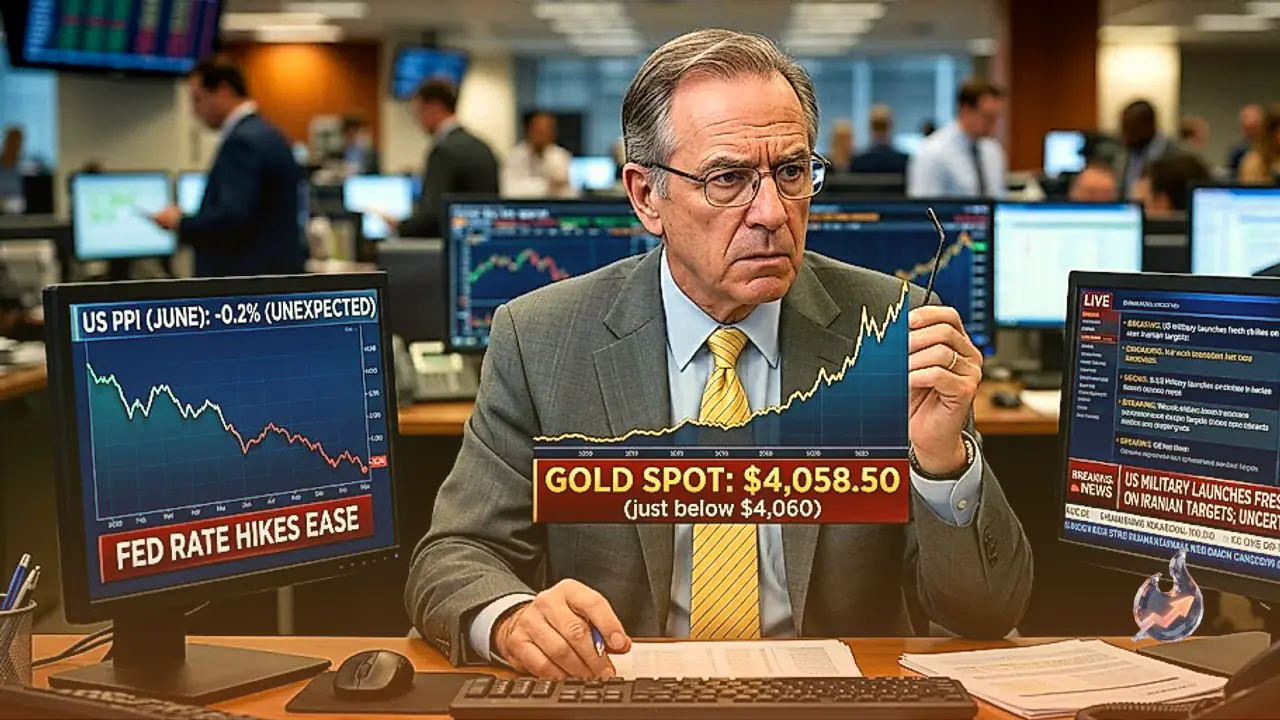

Gold regained its footing in early Asian trading on Thursday, climbing back toward $4,060 and holding above the $4,050 mark. The main trigger was a fresh inflation reading out of the United States: producer prices unexpectedly fell in June, knocking back fears that the Federal Reserve would keep raising interest rates repeatedly this year. Working in the other direction, a fresh wave of US strikes on Iran kept traders on edge, so the picture was far from one-sided.
Producer inflation cooled more than expected
Producer inflation, measured by the change in the Producer Price Index (PPI), eased to 5.5% year-on-year in June from 6.0% in May, which was itself revised down from 6.5%, the US Bureau of Labor Statistics (BLS) said on Wednesday. That reading came in well below the market's expectation of 6.2%. On a monthly basis, the PPI fell by 0.3%, compared with a 0.6% rise in May (revised from 1.1%), and it also beat the estimate that had pencilled in no change at all. In plain terms, the price pressure building at the factory gate is fading, and that worked in gold's favour.
Bets on a rate hike faded
The soft print reshaped how the market is reading the Fed. According to the CME FedWatch Tool, traders now see about a 10.2% probability of a rate hike at the Fed's July meeting, down from 16.6% before the data landed. A day earlier, on Tuesday, consumer inflation had also cooled by more than expected. The June CPI fell 0.4% on the month, the largest one-month drop since April 2020, dragging the annual rate down to 3.5% from May's 4.2% and snapping a three-month streak of acceleration. Core prices, which strip out food and energy, went nowhere on the month and slipped to 2.6% year-on-year. Both figures came in under consensus.
"Gold has pared losses from earlier this morning as PPI came in lower than expected and eased some of those concerns about the Fed having multiple interest rate hikes this year," said Phillip Streible, chief market strategist at Blue Line Futures. Because gold pays no interest, the prospect of rates staying lower makes it more attractive to hold.
US-Iran tensions add cross-currents
On the other side of the ledger, rising hostilities between the United States and Iran are proving to be a double-edged sword for gold. Airstrikes around the Strait of Hormuz have pushed crude oil prices higher. That could force central banks to keep interest rates elevated for longer, which would weigh on gold's appeal as a non-yielding asset.
On Wednesday evening the United States launched fresh strikes against Iran, with US President Donald Trump warning Tehran that it "better behave". Iran's top negotiator, Mohammad Bagher Ghalibaf, said Tehran had "no reason" to abide by the deal if it did not benefit from it. On Tuesday, Trump had threatened to attack bridges and power plants if Iran did not return to talks next week. That same geopolitical instability also lends gold support in its role as a safe haven.
Why gold is seen as a safe haven
Gold has played a central role throughout human history, long used as a store of value and a medium of exchange. Today, beyond its shine and its use in jewellery, the metal is widely regarded as a safe-haven asset, meaning it is seen as a good investment during turbulent times. Gold is also treated as a hedge against inflation and against depreciating currencies, because it does not rely on any specific issuer or government.
Central banks and their gold reserves
Central banks are the biggest holders of gold. In their effort to support their currencies during difficult periods, they tend to diversify their reserves and buy gold to strengthen the perceived health of the economy and the currency. Large gold reserves can be a source of confidence in a country's solvency. According to the World Gold Council, central banks added 1,136 tonnes of gold worth around $70 billion to their reserves in 2022, the highest yearly purchase since records began. Central banks in emerging economies such as China, India and Turkey are rapidly building up their gold holdings.
What moves the price of gold
Gold has an inverse relationship with the US Dollar and US Treasuries, both of which are major reserve and safe-haven assets. When the Dollar weakens, gold tends to rise, allowing investors and central banks to diversify in turbulent times. Gold is also inversely correlated with risk assets: a rally in the stock market usually weakens gold, while sell-offs in riskier markets tend to favour the metal.
The price can swing for a wide range of reasons. Geopolitical instability or fears of a deep recession can send gold sharply higher thanks to its safe-haven status. As a yieldless asset, gold tends to climb when interest rates fall, while a higher cost of money usually drags it down. Even so, most moves hinge on how the US Dollar behaves, since the metal is priced in dollars (XAU/USD). A strong Dollar tends to keep gold in check, whereas a weaker Dollar is likely to push prices higher.