






















South India is on the cusp of a landmark shift in inter-city travel as Indian Railways pushes ahead with plans to connect Tirupati, Hyderabad, Bengaluru, and Chennai through a new high-speed bullet train network. Routes and station locations have already been worked out for the project, bringing the region closer to a new era of fast, modern rail connectivity.
A 760.09-km Corridor Spanning Three States
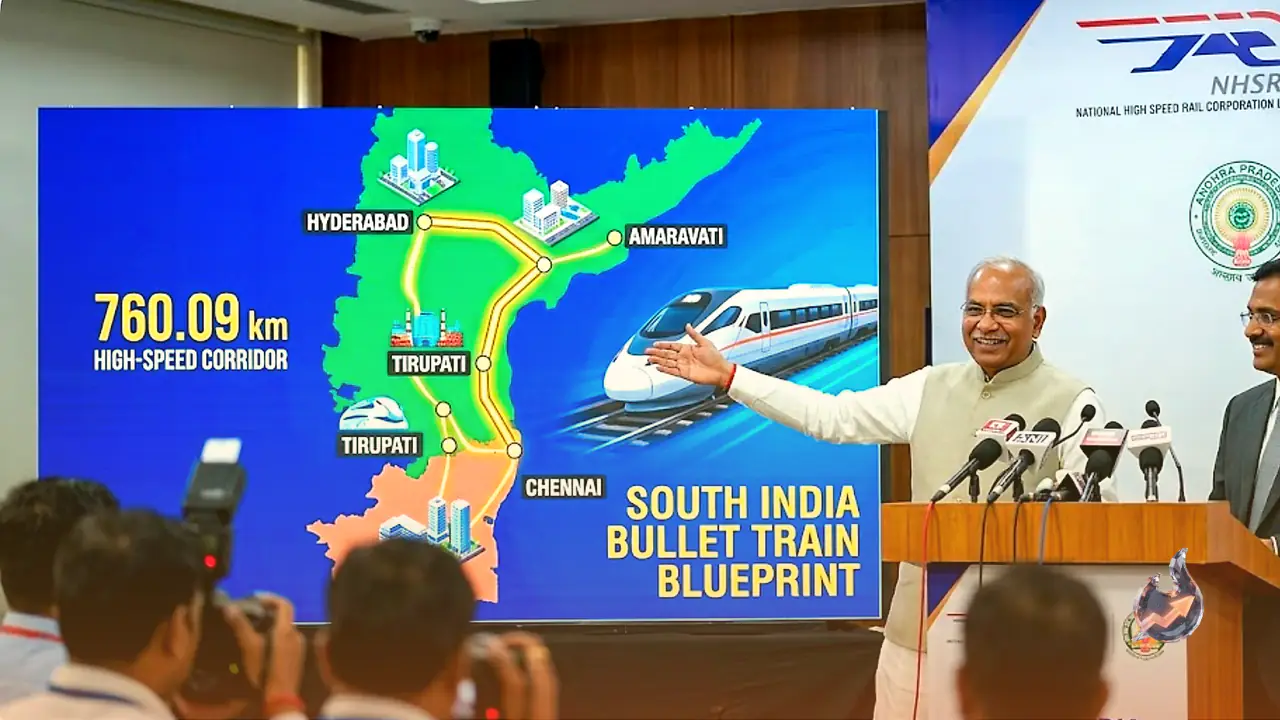
At the heart of the plan is a 760.09-km high-speed rail corridor designed to link Hyderabad, Amaravati, and Chennai. The National High Speed Rail Corporation Limited (NHSRCL) has responded positively to the state government's proposal, clearing the path for the project to advance. The largest share of the corridor, approximately 518.54 km, will pass through Andhra Pradesh, with the remaining portions running through Telangana and Tamil Nadu. Once complete, Andhra Pradesh is set to emerge as a central hub of South India's high-speed rail network.
18 Stations Proposed, Including Tirupati
A total of 18 stations are planned across the corridor. Key stops in Andhra Pradesh include Amaravati, Guntur, Nellore, and Tirupati. These stations will bring fast, modern transit options to major urban centres across the state and significantly improve connectivity between cities, making inter-city travel far more efficient for passengers than it currently is.
A Special 65-km Link Between Chittoor and Tirupati
One of the most notable elements of the proposal is a dedicated high-speed link corridor of approximately 65 km between Chittoor and Tirupati. This portion of the project has been taken up at the request of the state government. NHSRCL has already granted approval for a survey and Detailed Project Report (DPR) to be prepared for this link. Once the DPR is ready, it will be forwarded to the Railway Ministry for final approval before construction can begin.
Direct Bullet Train from Bengaluru to Tirupati Becomes Possible
The completion of the Chittoor-Tirupati link would open the door for a direct bullet train service between Bengaluru, Chittoor, Tirupati, and Amaravati. Passengers would be able to cover these long distances in a fraction of their current travel time. Connectivity across these cities would become substantially faster and more convenient, reshaping how people commute and travel across the region.
Gains for Pilgrims, Trade, and the Regional Economy
The benefits of this high-speed network reach well beyond faster journeys. Pilgrims travelling to Tirupati and Tirumala will gain access to a much quicker travel option, making one of India's most visited religious destinations easier to reach than ever before. More broadly, the network is expected to give a significant boost to industrial activity, trade, and tourism across the region. Improved connectivity is also anticipated to attract fresh investment and drive wider economic activity across all the states covered by the corridor.
Authorities Told to Fast-Track Survey and DPR
Officials have been instructed to complete the survey and DPR as quickly as possible to keep the project moving forward without delay. The government wants all work tied to land acquisition and technical approvals to be wrapped up on schedule. Once the reports are ready, approvals for the next phase and the commencement of construction will follow. The overarching aim of this project is to build a modern, capable transport network in Andhra Pradesh that ties the state firmly to South India's growing high-speed rail grid and positions it as a cornerstone of the region's infrastructure future.