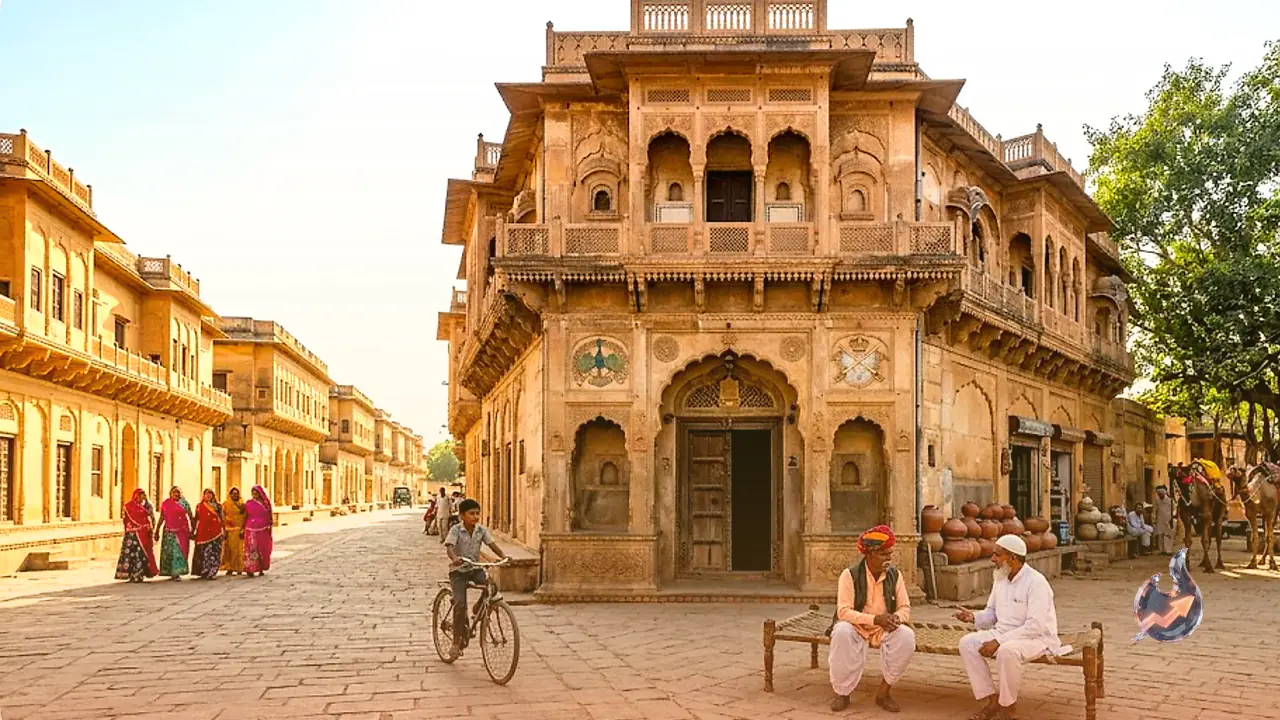

Nestled in the Sikar district of Rajasthan, about 65 kilometers away from the district headquarters, lies the historic village of Guhala. More than just a rural settlement, Guhala represents a living chronicle of centuries-old heritage, royal traditions, and a distinct cultural footprint. This unique village stands out in the region due to its historic structures, preserved customs, and an active social fabric that keeps its royal past alive. The architectural layout of the village, planned on the lines of a major historic city, continues to attract those interested in regional history and traditional urban planning.
Urban Planning Inspired by the Pink City
According to historical details shared by Advocate Krishna Kumar Sharma, the spatial organization of Guhala was modeled closely after the planned structure of Jaipur city during the royal era. The most prominent evidence of this sophisticated design is the village's central Chaupar Bazar. Serving as a prime example of historical town planning, this central square boasts a highly organized market layout. Right at the heart of Chaupar Bazar stands the Shri Laxminarayan Temple, which serves as a key landmark reflecting both spiritual significance and traditional architectural prowess. The historic buildings and aligned shops surrounding the square provide a vivid glimpse into the strategic planning of the bygone era.
Five Centuries of History and the Kantli River Legacy
Local historical accounts suggest that Guhala was founded approximately 500 years ago when members of the Gwal community first settled along the banks of the Kantli River. Over the centuries, this settlement steadily transformed into a prominent village. Beyond its deep-rooted history, Guhala achieved regional economic prominence due to its rich natural resources. High-quality gravel mining from the Kantli River bed became the village's primary economic driver. At one point, Guhala's superior-quality gravel was highly sought after and transported extensively to major districts across Rajasthan, including Jaipur, Bikaner, Sikar, Nagaur, and Jhunjhunu.
Royal Lineage and Administrative Evolution
The administrative journey of Guhala transitioned into the modern era when it was officially granted Gram Panchayat status in 1952, a milestone highlighted by Advocate Krishna Kumar Sharma. Elders of the village recall that the Jaipur Darbar had originally presented the estate of Guhala to Thakur Bhopal Singh of Bikaner. Subsequently, the administration of this territory was overseen by rulers Sangram Singh and Laduram Singh. The magnificent royal fort still stands tall in the village, serving as a physical monument to its aristocratic past. Demonstrating a unique continuity of history, families belonging to the traditional royal administrative lineages, such as the Hakims, Damamis, and Purohits, continue to reside in the village, keeping their ancestral connection to the local heritage intact.
Cultural Processions and Prominent Spiritual Centers
The cultural life of Guhala is marked by vibrant festivities and deeply respected religious practices. A historical tradition dictates that the early rulers of the village brought sacred idols of Gangaur from Bikaner. Since then, a grand royal procession of Gangaur is taken out from the local fort every year, drawing large crowds of devotees and villagers from surrounding regions. Additionally, the Hansanla Dham stands as a major spiritual center in the area, revered as a sacred site where holy saints performed penance. Every year on June 29, a massive fair is organized at this Dham. The site houses temples dedicated to Balaji and the Shri Ram Darbar, which remain central to local devotion.
A Model of Communal Harmony and Social Unity
Guhala is also celebrated across Rajasthan as a shining example of inter-faith harmony and community service. The village is home to more than 15 Hindu temples and four mosques, where members of both Hindu and Muslim communities live in complete peace and cooperation. Key religious sites include the Shri Gopinath Temple, Mandhiwale Balaji Temple, Shani Temple, Bhootnath Temple, and a Shivalaya located in the main market. Highlighting this spirit of mutual respect, five Saini brothers from the village made headlines throughout Rajasthan when they donated a valuable portion of their land to facilitate the expansion of the local Eidgah. Alongside this cultural unity, the village maintains a strong tradition of cattle welfare, with many residents actively contributing to the daily operations of the Shri Krishna Adarsh Gaushala.