























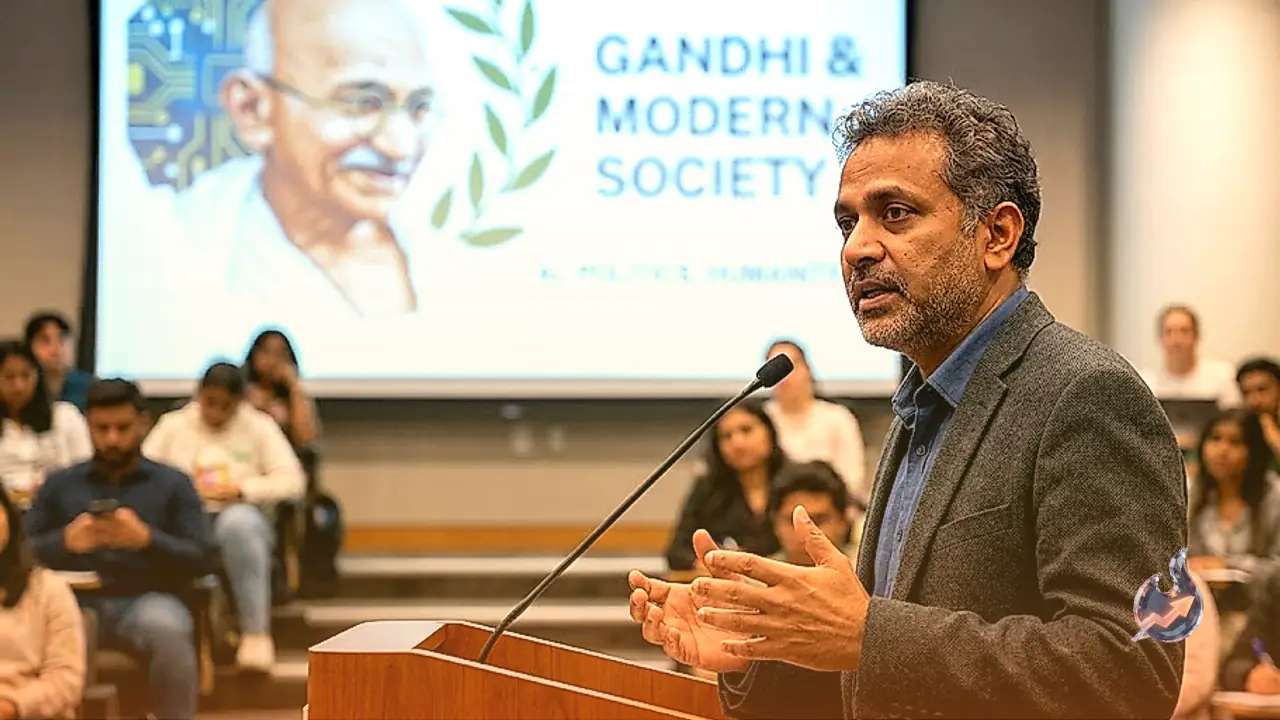

Mahatma Gandhi is often dismissed by many as merely a figure from history books or an image printed on currency, yet his ideas continue to provide essential direction for our social structures, politics, and individual lives. This perspective is shared by Shammi Kumar Singh, a researcher who has spent years conducting deep academic study on Gandhian philosophy. Singh asserts that Gandhi is not just a historical name, but a powerful medium for upholding the highest standards of human values.
From Student Politics to Gandhi Studies
Shammi Kumar Singh revealed that his interest in Gandhian ideology began during his BSc studies at UP College while participating in student politics. During his campaign for the post of general secretary, he became deeply influenced by Gandhi’s principles. He subsequently pursued a postgraduate degree in Gandhian philosophy at Kashi Vidyapith and was awarded a UGC fellowship. He later completed his research on 'The Contemporary Relevance of Socialist Thought of Gandhi and Lohia' at Lucknow University, working under the guidance of Professor KC Pandey.
Redefining Truth and Non-violence
Singh argues that if today's youth were to simply read Gandhi’s book ‘My Experiments with Truth’, most of the misconceptions surrounding his personality would be cleared away. Gandhi was not merely a political leader; he was a fundamental pillar of social, cultural, and philosophical thought. He established principles like truth, non-violence, and self-discipline as the basis of life. According to Singh, Gandhi presented the messages of compassion and non-violence from Lord Buddha to modern society in a fresh, accessible form.
The Influence of Buddha and Kabir
According to the researcher, Gandhi gave new dimensions to the teachings of Buddha and the simplicity of Kabir. He explains that Gandhi’s ‘Ekadash Vrat’ (Eleven Vows) is the foundation of self-discipline. If an individual integrates these into their life, they not only become a better human being but also move closer to divine qualities. Gandhi’s message that there is no substitute for truth remains one of his most significant teachings. Furthermore, his famous stance, “Hate the sin, not the sinner,” continues to teach tolerance and human values to society today.
Non-violence: A Symbol of Bravery
Shammi Kumar Singh’s interpretation of Gandhi’s non-violence is very precise. He explains that people often misunderstand Gandhi’s non-violence. Gandhi maintained that if one had to choose between cowardice and violence, he would choose violence, because there is no sin greater than cowardice. Gandhian non-violence signifies a corruption-free life, honesty, and fearlessness. In the current era of Artificial Intelligence (AI) and advanced technology, Gandhi’s relevance is further amplified. Singh argues that self-discipline is the biggest challenge in this technological age, making the study of the thoughts of Gandhi, Buddha, and Kabir mandatory so that we do not lose our humanity.