




















Few words frighten people the way cancer does, and with this disease, catching it early is often the difference between life and death. Radiologists usually flag cancer by spotting something off in a CT scan, but the human eye is not infallible. In three out of every ten scans, radiologists fail to catch the tumour. That miss can be deadly, because every delay lets the disease spread further. Now a strikingly unusual fix has emerged. A researcher in the United States has brought pigeons into the picture, and yes, you read that right, pigeons are now helping scientists detect lung cancer.
How six pigeons were taught to read scans
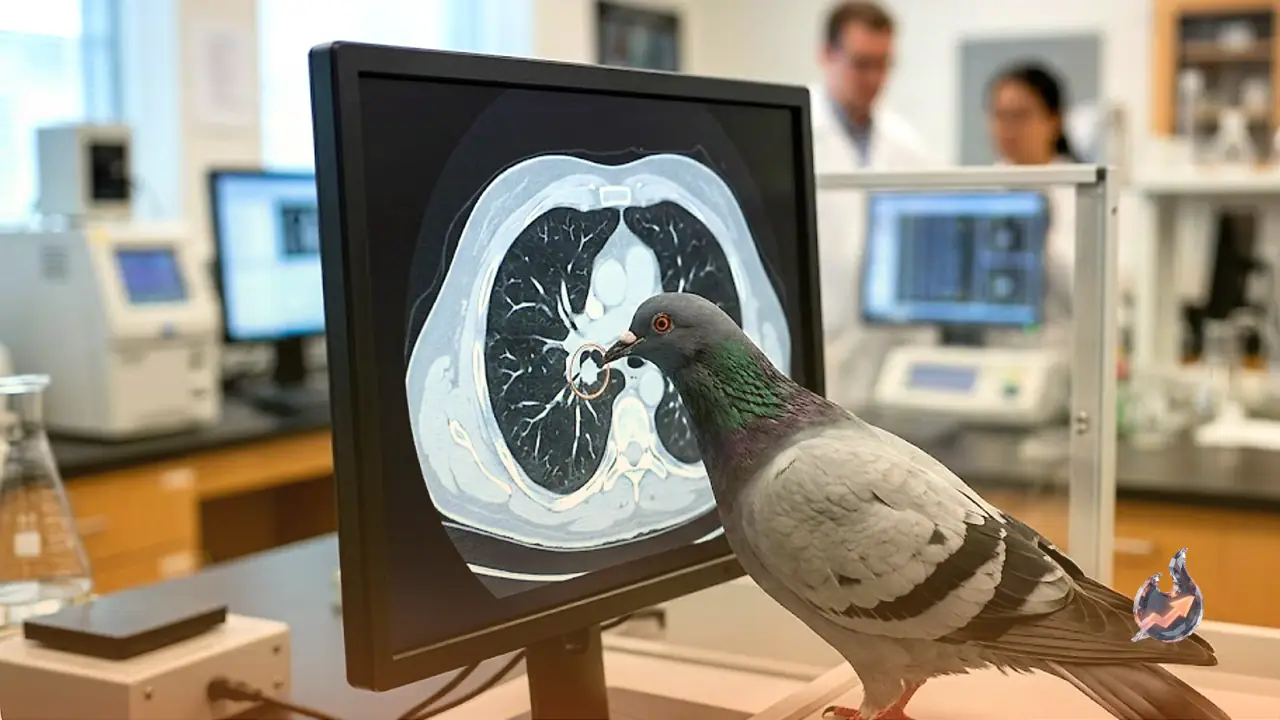
This intriguing study was carried out by Dr. Gregory DiGirolamo, a researcher at the College of the Holy Cross in Massachusetts, along with his team. He gave six pigeons special training and showed them short video clips of CT scans. The birds had just one job, to decide whether there was a nodule, a lump, in the lungs, the same kind of lump that can later turn into cancer.
The training method was as simple as it was clever. Half the pigeons earned a food reward whenever they correctly identified a tumour, while the other half were rewarded for correctly spotting a perfectly clean scan. Bit by bit, the birds mastered the task and began telling nodule scans apart from clear ones with ease. The most astonishing part was that they correctly identified even brand new scans they had never seen before.
Why the human brain sees a tumour yet misses it
The human brain has its own limits, and sometimes they cost dearly. In a key study published in 2025, Dr. Gregory explained that a radiologist's brain does register the tumour in a scan, but the conscious mind fails to process it, so the scan gets labelled normal.
Eye-tracking technology revealed something telling. When radiologists look at a tumour, their eyes pause on it and their pupils widen, a significant signal. In other words, their eyes and brain already sense that something is wrong, but that information never reaches the conscious mind, so the doctor overlooks the tumour. Dr. Gregory wanted to understand exactly this automatic, unthinking visual system, which is why he turned to pigeons, because their visual system works much like the human unconscious visual system.
The birds flagged two more diseases without being trained
The most surprising discovery surfaced a little later. Once the pigeons had learned to spot lung nodules, they also picked out two other diseases, even though they were never given any special training for them. The first was emphysema, in which the air sacs in the lungs are completely damaged. The second was the ground-glass nodule, considered a major sign of early lung cancer.
Dr. Gregory said, ‘To human eyes, these two diseases look completely different from a lung nodule.’ But the way the pigeons performed pointed to something new. It suggests that all three of these conditions share some common visual sign. The human brain may well catch this important cue too, but the doctor's conscious mind ends up calling the scan entirely normal.
Pigeons are not the goal, powerful medical AI is
You will be relieved to know that there will be no pigeon in a white coat at your next checkup. Dr. Gregory wants to use this discovery to build powerful medical AI tools. These advanced tools would help doctors examine scans far more closely, drawing on physiology data from eye-tracking and pupil dilation.
That would reveal how a radiologist's brain responds to the tiny diseases hidden in a scan. This very data would then be fed into new AI models to cut down on errors. Dr. Gregory made it clear, ‘This medical AI will not replace a radiologist, it will only assist them like a tool.’ The tool would bridge the gap between the doctor's conscious and unconscious mind and sharpen their ability.
Beyond lung cancer, how far this technique could reach
The scope of this technique is not limited to lung cancer, it could bring big changes across many other fields. Cardiologists could benefit too, detecting heart attacks far more accurately by reading an ECG.
There are gains beyond medicine as well. By tracking the eye movements of experts, AI can be trained better. With the same approach, art historians could one day tell a genuine masterpiece apart from a cleverly crafted forgery. The system could also prove highly useful in luggage checks at airports, because even when scanners declare an item safe, this system could detect a hidden bomb inside it.
For now, Dr. Gregory is keeping his focus on the medical field. ‘Right now I am keeping myself limited to the medical field, because it is more practical for me,’ he said. He did, however, express hope that down the line he will test this technique on distinguishing real paintings from fakes as well.