























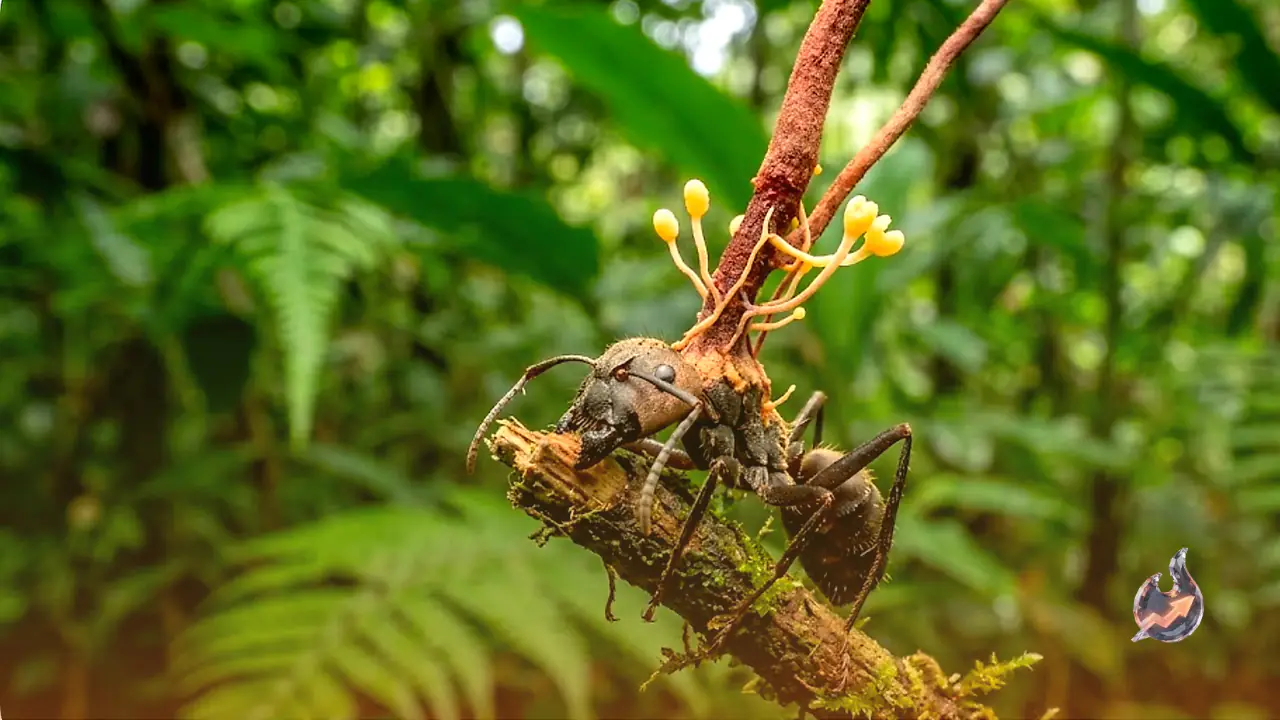

In the remote rainforests of Malaysian Borneo, researchers have made one of the most unusual biological discoveries in recent memory: a fungus that preys on another fungus, itself a well-known parasite of ants. The find adds a striking new dimension to our understanding of tropical ecosystems and the hidden layers of interaction that play out within them.
A Chance Encounter in Danum Valley
The discovery came during a series of field expeditions in the Danum Valley, a dense and largely unexplored stretch of forest in Sabah, a Malaysian state on the island of Borneo. Researchers were closely examining a dead ant when they stumbled upon the organism, reportedly almost by chance. The new species has since been formally named Pleurocordyceps cornusynnemata, a name chosen to reflect its distinctive horn-shaped structure, and its description has been published in the scientific journal Phytotaxa.
The Zombie Fungus and Its Unexpected Predator
To understand why this find is so remarkable, it helps to know the organism it targets. Ophiocordyceps, widely known as the zombie fungus, is a microorganism that infects insects, particularly ants. Once inside a host, it takes control of the insect's nervous system, compelling it to behave in ways that maximize the spread of the fungus's spores. The ant effectively becomes a biological vehicle for the parasite, and the fungus ultimately kills it.
Pleurocordyceps cornusynnemata does not operate by controlling the ant at all. Instead, it attacks the zombie fungus already growing inside the insect's body. Jaya Seelan Sathiya Seelan, deputy director of Malaysia Sabah's Institute for Tropical Biology and Conservation (ITBC) and one of the discoverers of the species, explained the process to AFP: "Rather than manipulating the insect's nervous system itself, Pleurocordyceps infiltrates and feeds directly on the thriving Ophiocordyceps tissue inside the host."
A Horn-Shaped Structure Unlike Any Known Hyperparasite
Hyperparasites, organisms that parasitize other parasites, have been observed in nature before. But Seelan noted that Pleurocordyceps cornusynnemata is the first known hyperparasite to display this particular horn-shaped structure, setting it apart from anything previously described. The ITBC captured the wider significance of the find in a press release: "This rare discovery reveals yet another hidden layer of complexity within tropical ecosystems and demonstrates how much remains unknown about the biodiversity of our forests."
A Spider-Killing Fungus Found During the Same Expeditions
The Danum Valley expeditions yielded another significant find. During the same research trips, the team also identified a previously unknown fungal species that kills spiders, spreading its spores throughout the arachnid's body before causing its death. The simultaneous discovery of two entirely new fungal species during a single set of expeditions underscores just how much undocumented life these tropical forests still contain.
From the Forest Floor to Medicine and Agriculture
These discoveries carry implications well beyond scientific curiosity. Seelan told AFP that both new fungi could prove genuinely useful: "These newly documented fungi hold immense potential, both as sources for developing next-generation antimicrobial drugs and as highly effective biocontrol agents against agricultural pests." At a time when antibiotic resistance poses a growing threat to global health and farmers around the world are actively seeking natural alternatives to chemical pesticides, findings like this one could eventually translate into real-world benefits for medicine and agriculture alike.