























Venture capital investments in robotics startups reached unprecedented heights this year, spanning both a higher volume of deals and larger sums of capital deployed, according to data compiled by PitchBook. Despite this financial surge, a significant number of robotics firms focus primarily on software development while continuing to rely heavily on Chinese manufacturers for their physical hardware components.
Regulatory Pressures and Industry Shifts
Recent regulatory decisions by the Federal Communications Commission to restrict new models of human-shaped robots, commonly known as humanoids, along with other sophisticated devices originating from China, threaten to disrupt smaller robotics enterprises across the United States. However, certain domestic businesses are positioned to capture advantages from this shift, most notably Ati. Established originally in 2017 to engineer drive motors for autonomous vehicles, the startup eventually pivoted toward manufacturing its own commercial robots, including heavy-duty tuggers and pallet movers capable of transporting tons of materials across sprawling industrial facilities.
Leveraging Local Engineering and R&D
By designing its hardware internally, Ati aimed to achieve superior functional performance, a strategic bet that founder Saurabh Chandra notes was met with caution by industry advisers but ultimately reduced the company's reliance on Chinese supply chains. That internal bet has begun yielding commercial results. Ati currently has several hundred operational robots deployed inside warehouses and factories alongside a customer base exceeding 50 clients. Furthermore, the firm's inaugural humanoid robot, designed to handle heavy storage bins, is scheduled for deployment later this year.
Capitalizing on the Electric Vehicle Boom
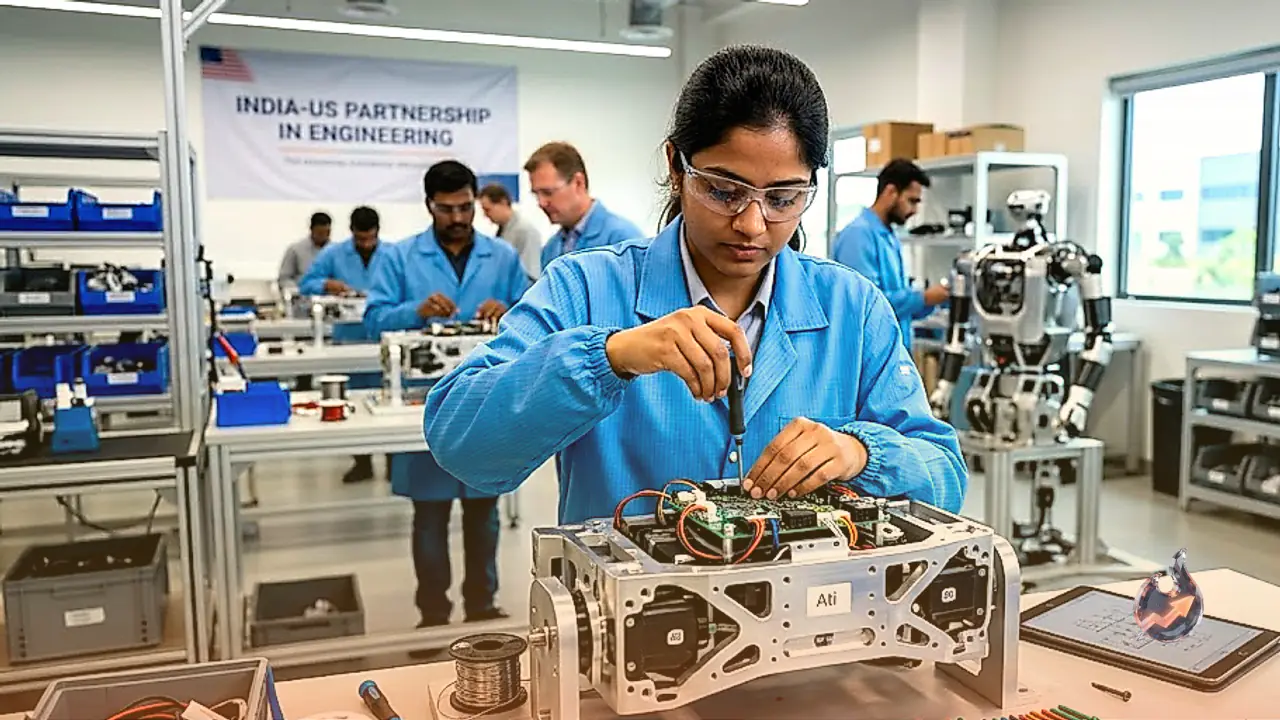
Sustaining hardware development is notoriously capital-intensive, but Ati managed the financial hurdles by establishing its research and development operations in Bangalore. During the startup's formative years, Bangalore was experiencing a massive electric vehicle revolution centered around two-wheelers and three-wheelers. Because the power profiles and operational characteristics required for industrial robots closely matched those being engineered for regional electric vehicles, the company successfully integrated components originally produced for the EV sector.
Securing Reliable Automotive Supply Chains
Automotive components are traditionally built to high standards of reliability and manufactured in high volumes, making them exceptionally cost-efficient. Although Ati engineers had to collaborate with vendors to adapt these automotive components for robotic applications, the engineering effort paid off significantly. When evaluating supply chain resiliency across Ati's product lineup, distinct tiers emerge. The company's top-selling models, specifically the 10,000-pound tugger and the pallet mover, incorporate very minimal components sourced from China.
Anatomy of a China-Free Industrial Tugger
These industrial tuggers and transport trolleys efficiently shuttle raw materials between storage areas and active factory assembly lines. Even within Ati's humanoid platform, the entire robotic arm assembly and its corresponding actuators are constructed locally in Bangalore, though the system still incorporates harmonic drives and frameless motors sourced from China for the time being. Similarly, battery cells originate from China, though Chandra emphasizes that alternative cell suppliers in South Korea or Japan remain readily accessible if needed.
Designing Around Component Constraints
Deeper analysis of the hardware reveals that Ati utilizes induction motors rather than permanent magnet designs, meaning the internal motor magnets completely bypass Chinese manufacturing channels. The company's 10,000-pound tugger stands out as its most independent model, effectively operating as a China-free machine, while the pallet mover contains less than 5 percent Chinese-sourced parts. While the tugger relies on U.S.-based Ouster lidar sensors, the pallet mover requires a specialized solid-state lidar sensor available exclusively from Chinese suppliers.
Engineering Trade-Offs and Efficiency
Choosing induction motors over brushless Chinese alternatives required engineering compromises, as induction motors exhibit slightly lower electrical efficiency. However, the company offsets this minor drop in efficiency by incorporating slightly larger battery capacities. While supply chain transparency is not the primary driver of Ati's marketing strategy, the company openly shares these manufacturing details with prospective buyers, many of whom acknowledge that domestic sourcing actively influences their purchasing decisions.
Expanding Manufacturing to the United States
Looking toward the future development of its humanoid robot, Ati acknowledges that supply chain optimization happens gradually rather than overnight. While precision gears are currently sourced from China, alternative manufacturing hubs exist across Germany, Taiwan, and Japan, providing scalable backups despite slightly higher costs. Addressing the broader impact of regulatory bans, Chandra observes that while the rules do not impose an outright ban on every Chinese part, they will inevitably disrupt numerous developers who rely heavily on imported hardware.
While all of Ati's current robots are manufactured in Bangalore, the company is actively establishing a new assembly facility in Madison Heights near Detroit, Michigan, to support future regional distribution. Industry sentiment regarding the regulatory changes remains mixed, with many peers initially entering a state of denial and attempting unsuccessful lobbying efforts in Washington, DC. Ultimately, Chandra believes that non-Chinese robotics developers across the United States and Europe, alongside established players like Tesla's Optimus and domestic startup Figure, stand to benefit as the industry adapts to a changing regulatory landscape.