


















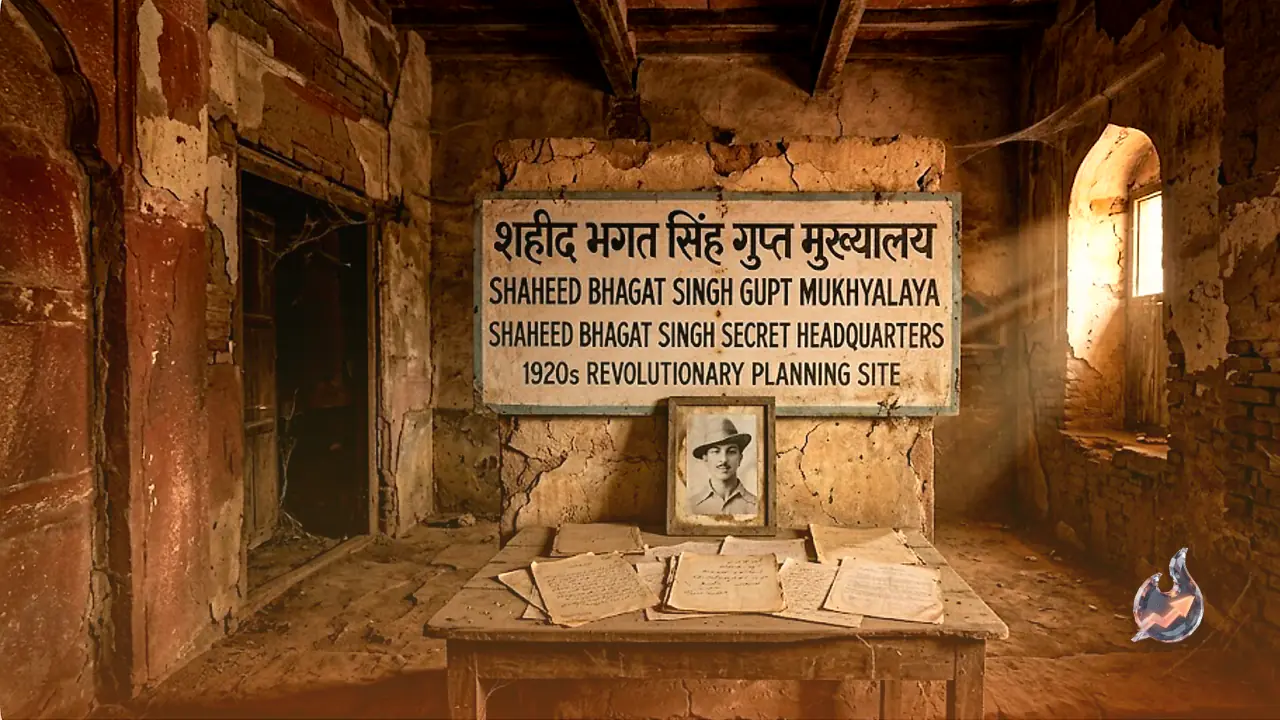

Agra is globally renowned for its Mughal architecture, yet a vital part of its legacy is its profound contribution to India's fight for independence. Few are aware that the city sheltered the revolutionaries who stood at the forefront of the freedom movement. Located in the Nuri Darwaza area, a specific building now known as the Bhagat Singh Dwar once served as the secret nerve center for these brave figures. While this site was once the birthplace of historic revolutionary strategies and clandestine operations, it now stands in a dilapidated state, resembling little more than a neglected ruin.
A Clandestine Revolutionary Haven
Historian Dr. Bhanu Pratap Singh reveals that Bhagat Singh and his revolutionary associates utilized this hidden location while disguised as students. By posing as learners, they managed to stay under the radar while refining their strategies for liberation. Crucially, it was within these walls that Yatindra Nath Das and his colleagues constructed the historic bomb, which was later deployed in the Central Assembly in Delhi on April 8, 1929. Furthermore, Chandrashekhar Azad, the commander-in-chief of the Hindustan Socialist Republican Association, frequently used this address as a refuge, operating under the alias Balraj to avoid detection.
Weaponry Training and Bomb Testing
The wilderness near Agra, specifically the forests of Keetham and Kailash, played a critical role in the revolutionaries' preparations. It was here that Chandrashekhar Azad personally trained his fellow fighters in precision shooting and tactical weaponry. Bhagat Singh and his companions would often conduct secret tests of their manufactured bombs in the isolation of these forests, ensuring their effectiveness for the mission in the capital.
Architectural Defenses for Stealth
Local resident Madan Singh explains that the choice of this particular building by the revolutionaries was highly strategic. The structure featured three distinct secret exit points, which provided the group with an immense tactical advantage. Whenever British police or military forces raided the area, the revolutionaries could easily slip away through one of these hidden routes before the authorities could apprehend them, ensuring their safety and the continuation of their activities.
The Call for a Memorial Museum
Although a statue of Shaheed Bhagat Singh currently stands at the site, where locals gather annually to celebrate his birth and offer respects, the community feels more must be done. Madan Singh and other area residents are calling upon the government to take immediate action to preserve this historic structure. They envision the site being restored and converted into a grand museum, serving as an educational hub to inform younger generations about the immense sacrifices and the rich history of the revolutionaries who once operated from within those walls.