





















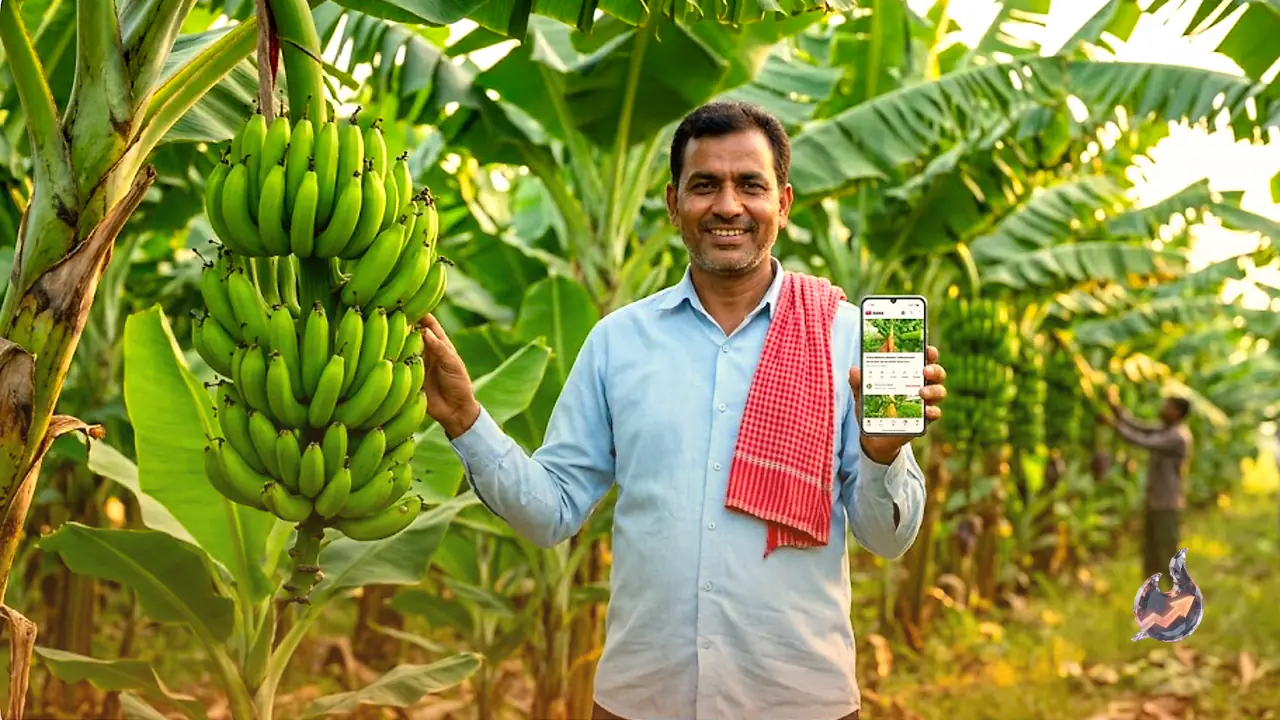

Agriculture in India is undergoing a quiet but powerful transition as modern farmers increasingly look beyond traditional grains to embrace high-value horticulture. In Rampur, Uttar Pradesh, a farmer named Mohammad Asif, residing under the Azeemnagar police station jurisdiction, has established a highly successful model of agricultural entrepreneurship. By leveraging digital learning through YouTube, Asif researched, planned, and executed a commercial G9 banana plantation across three acres of his land. His journey highlights how digital education, paired with a willingness to experiment with high-density cash crops, can elevate a farmer's income far beyond conventional cultivation limits.
Sourcing High-Quality Saplings and Planting Timelines
To ensure a high success rate, Asif did not rely on local seed dealers. Instead, he conducted thorough research into the Grand Naine (G9) banana variety, which is globally recognized for its high yield, excellent fruit quality, and resistance to common environmental stresses. He sourced premium-quality tissue-cultured G9 saplings directly from specialized nurseries in Maharashtra. Even when factoring in the cost of long-distance interstate transportation, each sapling cost him only about ₹18. Asif completed the transplanting process on July 10 of last year. After months of careful nourishment and monitoring, the plants have reached full physiological maturity and are expected to undergo their first major harvest between August and September this year.
High Yields and Substantial Financial Returns
What makes G9 banana cultivation exceptionally attractive to modern growers is its outstanding productivity metrics. The most notable characteristic of this variety is the massive size of its fruit bunches, which routinely weigh between 40 and 45 kilograms. Asif optimized his three-acre field by planting approximately 1200 saplings per acre. Under standard horticultural conditions, even if one calculates using a conservative average weight of 40 kilograms per bunch, a single acre can produce a massive yield of about 480 quintals of high-grade bananas. When backed by stable market demand and favorable market prices, a farmer can easily generate a handsome net profit ranging from ₹4 lakh to ₹5 lakh per acre, making it highly lucrative compared to traditional grain cropping systems.
Crucial Steps for Field Preparation and Spacing
The success of a banana plantation is largely determined before the saplings are even placed in the soil. Thorough land preparation is the absolute foundation of a healthy plantation. The process begins with deep plowing to break up the hard subsoil layers, followed by leveling the ground to ensure even water distribution. To enrich the soil with vital organic matter and micro-nutrients, farmers must integrate a generous amount of well-decomposed cow dung manure into the field. Once the land is fully prepared, the G9 saplings should be planted in a strict grid of 6 feet by 6 feet. This precise spacing is highly beneficial; it guarantees that each banana plant receives an equal and sufficient share of direct sunlight, air circulation, and underground rooting space. Furthermore, this deliberate spacing drastically reduces the risk of fungal leaf spots and other moisture-borne pathogens that thrive in overcrowded crops.
Ideal Planting Windows and the Ratoon Advantage
While G9 bananas offer cultivation flexibility, choosing the correct planting window is crucial for maximizing commercial returns. Agricultural experts recommend two primary planting periods: from February to April, and during the post-monsoon window of July to August. However, in regions where robust year-round irrigation infrastructure is available, farmers can customize their planting dates to suit their operational convenience. Typically, G9 banana plants take between 11 and 13 months to reach full harvest maturity from the date of transplanting. One of the most significant economic advantages of this crop is its ability to produce a "ratoon" harvest. After harvesting the primary stem, farmers do not need to purchase new seeds or clear the entire field. Instead, they can nurture the secondary shoots (suckers) that naturally grow from the base of the mother plant. With proper fertilization and weeding, a farmer can successfully harvest two to three consecutive crops from a single initial planting, significantly lowering input costs for subsequent seasons.
Precision Water Management and Drip Systems
Water management is a decisive factor in banana cultivation, as the crop is highly sensitive to both drought and waterlogging. In the early stages of growth, maintaining stable soil moisture is critical for root establishment. During the peak summer season, irrigation should be scheduled every 4 to 5 days, whereas in the winter months, a gap of 7 to 10 days is sufficient. Utilizing a drip irrigation system is widely considered the best approach for banana farming. Drip technology conserves a substantial volume of water by delivering it directly to the root zone, and it also enables efficient "fertigation" where soluble fertilizers are mixed directly with irrigation water. It is absolutely vital to ensure that there is no water stagnation in the field, as waterlogged conditions quickly lead to root rot, which can destroy the entire plantation in a matter of days.
Preventing Crop Damage with Rope Support Systems
As the G9 banana plants mature and the heavy fruit bunches develop, the physical weight of the crop poses a severe structural challenge. A single fruit bunch weighing over 40 kilograms places immense physical strain on the plant's pseudostem. During sudden high-velocity winds or heavy monsoon rains, these top-heavy plants are highly prone to breaking or falling over, which can lead to catastrophic losses. To prevent this, Asif implemented a practical rope support system in his field. By tying the mature plants together with strong, durable ropes, he created a network of mutual physical reinforcement. This simple yet highly effective management practice keeps the plants upright and stable, ensuring that the fruit bunches mature safely and uniformly without the risk of physical damage.