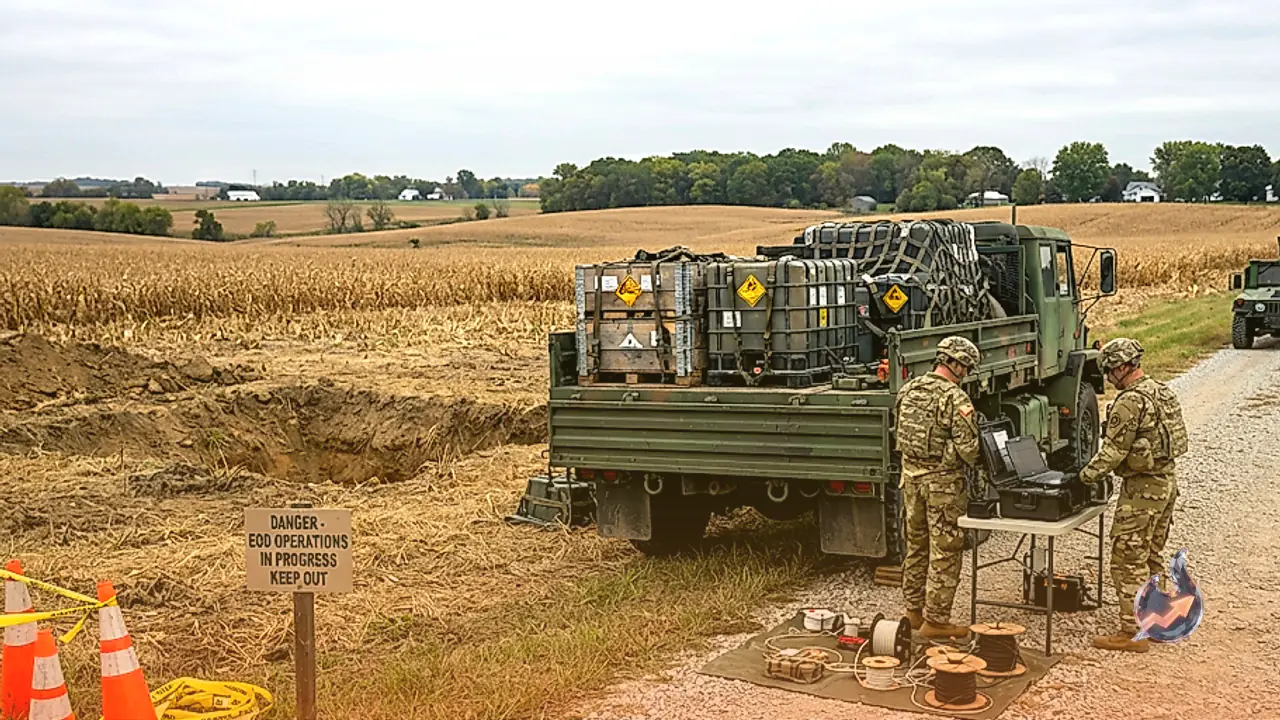

Dark clouds gathering across the sky do not signal a rainstorm, but rather a toxic and lethal plume capable of poisoning human breath directly. Two deafening explosions will suddenly shake the ground, shattering old windowpanes, while a dense, poisonous dust storm filled with lead and explosive chemicals engulfs the entire region. Floating through the air for approximately an hour, this toxic cloud will leave a thick layer of poison on the air, soil, water bodies, and playgrounds wherever it passes. Anyone who happens to get trapped in the path of this dust storm will inhale the venom directly into their lungs and bloodstream.
Panic in Iowa and Severe Administrative Delays
This is not a scene from a Hollywood motion picture, but rather the grim and terrifying reality unfolding in the southeastern part of the state of Iowa, where the U.S. military is scheduled to detonate roughly five tons of highly hazardous bomb-making chemicals. What makes this entire situation most shocking and infuriating is that the government and local administration delayed issuing safety warnings to the general public and schools significantly. The Environmental Protection Agency issued an emergency permit for this detonation on November 13, following which official notices were finally sent out on Sunday to areas spanning up to 100 miles away. Officials in Middletown, located about 20 miles from the plant, were stunned upon reviewing maps on Sunday when they realized their entire municipality fell directly in the path of this toxic fallout. Deputy City Clerk Amy Stucker expressed deep frustration, emphasizing that the primary issue has been a severe lack of communication. Shockingly, even the office of Iowa Governor Kim Reynolds was first informed about this public advisory on Monday. Consequently, a hurried decision was made on Tuesday to declare a Friday shutdown for local schools and cancel all scheduled athletic events.
The Severe Health Dangers Posed by Toxic Dust
According to officials, the poisonous dust kicked up by the blast will remain airborne for a maximum of one hour before settling down onto the ground, rooftops, vehicles, and trees. Experts point out that this is not ordinary soil, but rather a mixture containing lead and microscopic chemical residues used in munitions manufacturing. If an individual comes into contact with this dust or inhales it into their respiratory system, it launches a direct assault on the bloodstream and the nervous system. Professor Patrick O'Shaughnessy from the University of Iowa voiced profound concern over the matter, noting that lead is a dangerous neurological toxin that directly damages brain tissue in humans. The most devastating impact falls upon young children, as it can permanently arrest their cognitive development and destroy their memory and learning capabilities. Because toddlers frequently play on the ground and place objects in their mouths, settling dust of this nature can prove to be an absolute poison for them. Among adults as well, exposure risks include kidney failure, elevated blood pressure, and adverse effects on reproductive health. Animals and livestock face an equally lethal threat from the fallout.
Why the U.S. Military Was Forced to Detonate
The central question arising from this crisis is why the U.S. military is not simply postponing the blast given its extreme hazards. Hidden behind this decision is a critical administrative oversight dating back more than 20 years. Dozens of barrels containing a sensitive explosive chemical known as lead azide had been buried underground inside containers at the Iowa Army Ammunition Plant for over two decades. To keep them stable and secure, these substances were submerged in a solution of ethanol and water. However, during routine inspections earlier this year, military personnel discovered to their horror that the water inside the containers had completely evaporated, leaving the chemicals dried out into dangerous crystals. Under scientific principles, dried lead azide is so highly volatile that even minor friction, a slight jolt, or a shift in temperature can spontaneously trigger a massive explosion. According to Army Sustainment Command spokesperson Justine Barati, as colder winter weather approaches, the risk of spontaneous detonation multiplies significantly. Handling these barrels or attempting to transport them elsewhere was considered tantamount to courting death. The option of chemically neutralizing the contents was also dismissed because the slightest movement of the barrels could trigger a blast.
Evacuation Mandates and Rigorous Safety Precautions
Acknowledging the severity of the threat, local authorities instructed residents living immediately adjacent to the plant in Middletown to completely evacuate their homes by Friday morning and seek shelter elsewhere. Those unable to leave their residences have been issued strict advisories to keep all doors and windows tightly shut and remain indoors. To mitigate the dispersal of dust from the blast, the military has constructed thick concrete barriers and two-story high earthen mounds around the barrels. Water sprays and mist will be deployed into the air during the detonation to prevent toxic particles from traveling vast distances. Meanwhile, the public library in Mediapolis has been closed, and fire trucks stand ready to wash down athletic fields and public spaces immediately after the explosion. Despite these measures, citizens are questioning on social media whether merely washing cars and windows will eliminate this microscopic poison. Concerns have spread as far as the neighboring state of Illinois, where health officials have demanded testing of local soil and water resources. For now, thousands of residents hold their breath awaiting Friday, when two massive blasts will determine how much poison settles into their skies.