

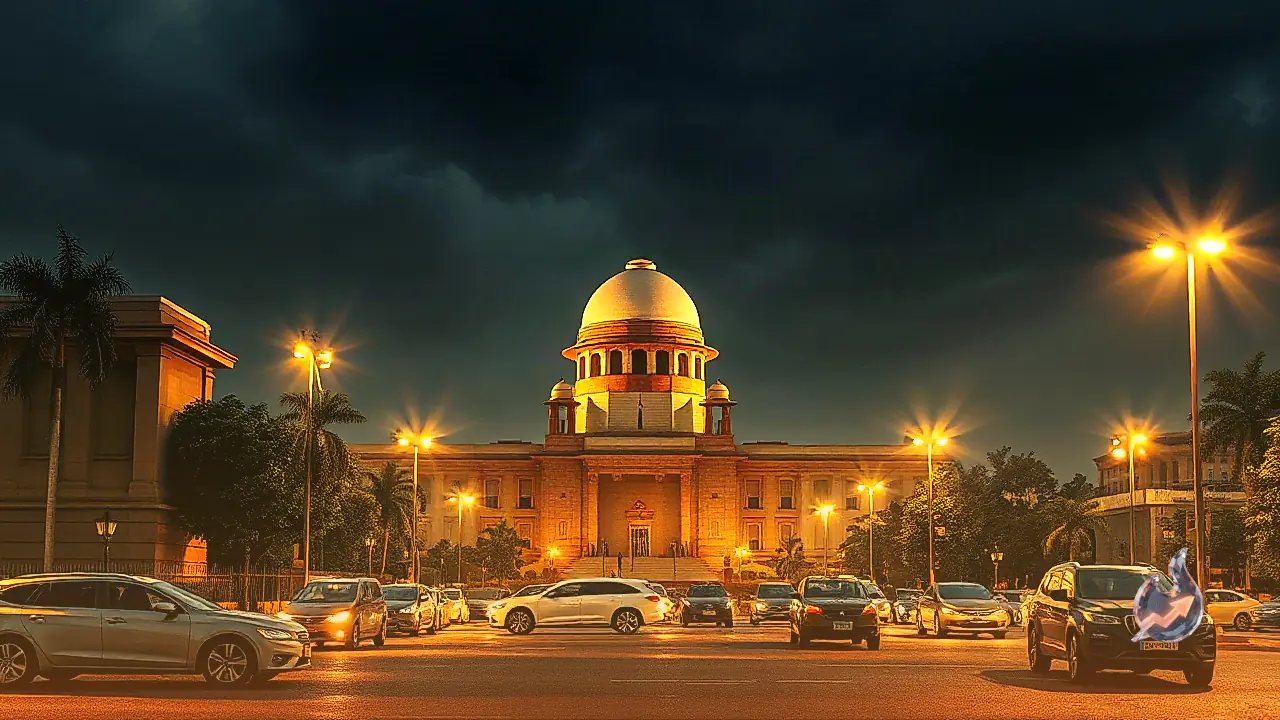





















Taking a stringent view of mounting unpaid fines across the country, the Supreme Court has cracked down on motorists who evade road safety penalties. Around Rs 20,000 crore remains outstanding across states and union territories in unpaid traffic e-challans. To address this massive backlog, the top court has directed all state governments and union territory administrations to immediately halt essential transport and digital services for any motorist or vehicle with outstanding traffic fines.
Halting Essential Vehicle Clearances and Central Portal Blacklisting
A bench comprising Justice J.B. Pardiwala and Justice K.V. Viswanathan issued sweeping instructions aimed at making electronic enforcement of traffic discipline far more potent across India. Under these directives, regional authorities must halt the renewal of vehicle registrations, fitness certifications, and the issuance of pollution under control (PUC) certificates for vehicles carrying pending fines. Furthermore, vehicle ownership transfers and driving licence renewals are to be blocked until the dues are cleared.
The bench ordered that all vehicles with unpaid e-challans must be placed on a blacklist on the central transport portal. This status effectively prohibits any sale, transfer, or commercial reassignment of the affected vehicles. Testing centres are prohibited from granting PUC clearances until all traffic dues are settled. For habitual traffic violators with multiple pending notices, the authorities have been instructed to withhold licence renewals and actively initiate proceedings to suspend active driving licences.
Issuing Fines Without Collection Serves Little Purpose
The bench observed that generating thousands or millions of electronic traffic notices accomplishes nothing if enforcement agencies lack the mechanism to collect the penalties. Statistical records submitted to the court indicated that out of an estimated Rs 49,194.05 crore generated through recent e-challans, only ₹26,175.05 crore has been successfully recovered so far. This leaves a massive deficit of nearly Rs 20,000 crore still uncollected across multiple jurisdictions.
Proposal to Link Outstanding Dues With Power Tariffs
The court expressed exasperation over the enormous gap between notices issued and revenue recovered. Justice J.B. Pardiwala and Justice K.V. Viswanathan emphasised that merely generating paper or digital citations is meaningless without effective recovery mechanisms. During earlier deliberations, the bench even floated an unconventional suggestion, asking authorities whether unpaid traffic fines could be clubbed directly with household electricity bills. The reasoning offered was that non-payment would risk disconnection of power supply, compelling vehicle owners to clear their dues, stressing that authorities must find practical avenues to enforce accountability.