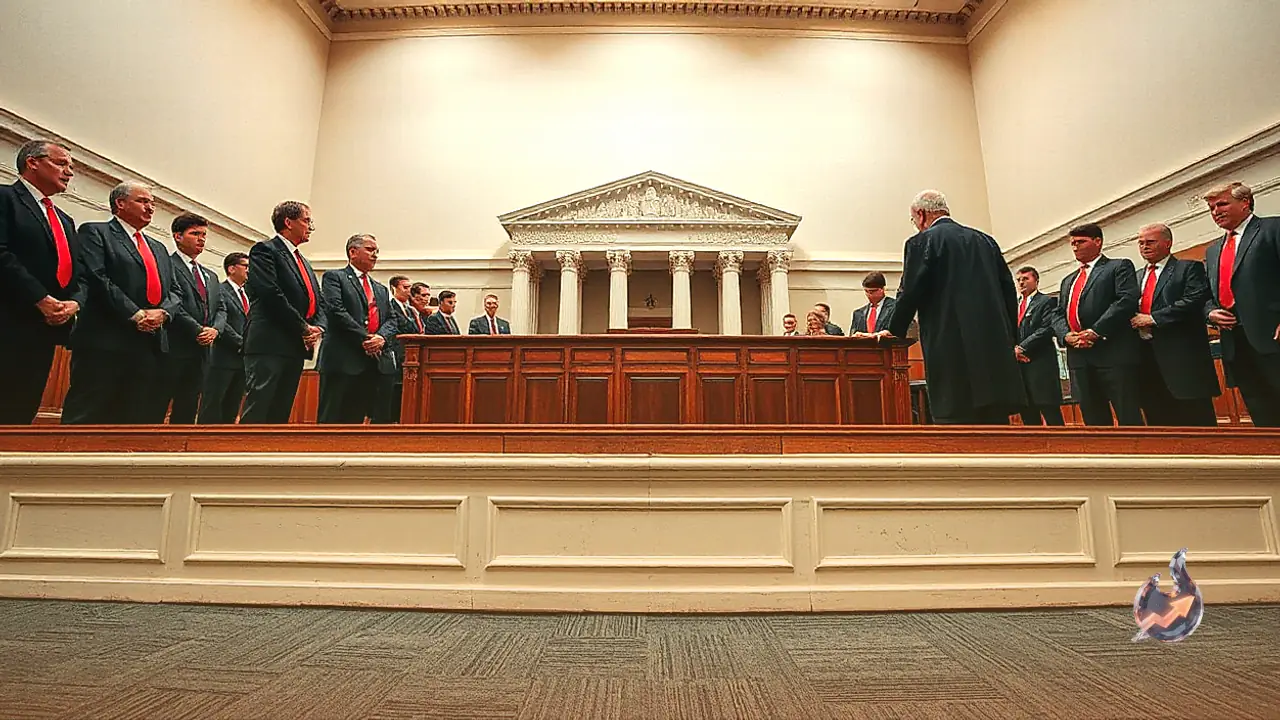

In a decisive move to uphold internal discipline within the highest court of the country, Chief Justice Surya Kant has taken strong administrative action. Following detailed consultations with the four senior-most judges of the Supreme Court, the Chief Justice has withdrawn at least two cases from the bench headed by Justice Ahsanuddin Amanullah. Along with this step, a strict advisory has been issued to all judges emphasizing the absolute necessity of adhering to assigned rosters.
Diversion of Private Pleas Into PILs
According to reports, the two cases in question had originally entered the Supreme Court as standard private litigation matters. However, as proceedings advanced before the bench, the scope was widened to transform them into public interest litigations. Notably, public interest matters did not fall under the designated roster allocated to Justice Amanullah, yet his bench proceeded to hear them. Observing this procedural anomaly, the Chief Justice acted immediately to remove both matters from that bench.
Preceding Directives on Roster Discipline
This decision is being viewed as an uncommon institutional intervention designed to enforce strict compliance with court rosters. Roughly four weeks prior during a full court meeting, the Chief Justice had explicitly noted that judges must confine hearings strictly to cases listed under their officially allotted rosters. Maintaining this system ensures systematic case allocation, preserves judicial discipline, and sustains public trust in the administration of justice.
First Matter Transferred to a New Bench
The first matter is titled Ayesha Jain v. Amity University Noida. It originated from a complaint filed by a student alleging harassment and the loss of an academic year following a name change. During hearings, the bench expanded the matter into a nationwide review regarding the establishment, funding, and regulation of private universities. Directives had also been issued to the Centre, various states, and regulatory bodies. This partly heard case has now been reassigned to a three-judge bench led by Justice Vikram Nath, alongside Justice R. Mahadevan and Justice Aparesh Kumar Singh. The matter is scheduled for hearing on November 19.
Second Matter Involving Unauthorised Construction
The second case involves Loganathan v. Government of Tamil Nadu. The proceedings began with a complaint concerning an unauthorised one-and-a-half-storey building in Chennai. Subsequently, the bench widened the scope to address unapproved constructions and the misuse of residential properties across the nation. Responses were sought from municipal bodies in major cities, including the Delhi-NCR region. This case will now be listed before the bench of Justice B.V. Nagarathna for hearing on November 23.
Consultations and Established Precedents
Sources indicated that before arriving at this decision, the Chief Justice consulted with Justice Vikram Nath, Justice B.V. Nagarathna, Justice M.M. Sundresh, and Justice P.S. Narasimha. A legal expert noted that if a bench felt a matter warranted consideration as a public interest litigation rather than a private dispute, it ought to have routed the file through the registry to the Chief Justice instead of assuming jurisdiction over matters outside its roster.
Master of the Roster Principle
This development aligns with several established rulings affirming that the Chief Justice remains the master of the roster. Landmark judgments, including the 2017 Campaign for Judicial Accountability case and the 1997 State of Rajasthan v. Prakash Chand matter, have clearly established that individual benches cannot take up cases suo motu outside proper administrative allocation. A request for comment sent to Justice Amanullah did not yield a response. The overarching development is seen as a significant step toward reinforcing judicial order and institutional discipline.