






















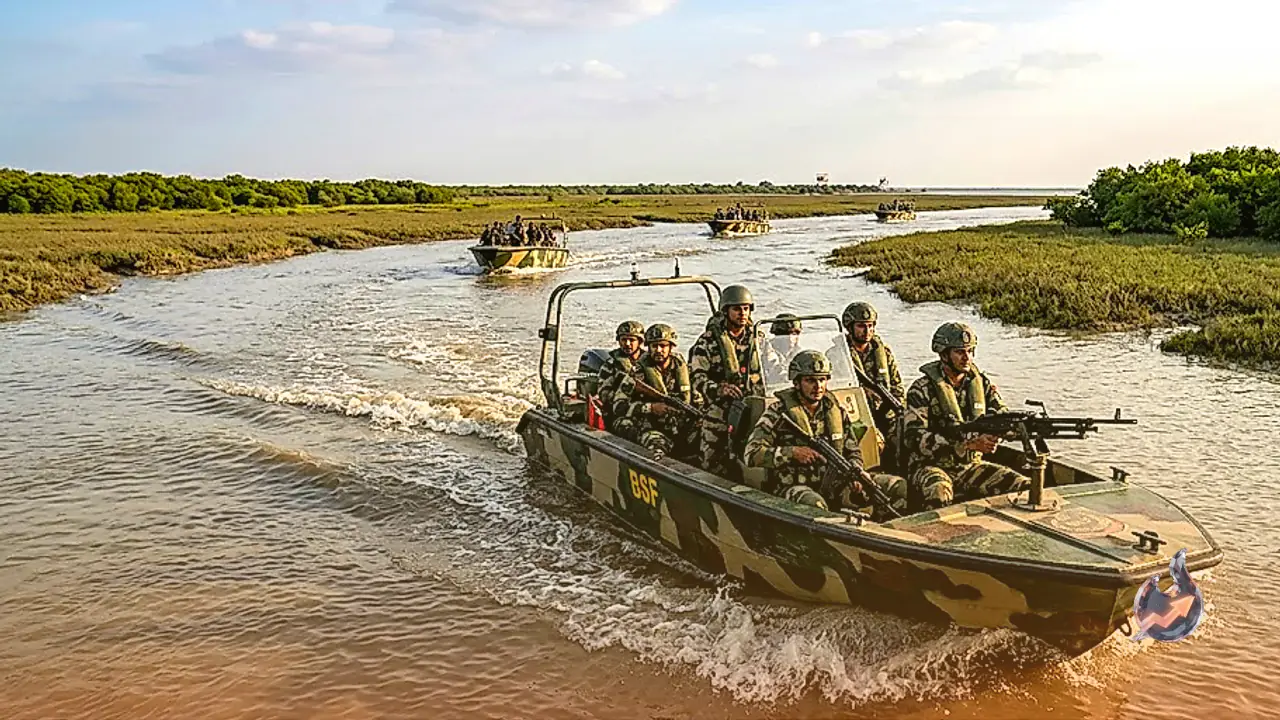

India has moved to lock down one of its most vulnerable frontiers, the marshy Sir Creek sector in Kutch, Gujarat, along the India Pakistan border. The Ministry of Defence has cleared the procurement of 11 indigenous, high speed amphibious combat boats, vessels capable of operating on both water and land, to patrol this strategically sensitive stretch. With this move, every suspicious movement along one of the most delicate points on the India Pakistan border will now come under the direct and sharp watch of the Indian Army.
A firm reply to last year's drone strikes
The decision has not come out of nowhere. Last year, the Pakistani army attempted to target Indian infrastructure using drones, an act India took extremely seriously. Recent intelligence inputs indicate that Pakistan has been steadily ramping up troop deployment and infrastructure in this disputed marshy stretch. To choke off that growing threat before it escalates further, India has chosen to effectively double its strike capability in the area, so that any infiltration or hostile plan from across the border can be crushed right at its source.
A dispute that has simmered since 1947
Sir Creek has remained a point of friction between India and Pakistan ever since Partition in 1947, when Sindh went to Pakistan while Gujarat stayed with India. The 1968 Tribunal Award settled most of the boundary disputes concerning Kutch, but the Sir Creek estuary has stayed unresolved despite several rounds of talks between the two sides, keeping this stretch a recurring flashpoint.
The Thalweg Principle at the heart of the standoff
The disagreement traces back to differing interpretations of an old 1914 resolution. Pakistan claims the entire creek and treats the eastern bank as the boundary. India, on the other hand, invokes the Thalweg Principle, an internationally recognised rule under which the border should run through the exact middle of the navigable channel. Pakistan has repeatedly, and unsuccessfully, tried to reject this principle by arguing that Sir Creek is a tidal estuary rather than a river. India's position remains firm that maps and historical boundary markers are the final and decisive basis for defending its border.
India now stands with the US, China and Russia
Amphibious combat boats and hovercraft, built to give troops fast and lethal mobility across shallow water, mudflats and marshland, have so far been the preserve of only a handful of nations. The United States, China, Russia, South Korea, Japan and Pakistan itself all deploy this kind of specialised capability to guard their coastlines and river deltas. With the induction of these 11 new indigenous boats, India now joins that same select military club, a clear marker of its growing military strength.
No escape route left for infiltrators
Once these boats are deployed, the entire demography and surveillance of the Sir Creek area will come fully under India's control. Any Pakistani soldier or infiltrator attempting to sneak through the marshland will no longer be able to slip past India's security cordon. The Ministry of Defence believes this move will further cement India's strategic edge in the Sir Creek sector and stamp out any cross border conspiracy right from the start.