






















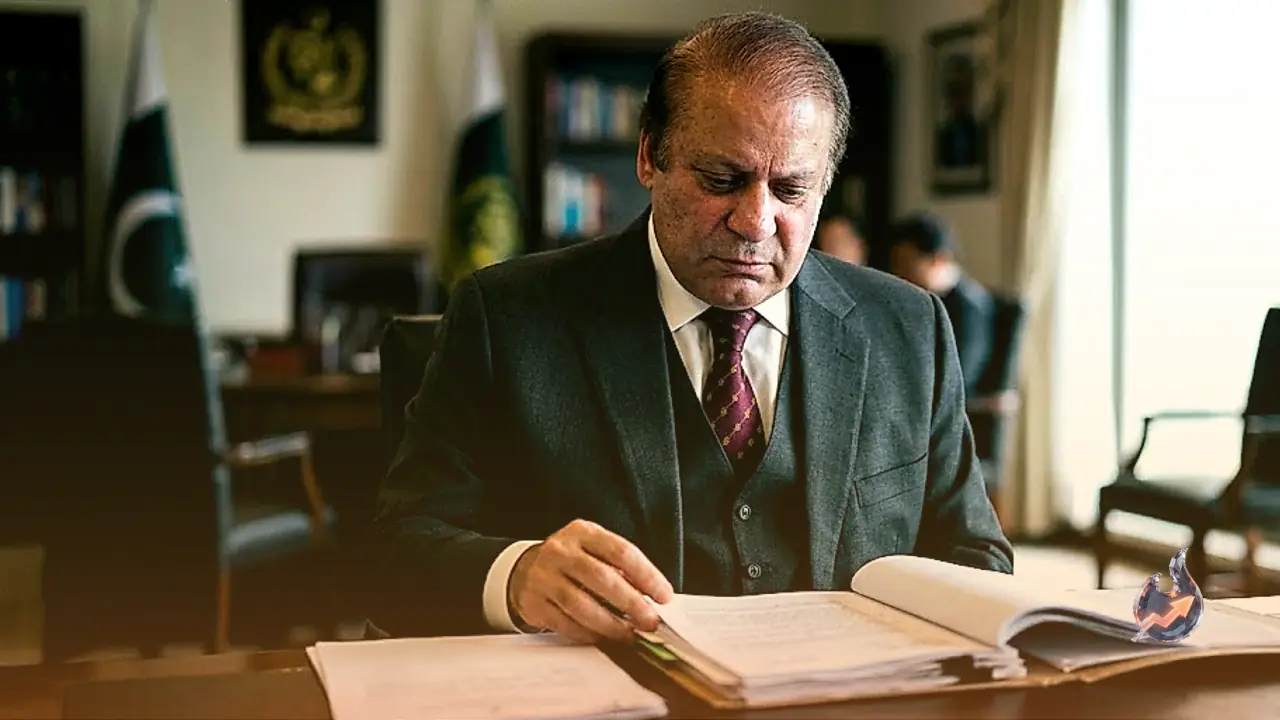

Five years after the Kargil war ended, Pakistan's then Prime Minister Nawaz Sharif made a statement that reopened an old and uncomfortable question. Sharif said appointing Pervez Musharraf as army chief was his biggest mistake, and that he had no knowledge of Operation Badr or the Kargil war. That claim revived a familiar debate: was Sharif genuinely in the dark, or was he part of the conspiracy himself? A closer look at the documented timeline suggests a messier answer, because Musharraf carried out Operation Badr by climbing a ladder Sharif himself had built. Operation Badr was, in fact, the code name given to the attack on Kargil.
Karamat's exit cleared Musharraf's path
According to documented accounts, Sharif and Musharraf had begun laying the groundwork for Operation Badr as early as August 1998. That may explain why Sharif picked a fight with then army chief General Jehangir Karamat over making Musharraf the next army chief. Karamat was only months away from retirement, but he did not want Musharraf to take over as Pakistan's new army chief. The friction between the two came out into the open when Sharif began openly criticising Karamat in public. Stung by the criticism, Karamat resigned from the post of army chief without waiting out his term.
Karamat's resignation cleared the way for Musharraf to become army chief, even though he was only the third-ranking officer in the Pakistan Army by seniority at the time. Despite that, Sharif bypassed two more senior officers and installed Pervez Musharraf as Pakistan's army chief, a decision that broke with normal military convention and raised eyebrows from the start.
Musharraf's first big moves as army chief
The moment he took charge, Musharraf went into action mode with a set of pointed appointments. He made Lieutenant General Mahmud Ahmed the commander of 10 Corps; Ahmed had previously been in charge of military operations in Pakistan-occupied Kashmir. Rules were also set aside to make Lieutenant General Mohammad Aziz Khan, then posted with the ISI, the Chief of Staff of the Pakistan Army. These reshuffles were a clear signal that something significant was being planned.
Planning for Kargil began in November 1998
With trusted officers placed in key positions, Musharraf began working on the plan to attack Kargil as early as November 1998. The goal was to shift control of the eastern side of the Line of Control near the Zoji La pass. Achieving that would have weakened India's grip on the Srinagar-Kargil-Leh highway, the key road link connecting Leh and Ladakh to the rest of Jammu and Kashmir, and would have opened a clear route for infiltration into Jammu and Kashmir.
A conspiracy kept under tight wraps
The plot to attack Kargil was kept extremely secret, known only to a select group of Pakistani military officers. North Light Infantry battalions were specially trained to carry out Operation Badr. New routes were built to move weapons and ammunition up to the border, and helipads were constructed to drop in soldiers disguised as militants. The level of preparation showed this was not a small-scale infiltration but a full-fledged military operation.
From February 1999, the plan moved onto the ground
Once preparations on the ground were complete, the Pakistan Army began acting from February 1999 onward. Patrol parties were sent first to survey the terrain and track Indian army movements. After scouting the border areas, Pakistani troops began setting up patrolling posts. Under the plan, Operation Badr was scheduled to be executed in April-May 1999, timed for right after the snow melted, when Indian posts would typically be reoccupied following the winter.
So did Nawaz Sharif really know nothing?
Sharif, Pakistan's Prime Minister at the time, always portrayed the Kargil war as a stain on his record. He repeatedly tried to establish that he had no idea of Musharraf's intentions. Sharif maintained that Musharraf never told him the real objective of the operation, and that he learned of the Pakistan Army's involvement in the Kargil war from India's then Prime Minister Atal Bihari Vajpayee. But several facts directly contradict these claims.
Intelligence reports say Sharif was briefed twice
According to intelligence reports, Sharif was first briefed about the plan to attack Kargil in December 1998 or January 1999. He was briefed again in March 1999. Secret conversations between Musharraf and his Chief of Staff Aziz Khan also back up the claim that Sharif was not entirely unaware of what was unfolding.
Sharif's anti-India rhetoric sharpened
Despite the Lahore Declaration, Sharif suddenly sharpened his rhetoric against India in April 1999. This was most visible after India tested the Agni-2 missile, when Pakistan's foreign minister Sartaj Aziz and Senator Akram Zaki accused India of serious human rights violations in Jammu and Kashmir. This escalation in statements came at the very time ground preparations for Operation Badr were entering their final stage.
The calculated outreach to Sikh separatists
To mislead India, Sharif appointed Lieutenant General Javed Nasir, a former chief of the ISI, as head of the Pakistan Gurdwara Prabandhak Committee. On 13 April 1999, under the cover of Baisakhi celebrations, Sharif went out of his way to meet Sikh separatists. Through this, Sharif wanted to signal to India that Pakistan was plotting to revive terrorism in Punjab again, drawing India's attention away from what was being readied at Kargil.
Special powers for Musharraf before the war
A few months before the Kargil war began, Sharif handed Musharraf special powers, making him the acting chairman of the Joint Chiefs Committee. This was the same period during which the groundwork for Operation Badr on the ground had nearly been completed, giving Musharraf a free hand to make decisions.