






















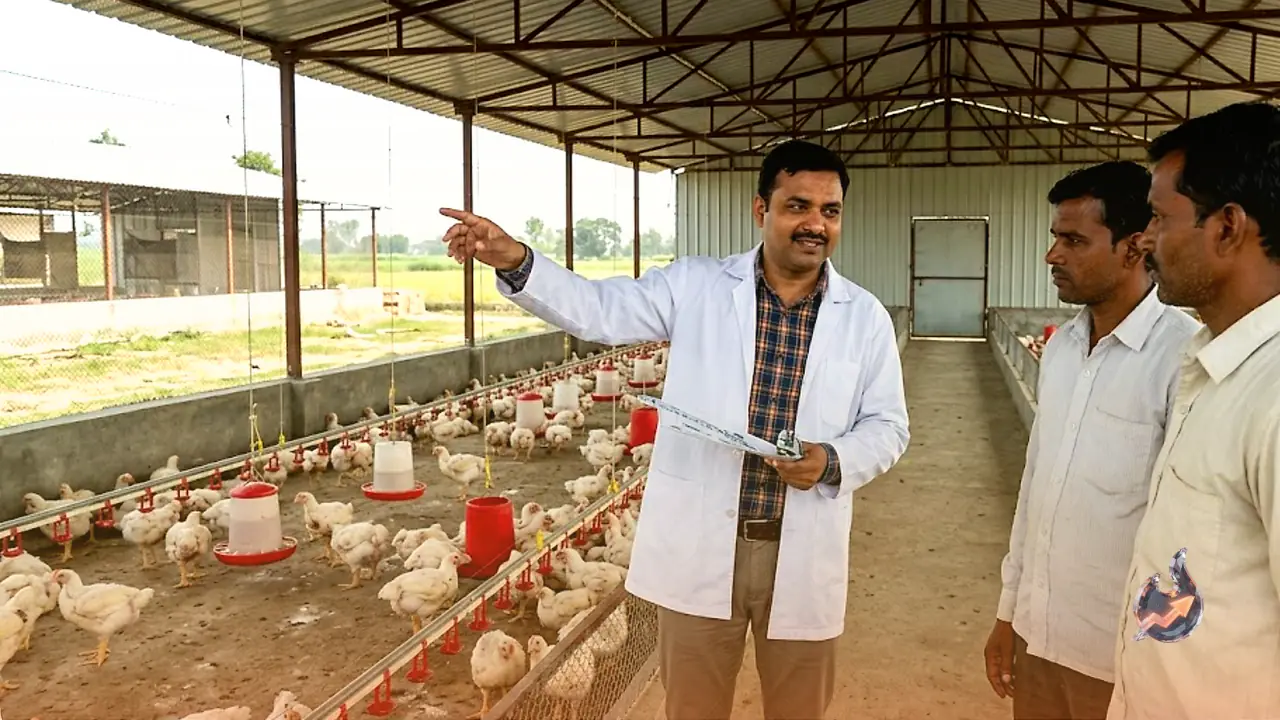

Cattle and buffalo usually dominate any conversation about animal husbandry, but when it comes to earning solid returns on a modest investment, poultry farming often comes out ahead. In Begusarai district, veterinary science expert Dr Vipin Kumar, who is attached to the Krishi Vigyan Kendra, says the business can be highly profitable, but a lack of basic technical knowledge before starting out can cause heavy losses for farmers. According to him, following a few scientific standards and basic arrangements before setting up a farm is essential. When space, ventilation and hygiene are managed properly, production improves and the risk of disease spreading among the birds also comes down.
How much space broiler and layer birds actually need
Dr Vipin Kumar explains that poultry farming mainly involves rearing two types of birds. The first is the broiler, raised for meat production, and the second is the layer, raised for egg production. Each type has different space requirements, and starting a farm without understanding this difference can prove costly. If broiler birds are kept in a deep litter system, each bird needs roughly 1 square foot of space. Layer birds, on the other hand, can be housed in two different ways. In a deep litter system, each layer bird needs about 1.5 to 2 square feet of space, while in a cage system, that requirement drops to roughly 0.5 to 0.8 square feet per bird. In other words, farmers with limited land can house more birds by opting for the cage system.
Build the farm structure on scientific lines
Space alone is not enough, the structure of the farm matters just as much. Dr Vipin Kumar says a poultry farm should be built roughly 1.5 to 2 feet above ground level. This keeps moisture under control and makes it easier to maintain cleanliness. The side walls of the farm should be about 6 to 7 feet high, while the height at the centre should be 10 to 12 feet. This height difference ensures proper air circulation inside the farm, which is considered essential for the health of the birds. The width of the farm is also recommended to be kept at around 22 to 25 feet, so that air keeps flowing freely inside and the birds do not suffocate.
Keep this distance if you are building more than one farm
For farmers planning to set up multiple poultry farms at once, Dr Vipin Kumar has an important piece of advice. He says a gap of roughly 50 to 100 feet should always be maintained between two farms. The reason is simple, if disease breaks out in one farm, this distance significantly lowers the chances of it spreading to the other farm. So even if one unit is affected, the entire business does not have to go down with it.
Careful preparation keeps losses in check
Dr Vipin Kumar says that if a poultry business is started using this scientific approach, losses remain limited even during an emergency such as a disease outbreak or a virus spreading through the flock. In short, choosing the right location, constructing the building on scientific lines and following set standards are all essential before starting a poultry farm. Farmers who keep these factors in mind while starting a poultry business can make it a far safer and more profitable venture than before.