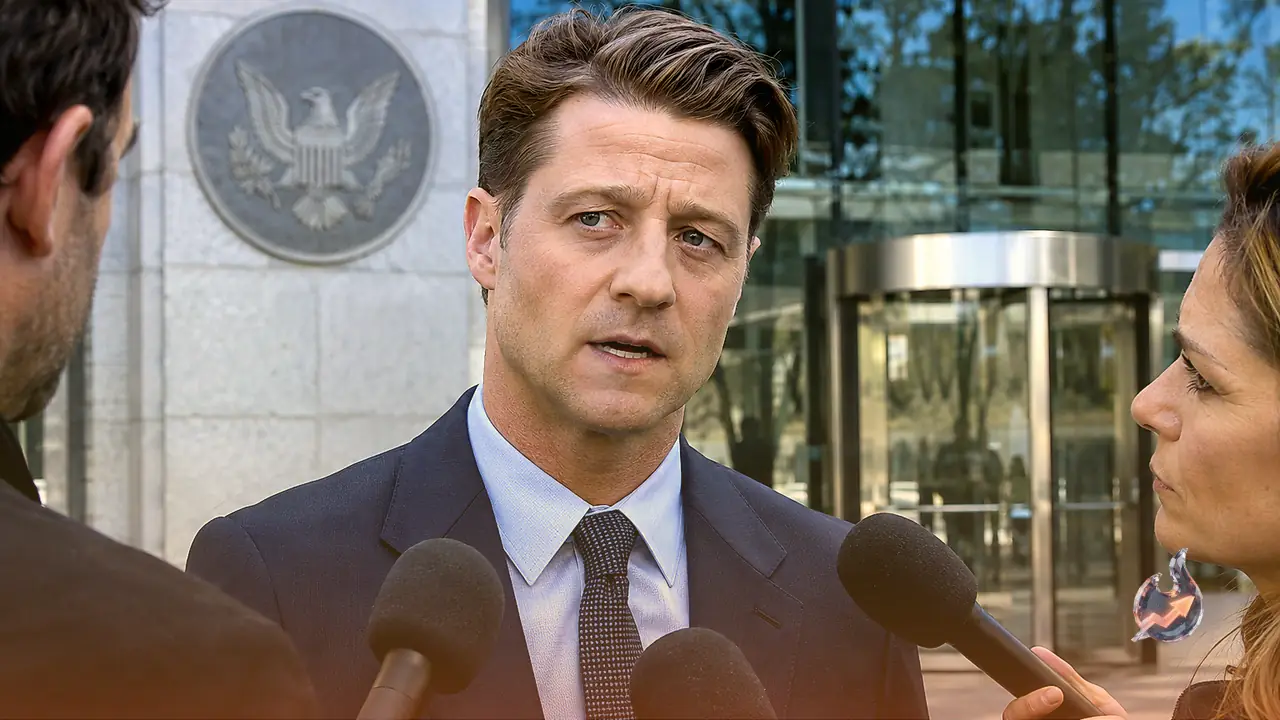

Ben McKenzie is widening his campaign against the cryptocurrency business to include platforms where users wager on the outcomes of sports and other events. He has launched a nonprofit, The Public Trust and Transparency Project, which will continue his crypto criticism while taking on prediction markets such as Polymarket and Kalshi. The new effort puts the risks, regulation and political connections of these markets on its agenda.
The project follows a pledge McKenzie made at the end of his documentary, “Everyone Is Lying to You for Money,” which focused on the cryptocurrency industry. In the closing scene, he told his wife and fellow actor Morena Baccarin that he would stop being an activist and return to the acting work that had made him famous. The nonprofit’s launch shows that the public campaign is continuing, now with a broader focus.
When wagering is presented as investing
McKenzie is concerned that gambling is becoming a normal part of economic life. Cryptocurrency is presented as an investment, while prediction markets offer trading on the likelihood of future events. He sees a common problem in both: activities involving bets are increasingly described as legitimate financial strategies. He calls this the “gamification” of the economy and worries that the language of investing can make gambling seem more acceptable.
Prediction markets reject comparisons with online casinos. Yet 80 percent of Kalshi’s trades came from sports in September, a figure reported by Bloomberg. McKenzie challenged the distinction between those trades and ordinary betting: “If your investment strategy is betting on Spurs-Knicks, come on, that’s a real problem.” In his view, calling a wager an investment does not remove the gambling element when the money depends on a sports result.
His position does not amount to a call to eliminate prediction markets. McKenzie accepts that they may serve some purpose, while arguing that they need proper regulation. Supporters say these platforms can help users hedge against risk. They also describe sports trading through prediction markets as more consumer-friendly than online gambling houses. McKenzie’s acknowledgement of potential benefits leaves the central policy question open: how should those benefits be weighed against the risks and what rules should govern the platforms?
Investigations and uneven financial outcomes
The nonprofit is starting as regulators and law enforcement officials at different levels increase scrutiny of prediction markets. Federal regulators have opened new probes into both major platforms. The Republican-led House Oversight Committee recently released an investigation into US troops and government insiders trading on information they knew through their positions on Polymarket and Kalshi.
The Senate has passed a bill that would prohibit prediction markets tied to military operations and assassinations. Platform executives expect a difficult few months ahead. Kalshi has launched an advertising campaign featuring Martha Stewart that reminds users not to trade on confidential information. These developments show that the debate covers both the boundaries of permitted markets and the risk that someone could profit from information unavailable to other users.
McKenzie’s project also plans to focus on losses among ordinary users. A recent Wall Street Journal report found that 0.01 percent of Polymarket accounts collect two-thirds of all profits. On Kalshi, unprofitable accounts outnumber profitable ones by almost three to one. The figures describe a sharp concentration of gains and a much larger group of accounts that lose money. They are part of the concern beyond insider trading that the new group intends to raise.
Political ties draw scrutiny
Potential conflicts and corruption are expected to be prominent issues for McKenzie’s project. The subject featured as a major issue in the recent midterm elections. Until recently, Donald Trump Jr. was a paid adviser to Kalshi. His venture firm, 1789 Capital, made its largest investment yet in Polymarket over the summer, the latest in a series of investments in the platform.
Several months before that investment, the Trump Justice Department sued Minnesota after the state tried to ban prediction markets there. At a recent conference, Polymarket CEO Shayne Coplan described the attention to Trump Jr.’s role as “heavily overblown,” adding that the company has all kinds of investors. McKenzie’s organization intends to put political and financial ties among the issues under examination.
A long history and an unsettled policy debate
Prediction markets have existed for hundreds of years, according to a forthcoming book on the subject. American academics have used them as teaching tools since the late 1980s. Advocates argue that trading around the probability of an outcome can help people hedge risk. They also say that, for sports, these platforms offer consumers a friendlier alternative to online gambling houses.
McKenzie does not dismiss the possibility that the markets have utility. His argument is that usefulness does not remove the need for rules. The questions he raises include what kinds of trading should be allowed, what risks users face and who can benefit from confidential information. His nonprofit plans to bring those issues into public debate and press Congress to act.
Taking the argument to Congress
McKenzie plans to push Congress toward regulating prediction markets. That effort reverses the direction of his public and private lobbying against the Clarity Act, which would have brought cryptocurrencies into the financial mainstream. The bill was rejected in September. His new campaign is aimed at building a regulatory framework for prediction markets rather than advancing that crypto legislation.
The pressure may grow when Democrats take control of Congress next year. Representative Frank Lucas, an Oklahoma Republican, told Politico that in the new political landscape beginning on the first Monday in January, “nobody’s untouchable anymore.” His comment points to the possibility of wider demands for scrutiny and accountability. The article does not detail the rules McKenzie’s group will propose; it says the organization intends to push Congress in the direction of regulation.